Giant leap (for television technology) at the Olympic Games
06 août 2012
2012 is the year when HDTV conquered the Olympic Games, with virtually all coverage in High Definition. Yet, at the same time, the Olympics were also a major milestone for next generation television. International Telecommunications Union experts agreed, earlier in the year, to the technical system for two levels of Ultra High Definition Television or UHDTV, which will be used for television in future years. The ITU submitted the proposal for approval to all administrations globally.
The lower quality level, though still of higher quality than today's HDTV, is called the 4k level, and the upper layer is called the 8k level or Super Hi Vision (SHV), and is well beyond HDTV quality. The genius behind SHV is the world famous research laboratory of Japan’s national broadcaster, NHK. Several European broadcasters have worked with NHK to test the SHV system for broadcasting in past years. The Olympic Games in 2012 is the occasion for a major trial of SHV, with feeds from London used for demonstrations around the world.
Technically speaking, the SHV at the Games was shot with 32 Megapixel images, 60 times per second, and with a 24 (or 22.2) channel sound system. The signals were compressed and distributed across the world at 350 Mbit/s. This is big stuff. HDTV today has images with about 1-1.5 Megapixels, and either 2 or 6 channel sound. HDTV today is broadcast with 8-12 Mbit/s. The perceived image quality jump from HDTV to SHV is roughly twice as large as the jump from standard definition television to HDTV. Coverage of stadium events at the Olympic Games uses three SHV camera positions, relatively few positions for such an event, but enough because the whole of a stadium can be captured in one camera shot.
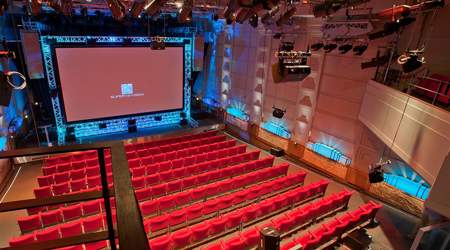
Above: The BBC Broadcasting House Radio Theatre with Super Hi Vision installed for the Olympics; Top: One of the only 4 SHV cameras in existence is prepared at BBC Television Centre for installation at the Olympic Village (Source)
Those lucky enough to see the SHV coverage agree that the results for the Olympic Games opening ceremony were simply astounding. Providing this degree of realism will open many doors for viewer involvement in all kinds of programmes.
Permanent SHV broadcasting is many years away, though NHK expect to begin test broadcasts by satellite in Japan by the end of the decade. Changing a television system is a monumental task and will take a long time, but those who saw the demonstrations agreed that, like HDTV, SHV will be too good to ignore, and the key question will be how to make the transition, rather than whether to make it.
As an omen, half-way through the Olympic Games, the news came that all the world’s administrations had now approved the specifications that the ITU experts prepared for the two UHDTV levels, including the upper layer SHV. The UHDTV standards are official now. For engineers, we are on the downhill path to the next generations of television. August 2012 will be a date to remember for the history of television.
Liens et documents pertinents
Related news

Communiqués
Les membres de l'UER proposent les Jeux Olympiques d'hiver les plus regardés de tous les temps avec Milano Cortina 2026
Les radiodiffuseurs membres de l'Union européenne de radio-télévision (UER) ont organisé les Jeux Olympiques d'hiver les plus réussis de leur histoire,...

How France TV is accelerating technology innovation at the Paris Olympic Games
For France Télévisions, the Paris Olympic Games provide the impetus for several advances in production and distribution technology. Skander Ben Attia (Head...

Communiqués
EBU Presents Excellence in Media Award to France Télévisions for Paris Olympics coverage
The EBU has presented its member organization France Télévisions with the "Excellence in Media Award" for their innovative and high-tech coverage of the...

Blogs
Milano Cortina 2026 : pourquoi les médias de service public sont importants dans des moments comme celui-ci
Dans deux semaines à peine, les Jeux olympiques d'hiver débuteront en Europe. Dès la première cérémonie d'ouverture le 6 février, Milano Cortina 2026 réunira...

A year of HDR highlights – and more to come
It has been a productive year for the EBU’s Video Group, with a focus on experience sharing, testing and training. Group chair Simon Thompson (BBC R&D)...

Communiqués
Les membres de l'UER attirent plusieurs millions de spectateurs lors de la première semaine de Milano Cortina 2026
Les radiodiffuseurs membres de l'Union européenne de radio-télévision (UER) diffusent les Jeux olympiques d'hiver de Milano Cortina 2026 à un large public...

Communiqués
SRG SSR Honoured with EBU Excellence in Media Award for Eurovision Song Contest 2025
The European Broadcasting Union (EBU) has awarded Swiss public service media organization SRG SSR the Excellence in Media Award in recognition of its outstanding...

Blogs
New EBU HDR monitor testing results published
Earlier this year, the EBU Video Systems group organized an HDR monitor testing activity hosted at BBC R&D’s Southlab (London, UK). The results of these...