EBU drives digital archiving in the Balkans
25 avril 2014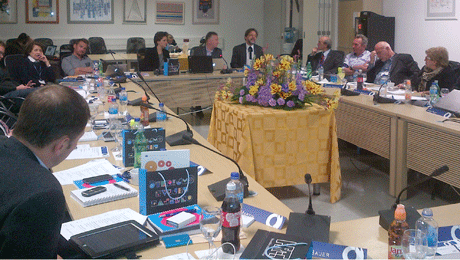 Archivists discuss digitization at HRT, in ZagrebSeven Balkans public broadcasters have agreed to join forces for the collective digitization of their audiovisual archives, a precious cultural resource that would be irretrievably lost if left on perishable analogue tape.
The recommendations for action emerged from a meeting in Zagreb staged by the EBU and HRT, which brought together 21 chief archivists from Albania (RTSH); Bosnia and Herzegovina (BHRT); Croatia (HRT); Macedonia (MKRTV); Montenegro (RTCG) and Serbia (RTS and RTV), as well as Kosovo’s public broadcaster RTK.
Next steps include:
- Creation of an EBU best practices guide on archiving and archivist training
- Mobilization for securing external financing
- Establishment of a shared online workspace for the exchange of materials
- Construction and coordination of a shared database
- Identification and development of common projects
- Organization of a donors' meeting in Sarajevo, in November
EBU Partnership Programme Project Manager Radka Betcheva said: “We cannot overstate the huge importance of audiovisual archives as a cultural and historical resource. Meetings like this facilitate professional exchanges and give impetus to EBU Members’ efforts to put their archives to best use in the most efficient and economical ways.”
The meeting was organized by the EBU Partnership Programme and EBU Technology & Innovation. Dr Hans Hoffmann, Head of Production Technology at EBU Technology & Innovation stressed the importance of defining archives as an integral part of the production chain, to meet the content demands of the future. He said that interoperable formats and interfaces, the consideration of the workflow impact, and an evolutionary approach will play vital roles in the utilisation of archives, and the digitization process.
The French National Audiovisual Institute (INA), the International Federation of TV Archives (IFTA), the Danish Broadcasting Corporation (DR) and Austrian public service broadcaster (ORF) also joined the meeting to share their knowledge and experiences.
In addition, the archivists accepted an HRT proposal to launch an operational group, with staff from HRT and RTS, to lead the regional exchange of information and develop a blueprint for archiving historical Yugoslav productions of key cultural value, an idea tabled by Christoph Bauer of ORF.
Liens et documents pertinents
Related news

Histoires
ERNO Regional Workshop in Sarajevo Focuses on Audience Engagement
This week, the Office of Eurovision Regional News Exchange for Southeast Europe (ERNO) hosted media professionals from in Sarajevo for a regional workshop...

Communiqués
Le projet de numérisation de Google ouvre la voie à la préservation des archives
L'Union européenne de radiodiffusion (UER), Google, YouTube et la Société de radiodiffusion de Chypre (CyBC) sont ravis d'annoncer le succès achèvement...

Blogs
Preparing to step up technical cooperation in times of emergency
Newly elected to the EBU Technical Committee, Deividas Grabauskas, Head of the TV Technical Division at Lithuania’s LRT, believes increased cooperation...

Communiqués
L’INA, gardien de l’histoire audiovisuelle française, rejoint l’Union Européenne de Radio-Télévision afin d’étendre son réseau et partager son expertise
L’Institut National de l’Audiovisuel (INA) en France a rejoint en tant que Participant Agréé l’Union Européenne de Radio-Télévision (UER), dans le but...
Communiqués
ARTE rejoint l'Union Européenne de Radio-Télévision, renforçant les liens culturels à travers l'Europe
ARTE, le radiodiffuseur public franco-allemand dédié à la culture, est devenu le nouveau membre de l'Union Européenne de Radio-Télévision (UER), après...

Blogs
Les archives de l'UER sur l'Ukraine constituent une ressource inestimable pour certains des meilleurs reportages au monde sur la guerre russo-ukrainienne.
Par Anne Koch, chef de projet, Archives Ukraine de l'UER L'UER, la plus grande alliance mondiale de médias de service public, s'apprête à ouvrir ses Archives...

Communiqués
L'UER va ouvrir des archives numériques sur l'Ukraine en tant que source fiable de documentation pour les journalistes, les chercheurs et autres enquêteurs
L'UER a lancé une vaste archive numérique de contenus d'actualités audiovisuelles sélectionnés documentant la guerre en Ukraine depuis février 2022. Les...

Histoires
Un nouveau groupe d'experts en relations internationales élu lors de la plénière de Bucarest
Un nouveau groupe d'experts en relations internationales a été élu lors de la réunion plénière sur les relations internationales qui s'est tenue à Bucarest,...