World broadcasters take practical steps to help counter satellite jamming
19 novembre 2014
Members of the World Broadcasting Unions-International Satellite Operations Group (WBU-ISOG), the WBU technical arm, the WBU Technical Committee (WBU-TC), and the European Broadcasting Union (EBU) have established a working group to further combat intentional interference to global satellite services.
The decision was taken by delegates attending the two-day annual WBU-ISOG Forum, which opened yesterday (18 November) at the Geneva headquarters of the EBU.
The working group will prepare a step-by-step guide about what an operator should do if subject to deliberate interference. The group will also ask the International Telecommunication Union (ITU) – the United Nations specialized agency for information and communication technologies – to monitor cases of intentional interference.
The practice of jamming has increased in recent years and has at times prevented some regional audiences from receiving TV and radio programmes from broadcasters including the British Broadcasting Corporation (BBC), Radio France Internationale, Deutsche Welle (Germany), RFE/RL, Inc.'s Radio Farda, Radio Netherlands Worldwide (RNW), and the Voice of America (VOA).
WBU-TC chair and former deputy director of the EBU Technology and Innovation Department Dr David Wood says world communications critically depend on the ordered use of authorized frequency spectrum.
“Determined action against deliberate interference to satellites is vital,” said Dr Wood. “Satellite broadcasts and satellite links between broadcasters are reliant on the transmission of signals from a ground station in one location being relayed to another location – a little like a ball bouncing off a tennis racquet from one direction to another. Occasionally, wrong signals are sent by mistake, but increasingly, the number of cases of intentional interference is rising. In this instance, the ground station causing the interference tries to hide its location and identity, which can be difficult to trace. These new measures by members of the world’s broadcasting unions will help to curtail the problem.“
On the opening day of the conference delegates also exchanged views on one of the emerging new forms of television – Ultra High Definition Television (UHDTV), discussing its costs, the launch of an American commercial service and trials taking place in Japan, Korea, and by European satellite operators. Talk centered on how and when the worlds ‘contribution networks,’ which move programmes between broadcasters can be made to carry UHDTV.
The meeting also discussed the combination of broadcast and internet, the future of sports programming, the use of fibre networks, and other issues on broadcasters’ agendas.
Dr Wood was also presented with a special award by the World Broadcasting Unions for his outstanding service to the WBU.
Liens et documents pertinents
Liens intéressants
Related news

EBU Media Cybersecurity group meets in Bergen
The EBU Media Cyber Security Group convened on 24–25 September in Bergen, Norway, bringing together security leaders from across Europe to address pressing...

EBU Technical Assembly calls for trusted Cloud and AI infrastructure in Europe
The European Broadcasting Union's (EBU) Technical Assembly has agreed on a position calling for the development of sovereign, interoperable, resilient,...
Histoires
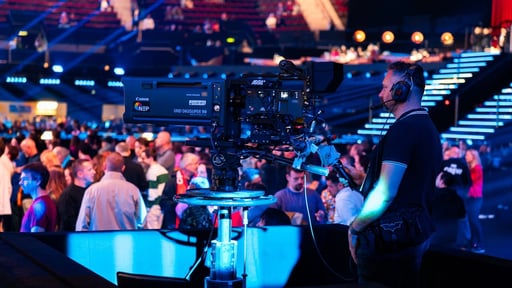
De Vienne à votre salon : comment le signal de l'Eurovision circule à travers l'Europe
Chaque année au mois de mai, des millions de téléspectateurs assistent à la grande finale du Concours Eurovision de la chanson. Ce qui apparaît à l'écran...
Histoires
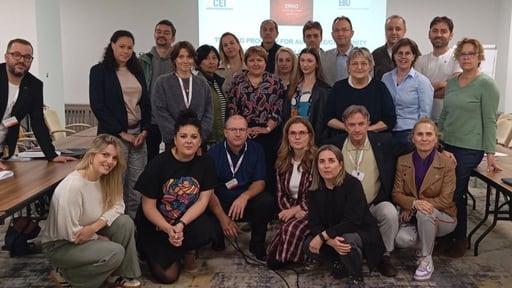
ERNO Regional Workshop in Sarajevo Focuses on Audience Engagement
This week, the Office of Eurovision Regional News Exchange for Southeast Europe (ERNO) hosted media professionals from in Sarajevo for a regional workshop...

Communiqués
L'Union européenne de radio-télévision et Alianza Informativa Latinoamericana concluent un accord historique de partage de contenus d'actualités
L'UER et l'Alianza Informativa Latinoamericana (AIL) ont conclu un accord historique de partage de contenu qui ouvre un nouveau chapitre dans la collaboration...

EBU TC Statement calling for Trusted Cloud and AI Infrastructure in Europe published
The European Broadcasting Union (EBU) Technical Committee has now officially published its position statement calling for sovereign, interoperable, resilient...

Communiqués
Le nouveau Comité Radio de l'UER devrait donner la priorité à la distribution et au cadre juridique
Les membres de l'UER ont élu aujourd'hui un nouveau Comité Radio, composé de quatorze cadres dirigeants de médias de service public de toute l'Europe....