Q&A: News Xchange, from humble beginnings to no. 1 industry event
18 octobre 2013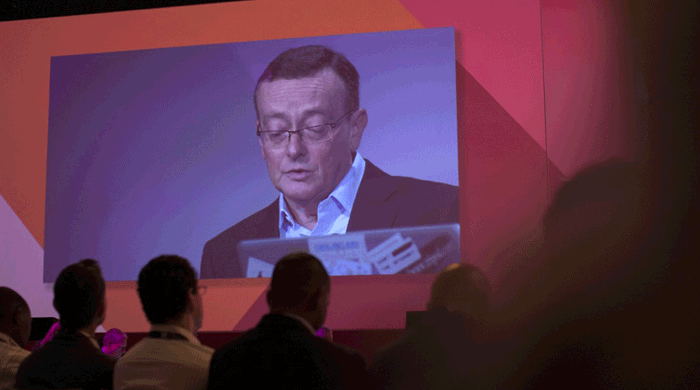
News Xchange 2012 (Photos: Stefano Santucci)
This November more than 500 media professionals will head to Marrakech for the world’s most varied and comprehensive conversation about the ever-changing, time-is-money news business. The EBU speaks to Peter Vickers and Amy Selwyn, who have spearheaded the dramatic evolution of News Xchange, the news industry's must-attend event.
In 2002, the inaugural News Xchange, in Ljubljana, Slovenia, was attended by just 80 people, almost all of whom worked for EBU Members. Eleven years later, News Xchange – known as 'NX' to regulars – has ballooned in terms of the number of attendees, the richness and variety of content, and the weightiness of its speakers and contributors. This year's opening address will be given by CNN's Christiane Amanpour.
Among the multitude will be journalists, photographers, bloggers, directors, documentarists and raconteurs, all pursuing ideas and inspiration about how to do a better job under increasingly competitive conditions.
Contrary to many other professional powwows, News Xchange does not seek to glorify the year’s standout stories and trade backslaps over jobs well done. Rather, its goal is to inspire news professionals by steeping them in the experiences of their international peers and finding lessons in real-life case studies. News Xchange's unique,enduring appeal lies in the fact that everyone is welcome: independent, public service or commercial.
At the head of News Xchange is Peter Vickers, a former TV news journalist turned marketing man who was Director of Commercial Productions for the Associated Press. Today he leads the EBU’s Strategic Events unit, which also organizes the Rose d’Or and other prominent media gatherings.
“Strategic Events exists to support our mission to make public service media indispensable,” he says. “News Xchange does this by bringing together all the major players in the news industry for an exchange of ideas, experiences and inspiration. And of course it’s a great opportunity for colleagues and peers to share ideas and make contacts.”
Peter Vickers' right hand for News Xchange is Amy Selwyn, a Boston-based media professional who went from child actor to banker before breaking into news, holding top-flight strategic posts at The New York Times, the Associated Press and the BBC.
Together they have transformed a modest meeting with limited networking scope into a pan-industry phenomenon that grabs the interest of news devotees everywhere.
Q & A with Amy Selwyn:
How different is News Xchange today from its humble beginnings?
News Xchange has evolved from an event whose main draw was networking and even sales opportunities to something that we've been told by delegates from major news organizations is a "must-attend" event. The number one reason for attending News Xchange today is knowledge-sharing and conversation. That is the fundamental shift and it is an exciting one because it means people come expecting and wanting to learn.
What has driven this evolution?
The evolution comes from the delegates themselves and from Eurovision's commitment to always keep this a delegate-driven event. Five years ago, we started doing research –surveys, telephone interviews, and so on. We asked the delegates, “What do you want and need News Xchange to be?” and we built it with the audience firmly in mind.
We also shifted from having an Advisory Board to an Executive Team. The difference is real. We ask our Executive Team to brainstorm, to come up with ideas, to flesh out those ideas and to build News Xchange with us. We draw that team from across the industry, so it includes Members as well as commercial broadcasters, non-traditional players like Global Voices, Google and Matter, a funding company for media start-up innovation.
A unique quality of News Xchange is its pan-industry character. How tough was it to get so many participants, many of them competitors, together in a room?
It wasn't tough at all, once we committed to building an agenda that focused on knowledge and learning. We don't create sessions around major news stories. We create sessions around coverage issues and what our delegates can share and learn and benefit from through discussion. So, take the recent shopping mall attack in Nairobi; we will not be doing a session on what happened in Kenya. But the story will most definitely be discussed as part of looking at how to cover conflicts or events without foreign correspondents, or with very limited access.
The other secret is that we stopped regarding ourselves as being so worthy. We made it okay to laugh. We achieved balance between very difficult, emotionally tough topics and things like News and Satire (which was produced by Google and featured The Onion).
News Xchange describes itself as “the industry's most thought-provoking conversation”. But when the talking stops, what do participants take away?
Participants take away three main things: first, they take away ideas and concrete suggestions and learning about the “hows” of news gathering, storytelling and distribution; second, they take away lessons learned by colleagues – things that worked, things that didn't and things that are still too new to be evaluated; and, finally, they take away ideas for projects, technology, storytelling and even potential partners that they didn't have when they entered the ballroom for the first time.
Where will you take News Xchange in the future?
News Xchange's success depends on our ability to meet the needs of the audience. So our focus has to be on reaching new audiences, finding what matters to them, building an agenda that speaks to real life issues and needs and, of course, adding in some elements of surprise!
Can you see the winning News Xchange formula being successfully applied in contexts other than news?
Absolutely. What makes News Xchange work is that it is built by and for people with a passion for news. Find what people are passionate about and the formula is the same. Bring people together, even competitors or archrivals, create a healthy, non-judgmental environment for discussion, throw in some fun and some laughter (yes, it's okay to laugh in the ballroom) and let it rock. Eurovision is uniquely qualified to facilitate that kind of discussion. Not only that, I believe the industry looks to Eurovision to do just that.
Liens et documents pertinents
Related news
Histoires
Questions-réponses avec Anne Lagercrantz : « La responsabilité est si précieuse, car elle deviendra une denrée rare »
Nous nous entretenons avec Anne Lagercrantz, directrice générale de la télévision suédoise SVT, dans le cadre d'une série d'entretiens avec les contributeurs...
Déclarations
L'avenir du journalisme à Gaza est l'avenir du journalisme
La semaine dernière, à la veille de la Journée mondiale de la liberté de la presse, l'Union européenne de radio-télévision a réuni des journalistes, des...

Discours
Certaines de nos lignes rouges sont devenues des tracasseries administratives contraignantes. Il est temps de repenser.
Ce texte est basé sur un discours prononcé par la directrice de l'information de l'UER, Liz Corbin, lors du Forum sur l'IA, le 25 mars 2026, à Bruxelles....

Histoires
Questions-réponses avec Kasper Lindskow : « L’IA générative peut donner des super-pouvoirs aux journalistes »
Nous nous entretenons avec Kasper Lindskow, responsable de l'IA au sein du groupe de médias JP/Politikens au Danemark, dans le cadre d'une série d'entretiens...

Communiqués
Eurovision News offre une couverture fiable des élections américaines et se prépare pour l'avenir avec un nouveau look et un nouveau leadership
Alors que les électeurs et les candidats se dirigent vers le jour des élections américaines du 5 novembre, Eurovision News est là avec une expertise éprouvée...

Histoires
"La transparence est importante, mais le public ne veut pas de labels IA partout, seulement lorsque cela est matériellement important"
L'IA générative va-t-elle changer la donne pour le journalisme ? Je suis un peu plus sceptique qu'il y a six mois. Il s'agit d'une énorme transformation...
Déclarations
Le Comité des nouvelles de l'UER exige que les journalistes étrangers soient autorisés à accéder sans restriction à Gaza après le cessez-le-feu.
Le Comité des nouvelles de l'UER, composé de hauts responsables des rédactions des radiodiffuseurs publics, a exigé des autorités israéliennes qu'elles...
Opinions
À l’occasion de la Journée mondiale de la liberté de la presse, les médias de service public s’unissent
Ce samedi, nous célébrerons la Journée mondiale de la liberté de la presse, à un moment où l’intégrité de l’information et la liberté de la presse sont...