Record numbers join the News Xchange conversation in Berlin
02 novembre 2015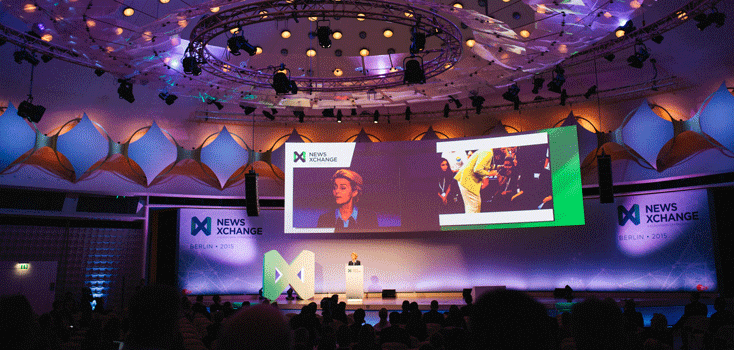
For the second year in a row, a record number of participants from the world's top news agencies gathered at News Xchange. More than 520 delegates attended the sold out event in Berlin (28 - 30 October), which was organized in partnership with host-broadcaster ZDF.
This year, News Xchange and its executive committee made up of senior representatives from across the industry put together an agenda to tackle the major issues news outlets are facing today. This included our choice of diction when discussing the refugee crisis, engaging audiences and using them to develop story leads and collaborate with tech companies and other news organizations.
Respect was a key theme of News Xchange 2015, whether this was about how we report or how we set our editorial direction. Much of the reflection was about putting the human being at the center of the discussion.
News Xchange asked about how the news industry speaks about people fleeing conflict, it asked how we talk about (and to) gay colleagues and story subjects, or how do we innovate and put the user in the driving seat of our editorial discussions. As journalistic storytelling gets more and more complex and the need for precision in our language and word choices becomes imperative.
With a panel of industry-leading executives, Clive Myrie of the BBC led a discussion on how we decide between the word migrant and the word refugee. But it wasn’t just that dichotomy that was discussed by the panel. Lindsey Hilsum of EBU Member Channel 4 noted how important it was to her to avoid "watery metaphors". She rejects terms such as “flood”, “storm” or “human waves” when covering the refugee crisis.
When the language used in storytelling is more emotional (including visual storytelling) there is a greater risk of "bandwagonism" in our profession. This was a major theme to come out of the session on January’s attacks on the Charlie Hebdo office in Paris and the ensuing crisis. As the discussion noted, live breaking news coverage can be an almost perfect petri dish for polarisation with stories all too quickly reduced to good guys versus bad guys - and that’s when the bandwagon rolls up. Complicated, complex stories like Charlie Hebdo get reduced to free press versus. fundamentalism, and news organizations rushed to photograph staff holding #JeSuisCharlie signs, as if this somehow declared their support for a free press. The story was a lot more complicated than that. So complicated, in fact, that CNN’s Tommy Evans noted that the channel’s coverage generated the most heated, passionate debate he could remember within the broadcaster.
Respect wasn’t just for the story at News Xchange. It was about the industry’s future. Two sessions challenged the audience to innovate all while respecting our teams and our audience. Adam Ellick, one of the authors of the New York Times’ Innovation Report, addressed the cultural changes it takes to allow innovation. The process of the report was allowing a team of reporters and staffers to go out and talk not only to the publisher’s audience, but also to the publisher’s competitors. By starting with the audience the approach to innovation was turned on its head. This audience-led approach was advocated by Jennifer Brandel, CEO of Hearken. Her keynote focussed on the idea that questions are the new comments. By allowing audiences to ask questions that journalists then answer, it can lead to a new form of journalism, stronger audience engagement and, ultimately, better storytelling. Brandel’s address highlighted the importance of positive collaboration.
The idea that collaboration in the news industry is a crucial part of the jigsaw now - not simply a way to survive - came through lloud and clear. The Reuters News Agency tackled the question of partnerships between tech companies and publishers. Google, Twitter and Microsoft were all challenged to answer what they really think about the news industry and the Thomson Reuters Foundation explored how news organisations can work together to break bigger stories. As Päivi Anttikoski of the Finnish newspaper Helsingin Sanomat noted, “you can no longer base your business model on scoops”.
That wasn’t all of course. A day of workshops explored 'storytooling', innovating within the newsroom and social media verification skills amongst other topics. And there was the networking - lubricated thanks to CBS and AFP and fuelled thanks to ZDF and CNN. News Xchange 2015 looked back at what we’ve learnt in our storytelling in the past 12 months, and what we need to address to keep our storytelling current.
In the closing session Jeff Jarvis challenged the industry as a whole. "We are still trying to take the old media business model and move it to the internet. It will not work”, he exclaimed. The sessions at News Xchange 2015 tried to show a different way. And that discussion will certainly be continued next year.
As usual, videos of 2015 sessions will be available shortly via News Xchange's Vimeo channel.
Liens et documents pertinents
Contact

Related news

Histoires
Questions-réponses avec Kasper Lindskow : « L’IA générative peut donner des super-pouvoirs aux journalistes »
Nous nous entretenons avec Kasper Lindskow, responsable de l'IA au sein du groupe de médias JP/Politikens au Danemark, dans le cadre d'une série d'entretiens...

Communiqués
Eurovision News offre une couverture fiable des élections américaines et se prépare pour l'avenir avec un nouveau look et un nouveau leadership
Alors que les électeurs et les candidats se dirigent vers le jour des élections américaines du 5 novembre, Eurovision News est là avec une expertise éprouvée...

Discours
Certaines de nos lignes rouges sont devenues des tracasseries administratives contraignantes. Il est temps de repenser.
Ce texte est basé sur un discours prononcé par la directrice de l'information de l'UER, Liz Corbin, lors du Forum sur l'IA, le 25 mars 2026, à Bruxelles....

Sveriges Radio and EBU collaborate on a smarter way to search the news
Since March 2025, Svergies Radio (SR) listeners have been testing a new type of news search in the form of an AI-driven chatbot powered by Neo from the...

EBU at IBC 2024: Unite, inspire, advocate
Visit our stand at IBC this year to explore the latest advancements in media technology, network with industry peers, and attend meetups and presentations...
Déclarations
L'avenir du journalisme à Gaza est l'avenir du journalisme
La semaine dernière, à la veille de la Journée mondiale de la liberté de la presse, l'Union européenne de radio-télévision a réuni des journalistes, des...

Histoires
Questions-réponses avec Peter Archer : « Ce que l’IA ne change pas, c’est qui nous sommes et ce que nous sommes censés faire. »
Nous nous entretenons avec Peter Archer, directeur du programme IA générative à la BBC, dans le cadre d'une série d'entretiens avec les contributeurs du...

Blogs
Études de cas créatives sur l'IA 2025 : une année d'innovation, d'expérimentation et de connaissances pratiques pour les médias de service public.
Alors que le soleil se couche en 2025, nous revenons sur la série d'études de cas créatives sur l'IA de l'UER, que nous avons produite pour montrer comment...