Brussels: EBU stresses importance of digital terrestrial platform
17 janvier 2013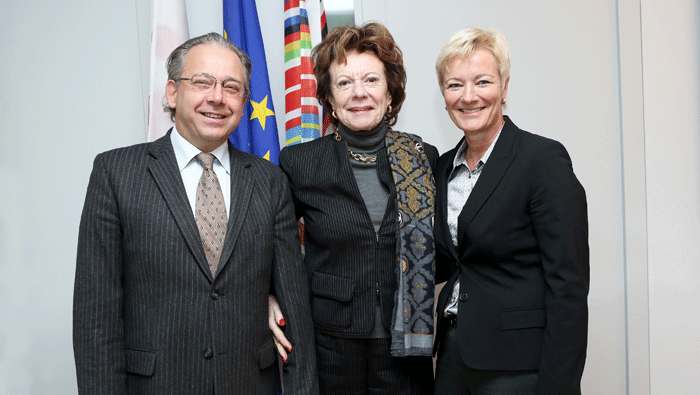
From left to right: EBU President Jean-Paul Philippot, European Commission Vice-President Neelie Kroes, EBU Director General Ingrid Deltenre.
EBU President Jean-Paul Philippot and Director General Ingrid Deltenre today impressed upon European Commission Vice-President Neelie Kroes that the DTT platform is crucial for efficient media delivery, at a meeting in Brussels.
Commissioner Kroes, who is in charge of the Digital Agenda for Europe, had sought the EBU’s views on the future of the 700 MHz band in the EU and the implications for terrestrial broadcasting.
She said: “The EU must agree on a common position on the 700MHz band that balances the stakeholders' interests, shows vision and serves the internal market. Spectrum is a precious, limited resource, and it is essential that we consider all sides in every decision. The point of today's meeting was to start engaging in a constructive dialogue with all relevant stakeholders, and to find future-proof solutions that put the needs of European citizens first and maximise the socio-economic benefits for the EU.”
The EBU delegation explained why the 700 MHz band is very important for Digital Terrestrial Television (DTT) services.
Today DTT enables 275 million people in the EU to access culturally diverse and high quality content; DTT networks deliver around 2,000 TV channels in the EU, including national, regional and local services.
In the future, DTT will continue to grow in importance as consumers enjoy an expanding and increasingly diverse range of audiovisual media.
EBU President Jean-Paul Philippot said: “Any decision regarding the 700 MHz band should focus on its impact on EU citizens and carefully assess the costs and benefits. Public service media organizations need a clear, long-term roadmap for the 700 MHz band and the future of DTT in order to support successful broadcasting business models and to ensure further investment in innovation and European content.”
One stand-out theme of the meeting was that audiences today also expect access to audiovisual content on multiple, mobile devices. Content produced by broadcasters is a major driver for broadband uptake and an important element to achieve the objectives of the Digital Agenda.
The EBU President and DG described the exchange of views with Vice-President Kroes as “extremely useful”. Commissioner Kroes and the EBU delegation agreed on the potential benefits of creating a platform to develop a shared vision.
Note to the editor:
As European Commissioner for the EU Digital Agenda, it is Neelie Kroes’ role to propose policies on communications networks, content and technology and foster the development of the EU Digital Single Market.
She is currently assessing what steps should follow a 2012 World Radio Conference decision to allocate the 700 MHz band to wireless broadband communications alongside broadcasting services.
Liens et documents pertinents
Related news

Communiqués
Digital Networks Act : la Commission européenne protège à juste titre les médias dans ses efforts visant à moderniser les marchés des télécommunications, mais la radio a besoin d'avantage
L'UER accueille favorablement la proposition la loi sur les réseaux numériques (Digital Networks Act), publiée aujourd'hui par la Commission européenne....
Positions
L'UER appelle les législateurs de l'UE à préserver la radio dans les voitures et la neutralité du net dans la loi sur les réseaux numériques
Le 18 mai, l'UER a publié sa position politique concernant la loi sur les réseaux numériques (DNA). L'ADN façonnera la manière dont les citoyens européens...
Communiqués
Prochaine évaluation de la Directive SMA : le Conseil aborde les questions clés pour les médias de service public
Le 13 mai, les ministres de la Culture de l'UE ont arrêté leur position concernant la prochaine évaluation de la Directive Services de médias audiovisuels...

Positions
L'UER demande à l'UE de protéger l'accès aux médias de service public dans le Digital Networks Act
Les membres de l'UER ont pour mission d'atteindre tous les citoyens avec un contenu de haute qualité pour les informer, les éduquer et les divertir. Pour...

Building a collaborative cloud future for European public service media
"Diversify rather than divide" – the newly formed EBU Cloud Strategy Group held its inaugural kickoff meeting in mid-August in Geneva. The group aims to...
Positions
La réglementation des télécommunications doit respecter les besoins des médias
La semaine dernière, l'UER a envoyé sa réponse à la consultation de la Commission européenne sur son Livre blanc sur "Comment maîtriser les besoins en...

Histoires
Les 10 principales actualités des affaires juridiques et publiques de 2025
Tenir les Membres informés des actualités importantes relatives aux médias de service public constitue une partie importante du travail juridique et politique...

Communiqués
Couverture diffusée par 212 chaînes du débat Eurovision 2024
Le 20 juin, l'UER a dévoilé les chiffres d'utilisation du débat Eurovision. 212 chaînes dans 51 pays ont diffusé le débat, qui s'est tenu le 23 mai et...