OSCE conference condemns attacks on journalists
15 novembre 2013
Dunja Mijatovic, the OSCE Representative on Freedom of the Media (Deutsche Welle/K. Danetzki)
A conference on media freedom has condemned attacks on journalists and called on the governments of Armenia, Azerbaijan and Georgia to guarantee the independence of public service broadcasters.
More than 80 journalists, officials, members of parliament, civil society representatives, government officials and academics took part in the 10th South Caucasus Media Conference, which took place in the Georgian capital of Tbilisi from 11 to 12 November and was organised by the Office of the OSCE's Representative on Freedom of the Media.
An 11-point declaration endorsed by the participants included a condemnation of "attacks, harassment and intimidation against journalists" and an appeal for swift and effective investigations to prevent a climate of fear and impunity.
It also stressed "the responsibility of the authorities to create a legal and regulatory environment that will guarantee political, editorial and financial independence of public service broadcasters".
This conference speakers and participants reviewed and evaluated major developments in the three countries over the past 10 years and discussed prospects for the media in the region.
Dunja Mijatovic, the OSCE Representative on Freedom of the Media, said some progress had been made over the past decade but that "the old challenges to media freedom remain and we see new ones emerge”. She mentioned problems such as threats to safety of journalists, lack of pluralism, deficiency of regulators’ independence, and undermining of the integrity of public service broadcasters.
Armenia, Azerbaijan and Georgia declared independence from the Soviet Union in 1991. Their national broadcasters joined the EBU in the mid-2000s after the Union extended eligibility to all countries in the Council of Europe.
Georgian Public Broadcaster (GPB) has been a major recipient of strategic and other assistance through the EBU Partnership Progamme. However, GPB has suffered over the past year from politically-based conflicts between its Board of Trustees and management. Director General Gyorgy Baratashvili was sacked early in the year, reinstated by an employment tribunal, and is appealing against a second dismissal. After several resignations and the expiry of some mandates, the Board of Trustees is currently unable to function pending new legislation.
Liens et documents pertinents
Related news

Communiqués
Rapport sur la liberté de la presse : environnement de plus en plus hostile au journalisme en Europe
Le 3 mars, les organisations partenaires de la Plateforme du Conseil de l'Europe pour promouvoir la protection du journalisme et la sécurité des journalistes...

Déclarations
L'UER condamne les attaques contre les journalistes en Géorgie
L'Union européenne de radio-télévision condamne fermement la violence et les agressions physiques contre les journalistes couvrant les manifestations en...

Communiqués
Le rapport 2024 sur la liberté de la presse en Europe met en garde contre les risques de guerre en Ukraine et les menaces persistantes pour la liberté des médias en Europe
Les risques auxquels sont confrontés les journalistes qui couvrent la guerre d’agression russe contre l’Ukraine demeurent la préoccupation la plus pressante...

Communiqués
L'UER déclare que « les journalistes comptent » pour le Conseil de l'Europe
Le 18 juin, l'Union européenne de radiodiffusion a annoncé son soutien au programme « Les journalistes comptent » du Conseil de l'Europe. campagne pour...
Déclarations
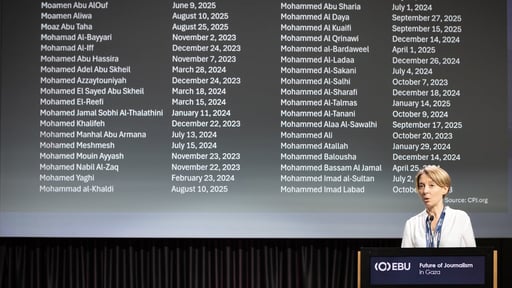
L'avenir du journalisme à Gaza est l'avenir du journalisme
La semaine dernière, à la veille de la Journée mondiale de la liberté de la presse, l'Union européenne de radio-télévision a réuni des journalistes, des...

Déclarations
L'UER et ses partenaires internationaux font part de leurs préoccupations concernant les modifications proposées au cadre des médias de service public en Lituanie
L'Union européenne de radio-télévision (UER) et les organisations de médias internationales soussignées ont fait part de leurs préoccupations concernant...
Histoires
Les chaînes de télévision d'Europe centrale et orientale de l'UER appellent le Parlement lituanien à préserver l'indépendance de la LRT
Les médias de service public de toute l'Europe centrale et orientale ont envoyé aujourd'hui une lettre ouverte conjointe au Seimas lituanien, exprimant...

Blogs
Une pression intense s'exerce sur les médias de service public en Lituanie
Récemment, la pression politique sur la société de service public lituanienne LRT s'est considérablement accrue. Cilla Benkö et Gabriel Byström de la radio...