Some answers, but many more questions at FORECAST'13
08 novembre 2013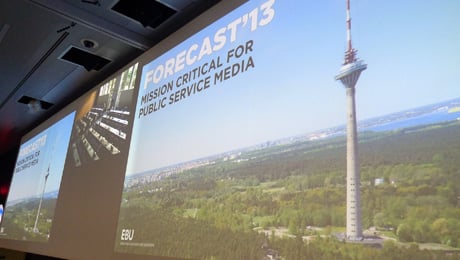
The EBU's annual FORECAST seminar brought more than 110 delegates to Geneva for two days this week. Representatives of broadcasters, network operators, manufacturers, national regulators, policymakers and research labs were all focused on what the future might hold for broadcast technologies.
The event opened with a reminder of why the discussions about spectrum use and broadcast technologies are so important. EBU Media Director Annika Nyberg Frankenhaeuser, in her keynote presentation, reminded the delegates that the EBU's mission is to make Public Service Media indispensible and stressed the importance of a sustainable terrestrial platform in making this mission a reality.
Convergence means divergence
The environment in which broadcasters are operating is evolving quickly and becoming more complex. Technology convergence actually means more divergence in distribution for EBU Members: more platforms to cover, more types of service to produce and more costs. All with less funding. The regulatory environment is also changing, and of particular importance in the context of FORECAST is the ever-increasing pressure on spectrum from mobile services, and the likelihood of interference problems growing as 4G networks are deployed.
Speakers called on the broadcasters present to make their voices heard more loudly at the World Radiocommunication Conferences that decide such matters, and the national administrations who are represented there. There is a strong alliance pushing for more spectrum for wireless broadband - broadcasters need to work hard to balance this. "If you don't use it, you will lose it", was the message.
There was plenty of evidence that broadcast technology is evolving, but still many open questions. When might UHDTV find a place on terrestrial networks? Will there be receiver legacy problems as third generation broadcast standards emerge and how can they be addressed? As distribution technologies approach the theoretical limit of what’s possible, it becomes difficult to produce more efficient systems.
The mobile conundrum
There was lots of discussion around the topic of content consumption on mobile devices. While all seemed to agree on the importance of the issue, even if it still represents a very small proportion of overall viewing figures, there were no clear answers yet on the best way to meet consumer demands in future. Currently the demand is met by wireless broadband networks, but, even with additional spectrum, such networks will not be able to meet the demand in future. Broadcast must have a role to play in meeting the demand of wireless data delivery in the future.
The session on hybrid broadcasting solutions generated considerable interest. Presentations on DVB-T2 Lite, transcoding from DVB-T/T2 to Wi-Fi in the home, and the Tower Overlay concept for DVB-T2 all provoked discussion. Regardless of which of these or other proposals might come to market, it's certain that close cooperation between the broadcast and broadband worlds would be required.
Liens et documents pertinents
Related news

EBU Technical Assembly calls for trusted Cloud and AI infrastructure in Europe
The European Broadcasting Union's (EBU) Technical Assembly has agreed on a position calling for the development of sovereign, interoperable, resilient,...

All content, for everyone, everywhere: a core challenge for PSM, past, present and future
With Italy’s Rai hosting the EBU Technology & Innovation Summit and Technical Assembly 2024 in Naples, Chief Technology Officer, Stefano Ciccotti provides...

Building a collaborative cloud future for European public service media
"Diversify rather than divide" – the newly formed EBU Cloud Strategy Group held its inaugural kickoff meeting in mid-August in Geneva. The group aims to...

Blogs
Ce que la crise de la BBC peut apprendre aux médias de service public
Dix jours de controverses et de démissions ont été traumatisants à la BBC, qui auront des répercussions dans toute l'Europe. La démission du directeur...

Histoires
"Nous devons réfléchir sérieusement au coût total de la numérisation..."
L'IA générative va-t-elle changer la donne en matière d'intelligence artificielle ? Cela change certainement la donne, car il s'agit d'une nouvelle façon...

EBU TC Statement calling for Trusted Cloud and AI Infrastructure in Europe published
The European Broadcasting Union (EBU) Technical Committee has now officially published its position statement calling for sovereign, interoperable, resilient...

Enhancing EuroVOX with real-time translation and smarter AI support
While the roots of EBU’s EuroVOX project go back to 2019, it has continued to evolve over the years. This article provides a few hints about new features...

Histoires
"La transparence est importante, mais le public ne veut pas de labels IA partout, seulement lorsque cela est matériellement important"
L'IA générative va-t-elle changer la donne pour le journalisme ? Je suis un peu plus sceptique qu'il y a six mois. Il s'agit d'une énorme transformation...