EBU hosts #JeSuisCharlie debate: “Always defend the rights of those who want to publish”
23 janvier 2015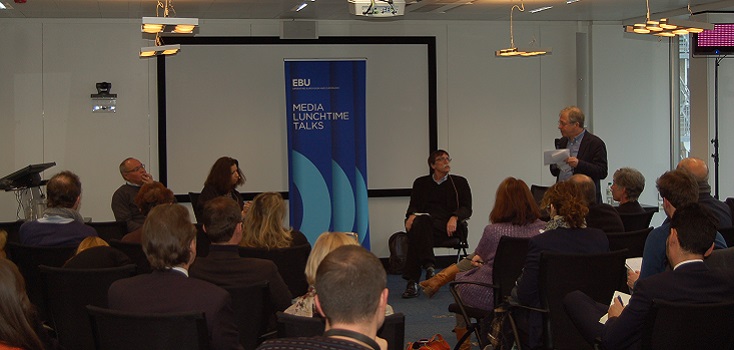
An EBU Media Lunchtime Talk held on Thursday (22 January) offered an international perspective on freedom of speech and journalistic ethics in the wake of the atrocious Charlie Hebdo killings earlier this month.
Held in the EBU Brussels Office and co-organised with the European Federation of Journalists (EFJ) and the European Newspaper Publishers Association (ENPA), a diverse panel of journalists gave their insight on some of the many issues raised by the events of 7 January affected media professionals.
Moderator and Senior Adviser for the Committee to Protect Journalists Jean-Paul Mermoz launched the debate by rasing the difference in different approach taken between the online press and the written press. The latter appeared more restrained when it came to publishing the cartoons, especially in the US and English press.
Veteran France Radio journalist and President of the Journalism and Citizenship Association (Association Journalisme et Citoyenneté) Jérôme Bouvier responded: “Despite showing clear signs of solidarity and ‘#JeSuisCharlie’ headlines, many Anglo-Saxon newspapers chose not to publish any cartoons. This choice not to publish was not understood by French journalists, all the more because the same papers showed footage of the killings. By contrast in France, practically every paper published the cartoons but showing the violent images was perceived as an affront to human dignity.”
He added: “For French society, the events touched upon the very concept of ‘living together’. Audiences were familiar with the cartoonists and their work which touched several generations. Emotions are running high”.
Later in the discussion, he noted that “a satirical journalist or cartoonist is always coming very close to a thin ‘red line’, and sometimes it will be crossed.”
For RTBF (Belgium) current affairs’ programme producer and journalist Safia Kessas, the decision to show the cartoons is “evident”.
“Our role is to inform and use the right terms to describe events accurately, even if this displeases”, she said. “It is more important to ask the right questions: on how we live together as a society rather than debate the interpretation of images.”
Her views contrasted with those of pan-Arab TV news channel Al-Arabia’s Brussels correspondent Nourredine Fridhi. He said: “Self-censorship is not a problem for me as long as I can manage my own space of freedom. I find that covering and talking about the events counts much more than showing the cartoons, which is not necessary. I do not want to upset people’s religious beliefs.”
The ensuing debate touched upon a wide range of subjects: the divergences between mainstream media coverage and reactions on social networks, the relevance of ethics’ committees, the global precariousness of safety of journalists around the world and the importance of not stigmatising Muslims, to name but a few.
Discussing the role of professional ethics, a speaker from the floor crucially highlighted how the imperative to inform and provide diverse viewpoints – the essence of freedom of the press – is different than freedom of expression, where any viewpoint can be put forward.
The debate concluded with a shared view: the different ways of treating the information and the decisions to or not to publish were themselves healthy signs of media diversity. However many also underlined that difficult times for journalists can be expected.
The final mood was well captured by a speaker from the floor, who said: “The decision to publish or not to publish should be an autonomous decision. But we should always defend the rights of those who want to publish.”
Liens et documents pertinents
Contact
Liens intéressants
Related news
Déclarations
L'avenir du journalisme à Gaza est l'avenir du journalisme
La semaine dernière, à la veille de la Journée mondiale de la liberté de la presse, l'Union européenne de radio-télévision a réuni des journalistes, des...
Opinions
À l’occasion de la Journée mondiale de la liberté de la presse, les médias de service public s’unissent
Ce samedi, nous célébrerons la Journée mondiale de la liberté de la presse, à un moment où l’intégrité de l’information et la liberté de la presse sont...

Blogs
La vérité dans la balance : défendre la démocratie à l’ère de l’intelligence
Alors que les dirigeants mondiaux se réunissent à Davos pour la réunion annuelle du Forum économique mondial, sous le thème « Collaboration pour l’ère...
Déclarations
Le Comité des nouvelles de l'UER exige que les journalistes étrangers soient autorisés à accéder sans restriction à Gaza après le cessez-le-feu.
Le Comité des nouvelles de l'UER, composé de hauts responsables des rédactions des radiodiffuseurs publics, a exigé des autorités israéliennes qu'elles...

Histoires
Karen Hao : L'IA est une histoire de pouvoir
Peu de journalistes se sont penchés sur l'essor de l'intelligence artificielle d'aussi près que Karen Hao, qui prononcera un discours clé lors du Forum...
Communiqués
Le Parlement européen défend les règles de l'UE sur les médias contre la pression américaine
L'UER salue l'adoption de la résolution du Parlement européen sur les obligations de la Directive Services de Médias Audiovisuels (SMA) dans le cadre du...
Blogs
Ce que la crise de la BBC peut apprendre aux médias de service public
Dix jours de controverses et de démissions ont été traumatisants à la BBC, qui auront des répercussions dans toute l'Europe. La démission du directeur...

Communiqués
L’UER exhorte les décideurs politiques de l’UE à protéger le secteur des médias européens au cours du nouveau mandat
L'UER exhorte les décideurs politiques de l'UE à préserver le secteur des médias européens au cours du nouveau mandat Le 10 septembre, l'UER a appelé les...