The EBU's application to administrate Top Level Domain (TLD) names .eurovision and .radio
03 août 2012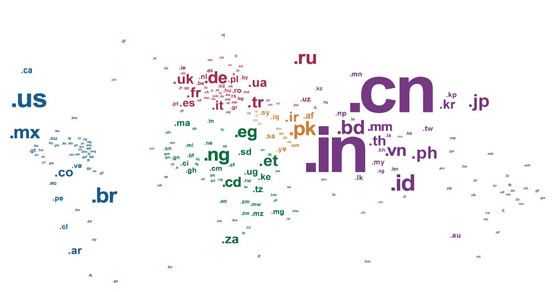
What are top-level domains?
TLDs are the part of an internet address – such as '.com' in www.eurovision.com – that tell you what sort of site you are visiting. There are about 250 country-level codes - such as .ch, .fr – and 21 generic TLDs (gTLDs) – such as .com, .org, .gov, or .edu. Applications under consideration would expand the number by at least 1,000. TLDs are like a telephone directory for the net; if a top-level domain isn't on the list, it doesn't appear.
How are they acquired?
Authority to create new categories of TLDs rests with the Internet Corporation for Assigned Names and Numbers (ICANN). The non-profit company was set up in California in September 1998 to take over the task from the American government, which had been responsible for the job until then, in part because that's where the internet originated. Once authorized, a TLD is run by a registrar – a single entity, which can delegate authority to register new websites to other companies. Ultimately, each TLD's registry is responsible for keeping order in its internet space, including solving disputes over ownership and making sure that sites are visible to the rest of the net.
How does ICANN decide what becomes a domain name?
ICANN seeks applications, considers public comment and determines whether an applicant will be able to function effectively now and in the future as a registrar for a domain. TLD applications may be categorized as:
-
TLDs that build on existing brands, for example .bbc
-
TLDs that are community based and benefit a clearly delineated group, for example, .edu
-
TLDs that are country-based or relate to a specific geographic area, for example .fr
-
TLDs that are generic, for example .music, .health, .green
Most applications are for generic names. Categories 1, 2 & 3 are given priority over category 4.
What interest does the European Broadcasting Union (EBU) have in obtaining TLDs?
In 2012, the EBU launched applications for two TLD names: .eurovision, which builds on the existing Eurovision brand, and .radio. The latter will be used to create a world-wide radio community, open to registration by all eligible radio representative organizations and broadcasters, Internet radios, radio amateurs, radio professionals and their respective representative organizations, as well as companies providing radio-specific products and services.
Why did the EBU apply for .eurovision?
-
It offers a gateway for the EBU to market new services
If awarded, the EBU will use .eurovision as the main access point to the Eurovision community, which includes sports rights, network services, news services and the already-established Eurovision Song Contest.
-
The name will strengthen bonds within the EBU community
The institutional TLD will be operated directly by the EBU on behalf of Members, increasing the security, visibility and accessibility of Eurovision online, and communications within the organization and its partners.
Why did the EBU applied for .radio?
-
The EBU can be trusted to serve community interests
The EBU represents the interests of the global radio community and can be relied on to provide a secure name space to facilitate and speed the radio industry's digital, online evolution. Our responsibility is to every member of the radio community – not only the financially able or best equipped and to provide protection against cyber squatting or competing interests, who exploit commercial opportunities.
-
The application has broad support
The .radio TLD is a diverse community-based application, which has the unanimous support of the eight broadcasting unions which form the World Broadcasting Unions (WBU) and other radio associations and organisations worldwide, such as The World Association of Community Radio Broadcasters (AMARC), The Association of European Radios (AER). These long established associations are governed by elected representatives who determine what is in the community's best interests. Beneficiaries include licensed broadcasters, large and small from developed and developing countries; unions and related organizations, trade-mark owners, licensed radio amateurs, web radios and radio professionals.
-
To enhance industry collaboration
The radio broadcasting unions and associations – of which the EBU is a proud representative – promote cooperation between broadcasters and facilitate the exchange of audio and audiovisual content. An EBU-administered .radio TLD will enhance audio content distribution and community-wide services, champion quality and competition for the benefit of listeners and internet users, encourage the radio community to adopt best practices in cyberspace, and provide an exemplary registry model.
What is the strategy behind the EBU's bid to create a new .radio internet domain?
The intention is to bring together the worldwide broadcasting community – radio, internet and amateur radio stations; professionals from the radio world and also all those companies that provide equipment or services to the community. We want to administer this domain to benefit the community, unlike other applicants, which are purely speculative.
If we are granted the rights to administer .radio, all the domains will have to be validated before being registered. This will ensure quality and consistency for this top-level domain; it will only comprise domains relating to the radio world.
Who will be able to register domain names with .radio?
Anyone who can claim a link to the radio world will be able to register a .radio domain, but during the launch period, preference will be given to members of the worldwide radio community. During this so-called 'sunrise' period, priority will be given to radio stations with a transmission licence, a brand name, or that are owners of a brand.
Once it is up and running, anyone will be able to apply for a domain, but a designated body (comprising representatives of the 12 main worldwide radio unions/associations) will oversee the process to safeguard against cybersquatting, i.e. the misuse of domain names for financial gain by those with no connection with the radio community in its broadest sense.
How many domains do you hope to attract?
We hope that the whole radio community (several tens of thousands of radio stations around the world) will eventually acquire their domain name on .radio so that we can duplicate the worldwide radio community on the internet and reinforce their links to their listeners.
.radio will be open to all those that can rightfully claim a direct link to the radio world (internet radio stations, amateur stations, professionals providing radio services and equipment, etc.) We also attach as much importance to the number of domains to be registered as to the extent to which they are representative of the radio community.
Why should ICANN select the EBU's application over others?
Criteria set by ICANN gives priority to traditional communities seeking to enhance their presence on the internet. The EBU's non-profit, public-service ethos is its guiding principle. Its motivation in applying to administer the .radio TLD is for the greater good: it would benefit the radio industry and its millions of employees and consumers.
It is not in the public interest to see .radio managed as a generic TLD by a non-radio stakeholder with commercial interests. We are confident that we will be recognised by ICANN as the organization best placed to serve the interests of the world radio community.
What is the relationship between ICANN and the Governmental Advisory Committee (GAC)?
GAC's key role is to provide advice to ICANN on issues of public policy, especially where there may be interaction between ICANN's activities or policies and national laws or international agreements. The EBU has been actively involved in the Internet Governance process since 2003 and has the status of an Observer with GAC and various other organizations associated with global governance. Examples include the Council of Europe, the International Telecommunication Union, the European Commission and UNESCO. The observer role with GAC does not include voting rights. The EBU's involvement is to serve the interests of public service broadcasters as they move progressively towards the on-line world.
Will the EBU profit from .radio?
The answer is simple: the EBU, along with other broadcasting unions in the world, is a not-for-profit organization. The pricing policy of .radio will be tailored to ensure the broadest possible access for broadcasters, organizations and individuals connected to the radio community.
Are you concerned that you may not succeed with the bid?
Not for an instant! The EBU has been closely following the debate at ICANN about the criteria for allocating new TLDs. The guidelines clearly state that priority will be given to TLDs representing existing communities and TLDs that represent the general public interest. These two criteria are fulfilled: radio broadcasting has been in existence since 1927 and radio stations that have national broadcasting licences fulfil the criterion of general public interest. We are fully confident that our application matches ICANN's exacting criteria and best serves the collective interests of the global radio community.
When is ICANN likely to make a decision?
A precise timetable is not known. On average, applications take five months to process. ICANN has announced that the first TLDs will start to come online in the first quarter of 2013. A decision on .radio may take a little longer because the application is community-centered and there are several applicants.
Liens et documents pertinents
Related news

Blogs
Quand tout tombe, la radio reste debout : un plaidoyer pour une action de l’UE
Qu’il s’agisse de catastrophes naturelles, de cyberattaques ou de coupures de courant, la radio s’est imposée discrètement comme l’un des moyens de communication...

Blogs
Facebook, Instagram, TikTok et X – Mettez-vous au diapason (en matière de services numériques) !
La prolifération de contenus illégaux et trompeurs, se faisant passer pour des marques médiatiques et des journalistes réputés, est devenue un problème...

All content, for everyone, everywhere: a core challenge for PSM, past, present and future
With Italy’s Rai hosting the EBU Technology & Innovation Summit and Technical Assembly 2024 in Naples, Chief Technology Officer, Stefano Ciccotti provides...

Positions
L'UER contribue aux lignes directrices de la Commission sur la protection des mineurs sur les plateformes en ligne
La loi sur les services numériques (DSA), qui est pleinement entrée en vigueur en février 2024, oblige les plateformes en ligne, telles que Facebook, TikTok...

Blogs
Tu entends ce que j'entends ? Big Tech a besoin d'un peu d'aide pour respecter la loi européenne sur la liberté des médias
Trouver des informations fiables en ligne est-il devenu une chasse au trésor à enjeux élevés sans carte ? C'est certainement ce que l'on ressent parfois....

Discours
Certaines de nos lignes rouges sont devenues des tracasseries administratives contraignantes. Il est temps de repenser.
Ce texte est basé sur un discours prononcé par la directrice de l'information de l'UER, Liz Corbin, lors du Forum sur l'IA, le 25 mars 2026, à Bruxelles....

Blogs
L'UER et ses membres surveillent les plans de Meta pour former son IA sur les publications publiques – et ses paramètres de désinscription
Meta a annoncé des modifications à sa politique de confidentialité qui lui permettront d'utiliser les publications publiques de Facebook et Instagram pour...