Euroradio Members optimistic about future of public broadcasters despite digital competition
13 novembre 2014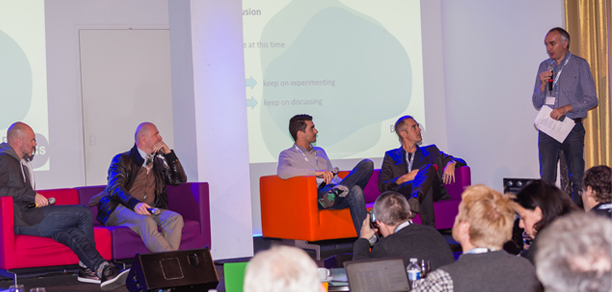
More than 60 Members joined the discussion on music aggregation platforms at the annual Euroradio strategy conference in Leuven on 6 and 7 November 2014, kindly hosted by VRT.
With 20 presentations from 11 countries, participants received a broad overview on the current situation of music radio stations throughout Europe, including visions and strategies. They worked together to come up with new project ideas on how to grow audiences, and even revenues, with high quality music programs in keeping with the public service media mission.
The music industry is without a doubt one of the most dynamic in the world. Ways of finding, sharing and listening to music are changing at an unbelievable pace. Today, the Internet dictates the rules. With a wide variety of music websites, streaming platforms and social media, the World Wide Web is an attractive source of music and inspiration for listeners. Does traditional radio broadcast stand a chance against this challenge? The conclusion of speakers and participants at the New Radio Day in Leuven was far more optimistic than one might expect.
We now have easy and unlimited access to music online, but this doesn’t necessarily enrich the listening experience. On the contrary, people tend to use the Internet mostly for music they already know. For its vast collections and almost unlimited accessibility, the net still can’t replace radio in being the music curator, setting new trends and shaping audience tastes.
According to Ben Chapman from the BBC, BBC Playlister is a great example of new radio thinking, combining traditional broadcasting with the streaming channel idea. It also meets the needs of different listener groups, from mainstream to niche music lovers. Radio France’s music platform RF8 has the same approach while using the organisation’s huge music archives. Another fascinating example is how Czech Radio collaborates with YouTube, creating a win-win situation.
Fabrizio Gentile from Deezer emphasized that streaming platforms and public broadcasters should not treat one another as competitors, but rather as partners. The same idea was shared by Tomas Granryd from Swedish Radio. He believes public broadcasters should not perceive streaming channels as a threat, but as an opportunity. The big question is how to make such cooperation most beneficial to radio. Finding the answer will probably be one of the most important challenges for public broadcasters.
The Dutch young radio station 3FM is very active in delivering music on all platforms, explained Wilbert Mutsaers, who noted the latest trend: "Voting is out, playlists are in!" The same strategy is used by Puls from Bayerischer Rundfunk, Munich, who build a strong brand on as many platforms as possible.
To be successful, radio must embrace the changes brought by the digital era. But, it must remember that in the vast Internet universe, it’s the only medium that can play the role of a music curator. Knowing this, the application MusicBan, shown by Dominic Born, tpc Bern, goes in the opposite direction by offering listeners the option to replace music they don’t like on the radio with their favourite songs, and it’s completely automated.
Quite surprising for the conference participants was the case of the Norwegian public broadcaster NRK increasing radio’s listening share through the systematic expansion of its DAB+ stations. Connect with your audience: that was also the conclusion of Ferre Vandervreken, audience researcher at VRT, presenting the latest figures on music consumption in Flemish-speaking Belgium.
Liens et documents pertinents
Liens intéressants
Related news

Communiqués
Le projet anniversaire de l'UER présente 10 nouvelles œuvres de musique contemporaine à des millions d'auditeurs
Dans le cadre de ses célébrations du 75e anniversaire, l’Union Européenne de Radio-Télévision (UER) a lancé le EBU Music Commissioning Scheme, une nouvelle...

Communiqués
Le Concours Eurovision de la chanson célèbre son 70e anniversaire avec la plus grande célébration mondiale jamais organisée
Alors que les répétitions débuteront à Vienne ce week-end, l'Union européenne de radio-télévision (UER) et ses membres entament le 70e anniversaire du...
Communiqués
Le Concours Eurovision de la chanson célèbre les 70 ans de United by Music
Il y a 70 ans, le 24 mai 1956, des artistes représentant sept chaînes de télévision se sont réunis au Teatro Kursaal de Lugano, en Suisse, pour une nouvelle...

Blogs
EBU x Eurosonic : une longue histoire de collaboration
Comment tout a commencé : À l'EBU, nous passons beaucoup de temps à parler de la musique qui traverse les frontières et Eurosonic Noorderslag est l'un...

Blogs
YouTube : ami ou ennemi ? Le dilemme pour les radiodiffuseurs
Pendant la majeure partie de la dernière décennie, YouTube a occupé une place relativement simple dans les stratégies numériques des médias de service...

Blogs
Cilla Benkö : La radio doit rester au cœur de la voiture connectée
Le public adore la radio dans sa voiture. Mais la complexité des voitures plus récentes menace la commodité de la radio. Les constructeurs automobiles...
Blogs
Médias de service public : innover, collaborer et protéger l’avenir numérique de l’Europe
Cette année, nous célébrons 100 ans de collaboration technique entre les médias de service public. Le prédécesseur de l'UER, l'Union internationale de...

Communiqués
L'UER et BBC Arts s'associent pour la première nouvelle coproduction musicale Eurovision depuis plus de 40 ans
Les Concerts Classiques Eurovision célèbrent la grande musique et les orchestres de renommée mondiale qui collaborent avec les radiodiffuseurs publics...