Noel Curran Keynote to UN on World Press Freedom Day
03 mai 2018Let me start by thanking the Palais des Nations for hosting this important event and allowing me to talk about press freedom and the rule of law on such an important occasion.
This is an important event, now more than ever. I've worked as a journalist, producer, editor and media manager for thirty years now and I think it's no exaggeration to say that the threat to press freedom is greater now than at any time in the last three decades.
Today World Press Freedom Day celebrates its 25th anniversary. This important remembrance was proclaimed by the UN General Assembly to draw attention to the sacrifices made around the world to support freedom of the press and, by extension, democracy. In pursuit of this freedom, journalists, editors and publishers have been harassed, attacked, imprisoned and murdered.
World Press Freedom Day also serves as a reminder to governments of their obligations to uphold freedom of opinion and expression pursuant to Article 19 of the Universal Declaration of Human Rights.
Unfortunately, this is not always self-evident.
We have all seen the latest figures of the World Press Freedom Index from Reporters without Borders and they are worrying. They show a rising trend of politicians openly attacking the media – not just in authoritarian states but also in democracies right here in Europe where too often journalists are labelled 'enemies of the people' and European leaders describe them as "filthy prostitutes" or "hyenas".
Regrettably, journalist attacks and murders are also not a new phenomenon. When I read about the recent appalling murders of journalists in Afghanistan, Slovakia and Malta, my mind went back twenty years to Ireland in 1996.
At a traffic light junction on a motorway, Veronica Guerin, a journalist, a mother, and one of the most fearless people I ever knew, was shot dead in her car. She had been investigating organized crime gangs in Ireland.
Different decades, different centuries but the same brutal suppression of investigative journalism where impunity for killings still runs at over 90%, self-censorship remains widespread and freedom of expression, and press freedom are poorly guaranteed by the law and poorly protected by an independent judiciary system.
The statistics are startling. According to the Committee to Protect journalists there are 42 outstanding unsolved killings of journalists, 21 in Mexico, 21 in Pakistan.
Harassment and intimidation of journalists is now a daily occurrence.
In just one example the Iranian authorities are threatening the staff of BBC Persia and other broadcasters. Journalists are being investigated and accused of crimes against national security. Assets are frozen. Family members in Iran are arbitrarily detained and harassed. Passports have been confiscated.
All this raises concerns about safety.
It goes without saying that safety goes hand in hand with freedom of expression. Without proper protection of the rule of law, public service media organisations struggle to maintain plurality of sources, news bureaux in conflict zones, and to report from the most dangerous - and the most in need - parts of the world.
If our journalists, all journalists, are not protected and they themselves are open to legal action which prevents them from reporting in the public interest, the rule of law is seriously threatened.
So what can we all do about it? I don't agree that this is just an inevitable symptom of declining faith in old 'institutions' and old 'institutional' values.
It is not some natural progression from one order to the next. It is an orchestrated and concentrated attack by people in power, whether criminal or governmental, on what they see as threatening to their interests.
The first response has to be a calling to account - public statements, public events like this and others, highlighting, questioning, advocating, condemning.
International organisatations such as the UN have a key role to play here to work with governments, in their own member countries, to put in place well-functioning criminal investigation and judicial systems to deal with intimidation and hate crimes as crimes against democracy.
And, in particular, to invest the resources required for the police authorities, in every country, to be able to effectively investigate and prosecute crimes against journalists.
Our collective voice and actions can help hold governments to account and shape the national debate. By working together with organisations such as yours, the Council of Europe, OSCE, the EU Institutions and civil society, we can have a true impact and help safeguard media freedom and protect journalists in their daily work.
This is why the EBU participates in all of the UN and UN agencies', such as UNESCO, activities to enhance safety of journalists, and is a member of the Council of Europe’s Platform for the Protection of Journalism and the Safety of Journalists.
This is why we support many civil society initiatives and those of journalists' professional associations to enhance safety standards and to fight impunity.
This includes campaigning with Reporters without Borders to create a Special Representative of the United Nations Secretary General for the Safety of Journalists, and working with the International Federation of Journalists to bring to the UN General Assembly a treaty for the safety of journalists. The EBU is also proud to be a Member of the Board of the International News Safety Institute.
We also need legislation that protects freedom of expression, that reviews the draconian libel laws in some countries, and legislation that limits media concentration, and that promotes the visibility and prominence of quality independent news online.
What we don't need is the kind of knee jerk legislative response that we've seen from some governments to the threats of fake news and misinformation. This can actually restrict freedom of expression.
This is why the EBU supported the new code of practice approach from the EU Expert Group on Fake News. It is also why we have joined forces with Reporters without Borders on a new Trust in Journalism initiative.
But media companies must also look to themselves, not just the legislators. It is vital that investigative journalism continues to be invested in, despite today's financial constraints, and limited safety standards. This is a particular responsibility I believe of Public Service Media, given our public funding.
That is one of the reasons that the EBU is launching a new investigative network with some of our member organizations that enables investigative journalists to work together on important stories that cross national boundaries.
Media companies have also to take responsibility for the safety of their journalists. If journalism is a risky job, managing risks is a shared responsibility. Together, we are accountable for our reporters.
The EBU, through its Academy, has trained over 700 journalists on safety & security to face potential dangers when reporting in unsafe and unpredictable situations.
These are important initiatives to face the increased threat of violence our reporters deal with on a daily basis.
But today there is another more subtle, less visible, but equally corrosive attack on freedom of expression and media pluralism.
That is the sustainability of quality journalism itself and the media organizations that provide it, particularly public service media.
As concentration of ownership increases, and the media sector internationally struggles to deal with social media platforms that take an ever increasing slice of advertising and reach, our industry is under intense pressure all around the globe.
Quality journalism requires adequate funding. Decisions to send reporters to conflict zones are not just guided by safety concerns – they are also guided by financial concerns.
The growth of social media platforms has brought enormous benefits to the world but the stranglehold they now have on digital revenues and online audience reach is a real danger to pluarity and freedom of expression.
Over half of digital ad revenue in the US is controlled by three companies. That’s unheard of. No wonder newspaper revenues have fallen by over 60% in a decade. No wonder that in the UK 200 local newspapers have closed and regional journalist numbers have fallen by 7000 in since 05.
Legislators must find ways of protecting and defending a media ecosystem where quality journalism can thrive and be given a prominence on social media platforms.
We are in a phase of self-regulation by the platforms allowing them to respond but, particularly after the revelations of Cambridge Analytica, that must move quickly to firm regulation if there is not adequate action taken quickly.
So overall I believe there are positive responses we can envisage to the erosion of press freedom. There are affirmative actions.
Cross agency co-operation. Calling out, criticizing and condemning. Strengthening judiciary powers, increasing resource allocation to proper policing, regulation to ensure sustainability and diversity of quality media, regulation of social media platforms to increase transparency and prominence of quality media.
And most importantly commitments from media organizations to protecting their reporters and investing in their investigative work.
I firmly believe that by implementing all of these actions and discussions we will see tangible results.
Defending press freedom and freedom of expression are not lost causes. If we cease to work tirelessly to protect these key democratic pillars, we play right into the hands of those that want to rid us of them. That would be the ultimate disservice to those that have already lost their lives on the front line in too many places around the world.
Thank you.
Liens et documents pertinents
Liens intéressants
Related news
Blogs
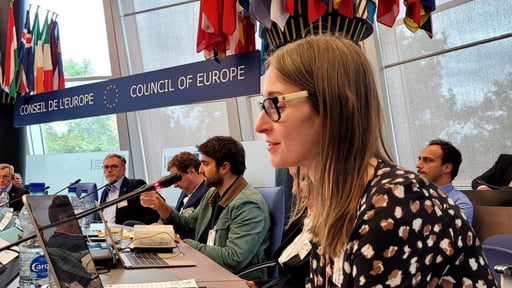
L'UER appelle les États membres du Conseil de l'Europe à protéger les médias de service public
Je voudrais commencer par le positif. Le Conseil de l'Europe comprend le rôle des médias de service public dans la défense du droit fondamental à la liberté...

Blogs
La vérité dans la balance : défendre la démocratie à l’ère de l’intelligence
Alors que les dirigeants mondiaux se réunissent à Davos pour la réunion annuelle du Forum économique mondial, sous le thème « Collaboration pour l’ère...
Déclarations
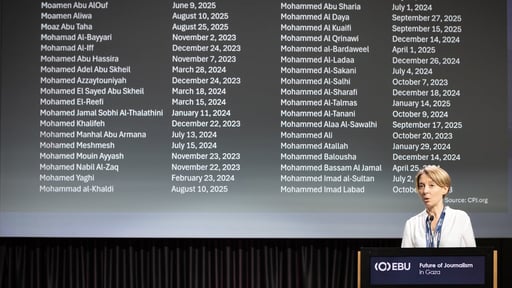
L'avenir du journalisme à Gaza est l'avenir du journalisme
La semaine dernière, à la veille de la Journée mondiale de la liberté de la presse, l'Union européenne de radio-télévision a réuni des journalistes, des...

Blogs
Défendre la démocratie et la liberté des médias
L'état des démocraties du monde se détériore. En 40 ans de carrière de journaliste, je n'ai jamais été aussi préoccupée qu'aujourd'hui », écrit Cilla Benkö,...
Discours
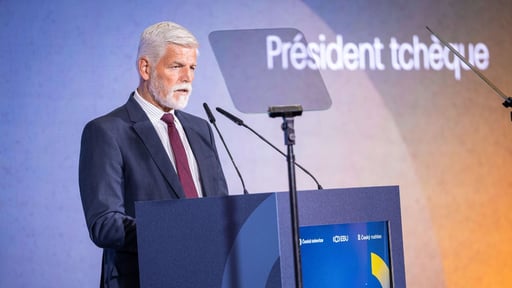
Des médias de service public forts sont un pilier de la sécurité démocratique
En République tchèque, nous bénéficions d'un environnement médiatique bien structuré, qui associe des médias de service public solides à des organisations...

Opinions
Vous méritez la vérité, pas l’interprétation qu’en fait une IA
Cet éditorial a été co-écrit par Liz Corbin, directrice de l'information de l'UER, et Vincent Peyrègne, PDG de la WAN-IFRA, à l'occasion de la Journée...
Histoires
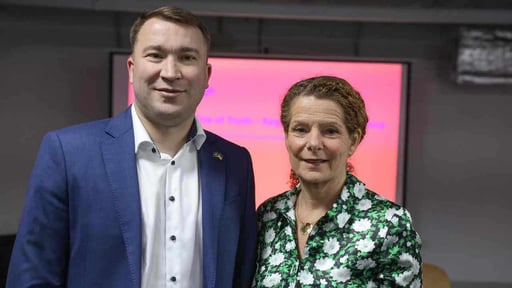
Le journalisme est attaqué comme jamais auparavant, prévient Cilla Benkö à l'occasion de la Journée mondiale de la liberté de la presse
Le journalisme n'a jamais été aussi dangereux, a averti aujourd'hui Cilla Benkö, vice-présidente de l'UER et directrice générale de la radio suédoise,...
Opinions
À l’occasion de la Journée mondiale de la liberté de la presse, les médias de service public s’unissent
Ce samedi, nous célébrerons la Journée mondiale de la liberté de la presse, à un moment où l’intégrité de l’information et la liberté de la presse sont...