Digital Radio in Europe 'Beyond the Tipping Point'
12 octobre 2012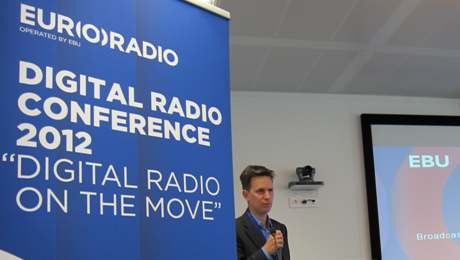
Now is the time to focus on the 'certainty' of a hybrid digital future for radio, because the European digital radio project has passed the tipping point, Tim Davie, BBC Director of Audio and Music, told delegates at the EBU Digital Radio Conference, which concluded on Thursday 11 October at the EBU office in Brussels.
Addressing over 50 representatives of broadcasters, network operators, car-makers and other key players in the European radio sector, Mr. Davie (http://www.bbc.co.uk/pressoffice/biographies/biogs/executives/timdavie.shtml) went on to applaud the successes of the past years, and to urge the sector to build on them as a unified digital radio ecosystem emerges across Europe over the coming months.
The conference (http://newradio.ebu.ch/events/121010_DRC12.php) this year addressed the specific theme of mobility issues in digital radio, and importance of continuing to serve in-car listeners was noted. Indeed in Italy, where up to 65% of total radio listening is done in cars, strong coverage of the country's road network is of critical importance, according to Gianluca Sigillo of Italian network operator RaiWay (http://www.raiway.it/index.php?lang=EN). In the UK, recent figures show that 26% of new cars in the last period were equipped with digital radio receivers as standard, and indicators suggest this figure will surge to 80% in 2013.
Radio serves travelers with rich data
Radio remains in a uniquely strong position to provide travelers with up-to-date journey information, and the digital age opens up the possibility to serve significantly higher-resolution and richer data than was previously possible, as Thomas Kusche, President of the Traveller Information Systems Association (TISA) (http://www.tisa.org/) highlighted. Jan Cools of travel information systems provider Be Mobile (http://www.be-mobile.be/) cited an example of such a service in action: a pioneering programmer from carmaker Toyota (http://telematicsnews.info/2012/02/16/eu-toyota-launches-tpeg-over-dab-traffic-and-travel-services_f3162/) to visualise TPEG (http://en.wikipedia.org/wiki/TPEG) information embedded into a DAB stream for drivers.
Elsewhere the now widely-accepted multiplatform broadcast/broadband paradigm was explored in depth, with the mobility issues of IP distribution coming under particular scrutiny. Streaming radio has not yet proved a highly-mobile platform for radio distribution, and, although LTE multicast scenarios may address some of these issues in specific use cases, digital broadcast is still regarded as of critical importance in ensuring radio remains an 'on-the-move' medium.
Fast growing importance of mobile devices for broadcasters
While indications from the car industry remain positive, the issue of access to broadcast radio through mobile devices, perhaps the second-most important platform for radio, remains problematic. As gatekeepers to the entire mobile device market, it is the telecom network operators to whom the industry must show itself desirable, even indispensable, particularly to young consumers if progress is to be achieved in this area.
Closing the conference, New Radio Group Chairman Mats Åkerlund of Swedish Radio called on the industry to leverage its power to achieve this and other remaining goals, reminding them that 'European radio is unique, strong and has the audience's support.'
The conference also included a tribute to Harry Johnson, former CEO of vTuner (http://www.vtuner.com/) and President of the Internet Media Device Alliance (IMDA) (http://www.imdalliance.org/) who passed away shortly beforehand, and whose work in the standardisation of internet radio metadata was widely-appreciated by the broader digital radio community.
Liens et documents pertinents
Related news
Communiqués
Digital Networks Act : la Commission européenne protège à juste titre les médias dans ses efforts visant à moderniser les marchés des télécommunications, mais la radio a besoin d'avantage
L'UER accueille favorablement la proposition la loi sur les réseaux numériques (Digital Networks Act), publiée aujourd'hui par la Commission européenne....
Positions
L'UER appelle les législateurs de l'UE à préserver la radio dans les voitures et la neutralité du net dans la loi sur les réseaux numériques
Le 18 mai, l'UER a publié sa position politique concernant la loi sur les réseaux numériques (DNA). L'ADN façonnera la manière dont les citoyens européens...

All content, for everyone, everywhere: a core challenge for PSM, past, present and future
With Italy’s Rai hosting the EBU Technology & Innovation Summit and Technical Assembly 2024 in Naples, Chief Technology Officer, Stefano Ciccotti provides...

Blogs
Quand tout tombe, la radio reste debout : un plaidoyer pour une action de l’UE
Qu’il s’agisse de catastrophes naturelles, de cyberattaques ou de coupures de courant, la radio s’est imposée discrètement comme l’un des moyens de communication...

Switching off MW and switching on to a digital future for Spanish radio
Manuel Delgado, Head of Broadcast Resources at Spain’s RTVE, explains why the roll-out of DAB+ is essential to secure radio’s digital future while keeping...

tech-i 63: A shift in the future of radio in cars?
The March 2025 issue of tech-i magazine asks whether absence of any radio in most models of what is, for now, a niche category of vehicle could point towards...
Positions
La réglementation des télécommunications doit respecter les besoins des médias
La semaine dernière, l'UER a envoyé sa réponse à la consultation de la Commission européenne sur son Livre blanc sur "Comment maîtriser les besoins en...

Blogs
Cilla Benkö : La radio doit rester au cœur de la voiture connectée
Le public adore la radio dans sa voiture. Mais la complexité des voitures plus récentes menace la commodité de la radio. Les constructeurs automobiles...