The role of public media in guaranteeing democracy
20 juin 2013Madam Chair, distinguished ladies and gentlemen, good afternoon!
I was very grateful for the opportunity to address your important committee on the role of public service media in guaranteeing democracy and human rights.
Since the abrupt and appalling closure of the Greek public broadcaster ERT last week, this opportunity has become even more timely. That move – in the birthplace of democracy, of all places – was not only unprofessional. It was also anti-democratic. (Many thanks, incidentally, to all those MEPs who have shared and voiced similar opinions. Public service broadcasting is vital to European democracy, and needs your support.)
More about Greece in a minute. But in case you don’t know the European Broadcasting Union, let me tell you first that we brings together and represents the national public broadcasters of more than 50 countries in and around Europe. So excuse me for boasting: the EBU is not only older than the European Union. (We were founded in 1950.) We also have members in twice as many countries!
I must stress that the EBU is not a human rights organization. We exist to serve our Members. Nevertheless, the EBU’s commitment to key human rights is clear from the very first Article of our Statutes. Our purposes, among others, are defined as
- the safeguarding and improving of freedom of expression and information, as essential foundations of a democratic society, and
- “enhancing the freedom and pluralism of the media, the free flow of information and ideas, and the free formation of opinions”.
Over the past couple of years, we have put flesh on these principles by developing and promoting six core values of public service media: universality, independence, excellence, diversity, accountability and innovation. These values were adopted unanimously by all our Members at our General Assembly in Strasbourg last summer. We explain and enlarge on them in this brochure we have made available to you. As you see, it is entitled “Empowering Society”.
And we promote these values constantly in our Partnership Programme, which works to assist our poorer Members – most of them in EU accession or neighbourhood countries.
The European Union has recognized the vital role played by true public service media in healthy European societies. Which is why – last July – Commissioner Füle signed a Memorandum of Understanding with the EBU to strengthen the public broadcasters in the countries preparing to join the Union.
We are now implementing an EU-funded action plan entitled “Enabling the Democratic Role of Public Service Media in the EU Accession countries”. And we are in discussion with Commissioner Füle’s services on developing similar MoUs and action plans for work in the Eastern and Southern Partnership countries.
But we must not forget the public broadcasters in those countries which are already members of the EU. Which brings me back to Greece and ERT.
Of course, nobody would deny that Greece has financial problems. And nobody would claim that ERT has been a perfect public broadcaster over recent years. But the abrupt decision of two Ministers to close down ERT will not save the government any money, it is quite the contrary, it will cost them even more. ERT was funded from the licence fee by the citizens it serves and it generated a small surplus. The channel was not bankrupt and this is why these measures taken were not proportional and illustrate a fundamental lack of understanding of the freedom of expression.
What can you do to help? We urge MEPs to continue to express their strong support for the concept of public service media, denouncing any attempt to use the economic crisis as a pretext destroy it. And to look at the situation in existing EU Members as well as future ones. Greece and Hungary come to mind. There are no doubt others.
Turning back now to what the EBU is doing in candidate EU member countries, our activities in the Western Balkans this year have included seven workshops on the meaning and practice of public service news, and on the EBU editorial principles of impartiality and independence, fairness and respect, connectedness and accountability, accuracy and relevance. In September we shall train the best workshop trainees as trainers, and they will then spread their learning to all their journalist colleagues.
We have mounted a regional conference on the relationship between public service media and the citizen, and another on public service media and Roma minorities. (You will find the conclusions and recommendations of those conferences in your dossiers, and on the EBU website www.ebu.ch.) There will be follow-ups to both of these conferences, a new regional event on minorities and another on the relationship between public service media and Parliaments which we hope some of you will attend.
In the post-conflict societies of the Accession and Neighbourhood countries, free and independent media, and in particular public service media, are essential to guaranteeing genuine democracy. Free and independent PSM are:
- a source of impartial and independent information, not only for free and fair elections, but also on the everyday life of citizens.
- a forum for pluralistic public discussion – a “national conversation” – which promotes democratic participation.
- a platform for all groups in society, contributing to cultural diversity and understanding. This is all the more important in highly fragmented post-conflict societies such as those in the Western Balkans.
Free and independent media are key weapons in the fight against corruption. It is no coincidence that corruption is less widespread in countries which have high-quality independent journalism. And vice versa. This shows the importance of fostering investigative journalism and a climate in which journalists can work without fear of losing their livelihoods – or in the worst case even their lives.
The EBU was very pleased that the recent European Parliament resolution on media and press freedom recognized the crucial role played by public service media in deepening democracy and empowering citizens.
And we welcomed the Resolutions on the 2012 Enlargement progress reports in which MEPs have called on national authorities to ensure the independence and sustainability of PSM and their compliance with European standards.
You may say that the EU can only do so much, as the Amsterdam Protocol leaves the establishment of legal frameworks on public service media clearly with national parliaments. But while there is no ideal universal model for the legal framework, the values and principles laid down in the conventions and recommendations of the Council of Europe and UNESCO do provide an ideal vision of freedom, independence and media pluralism.
In the important area of governance, it is vital that appointment procedures do not endanger the editorial and political independence of public service broadcasters.
Supervisory bodies should include representatives of civil society and different walks of life. And the director general should be appointed by the supervisory body rather than directly by the prime minister or parliament.
Funding must be sufficient, appropriate and long-term. It must allow public service media to fulfil their remit, ensure continuity of service, plan and introduce new technologies, and meet new audience demands.
A recent EBU study of 40 countries where we have Members showed that licence fee provides more than 64% of total income. But in 17 countries – including in the EU accession and neighbourhood areas, public service media rely mostly on public funds.
The licence fee system has the advantage of establishing a clear link between public broadcasters and the citizens they serve. If respected by governments, it also provides a guarantee of independence. Direct financing from state budgets is more problematic unless there are cast-iron guarantees that protect broadcasters from short-term political decisions and political interference, including when governments change after elections.
Formulae which allocate a small proportion of the state budget to public service media do not give broadcasters the certainty they need for medium-term investment and planning, as budgets can be subject to severe cuts from year to year, and even during a year in course. Public service media need specific and sustainable income which is predictable over the medium term. Where the licence fee system is not possible, a better solution than a proportion of the budget is to base funding on a country’s gross domestic product, which is less liable to sharp decreases.
We at the EBU work to strengthen our Members, the national public service media of the European Union and its neighbouring countries. And we urge parliaments – including the European Parliament – to support this cause through measures that will enable them to be strong, innovative, sustainable and independent.
Only when broadcasters attain that state can they fulfil the role they can and should play as watchdogs for democracy and guarantors of human rights. That goes, of course, for the national public broadcaster of Greece, as well as the national public broadcasters of the EU accession countries.
Thank you for your attention.
Liens et documents pertinents
Related news
Blogs
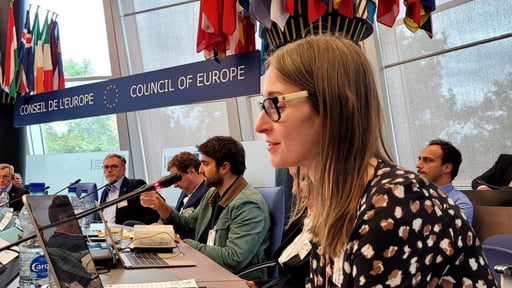
L'UER appelle les États membres du Conseil de l'Europe à protéger les médias de service public
Je voudrais commencer par le positif. Le Conseil de l'Europe comprend le rôle des médias de service public dans la défense du droit fondamental à la liberté...

Positions
L'UER exhorte la Pologne à accompagner les réformes de la liberté des médias d'un financement adéquat des médias de service public.
Le 5 novembre, l'UER a adressé une lettre au gouvernement polonais l'exhortant à garantir un financement adéquat et durable aux médias de service public...
Discours
Jean Philip De Tender : la société aura toujours besoin des médias de service public si nous restons fidèles à nos valeurs
Jean Philip De Tender, directeur général adjoint et directeur des médias de l'UER, a prononcé ce discours lors du salon Public Broadcasters International,...

Blogs
La vérité dans la balance : défendre la démocratie à l’ère de l’intelligence
Alors que les dirigeants mondiaux se réunissent à Davos pour la réunion annuelle du Forum économique mondial, sous le thème « Collaboration pour l’ère...

Communiqués
Post-élections : les décideurs politiques de l’UE doivent s’engager à protéger le secteur des médias européen
Alors que la poussière retombe sur les récentes élections européennes, l'UER fait appel aux nouveaux députés européens (MPE) donner la priorité à la santé...

Histoires
Top 10 des articles juridiques et politiques en 2024
Tenir les Membres au courant des actualités importantes liées aux médias de service public constitue une part importante du travail des affaires juridique...

Blogs
Défendre la démocratie et la liberté des médias
L'état des démocraties du monde se détériore. En 40 ans de carrière de journaliste, je n'ai jamais été aussi préoccupée qu'aujourd'hui », écrit Cilla Benkö,...

Déclarations
Déclaration de l’UER concernant les réactions à la discussion de l’Assemblée générale sur le Concours Eurovision de la Chanson
Dans le sillage de la discussion que l’Assemblée générale a eue récemment sur le Concours Eurovision de la Chanson, plusieurs Membres de l’UER ont été...