Democracy vs Economic Power
18 mai 2012‘Democracy versus economic power’ is of course a provocation. It sounds good, but as so many provocations: it is not true.
Of course there are some very fortunate countries which are ruled by a feudal system or dictatorship and still do well economically because their economic power is built on natural resources such as oil, gas or gold.
But even those countries, if they do not develop strong democratic institutions, will not prevail over time.
Why is this?
Because sustainable economic power and wealth – not only for a small elite at the top but for the majority of the people – are always built on education, innovation and endeavour.
These qualities cannot thrive in countries that are ruled by absolute power and suppression.
Dictatorships that try to control their people in undemocratic and inhumane ways do not allow education with unrestricted and uncontrolled access to knowledge.
Dictatorships that try to control their people in undemocratic and inhumane ways do not accept a spirit of innovation.
Dictatorships that try to control their people in undemocratic and inhumane ways do not reward individual achievements based on endeavour.
This is why all such countries have failed to generate wealth for their people and will continue to fail doing so unless they develop into democracies.
To educate properly you need to open the gates of knowledge beyond your own borders.
To create innovation you have to allow everything to be questioned – including you yourself. You have to let people think outside the box and, above all, make mistakes.
To be willing to work hard you have to have the opportunity for a fair reward – a reward that is based on your own actions instead of just the protection of those who hold power.
It is democracies which allow and foster all these qualities.
This is the reason why in democracies the gap between the rich and the less rich, in general, is much smaller than in non-democratic countries.
Therefore, to construct a divide between the political and economical forces in a democracy is not only fundamentally wrong, but also dangerous.
In today’s times of major political and economic uncertainties it might be tempting – for politicians and media alike – to depict such an antagonism. But by doing so we risk undermining our political system and the foundation for the advancement of our people.
Because both powers – political and economical ones – are part of the same equation: only when they are both strong will the result of the equation be an improvement in the quality of life of the people.
Of course, I am aware that even in our western democracies with our market economics, we don’t live in a perfect world but, instead, in times with many imperfections – such as we see in the political chaos in Greece or in shareholder votes against the obscene bonuses of some top managers.
But, notwithstanding these faults, our democratic world still is infinitely better than the one in countries which, until recently were, or still are, governed by dictators or other rulers with absolute power.
Therefore, instead of talking about "democracy versus economic power" I would rather like to focus on the question: What are the fundamental prerequisites for a sustainable democratic political system that can foster economic growth and, with it, the wellbeing of its people?
I think, in essence, there are five things:
- strong political institutions
- a strict separation of powers
- educated people able to form their own thoughts
- a set of laws and a judiciary which allow these people to express their thoughts freely
- strong, independent and relevant media to oversee all of this
Since I am the Director General of a media organization I will now focus on this fifth prerequisite of a strong democracy and economy: independent and relevant media.
Why are such media fundamental for a democracy? And why will they contribute to the positive development of society?
Strong, independent and relevant media – media that take their task seriously and employ journalists with high ethical and professional standards – are watchdogs.
They hold the political and economic elites accountable and help to establish a sound balance between the two.
This is not mere theory, this is a living fact.
According to our surveys there is a strong correlation between media freedom and corruption.
In general, countries with more media freedom exhibit less corruption, while countries with strong censorship and media controlled by the state are more corrupt.
Therefore, strong, independent and responsibly acting media have a direct impact on the overall improvement of society.
But to be able to fulfil this mission, the media and their representatives – the journalists – need to be protected by the law.
Speaking here in Austria, or in Switzerland, where I live, or in the United States, the country of President Clinton, or in most other Western European countries, we take this for granted.
But we shouldn't!
In many countries it can still be fatal to report on abuse of power – whether it is of political or economic nature.
According to the organization Reporters Without Borders, in 2011
- 66 journalists were killed just for doing their job.
- 71 had to flee their country.
- 1044 were arrested.
- And 1959 journalists were harassed.
In the end all these misuses of power have one clear goal: to send a message to the journalists in the field and to their colleagues and superiors in the newsrooms and upper echelons of their organizations: don’t mess with us, go somewhere else and let us do what we want to do.
If we allow this we allow the destruction of democracy and our way of life.
Another way to pressure critical and independent media is through economic means.
At commercial media this is done by threatening to reduce advertising spending.
At public media, such as the members of our organization, Eurovision, it is done by threatening to reduce their license fees, taxes or the mixture of the two through which they are financed.
Today, you will still find quite a few markets where politicians or business leaders try to make the media their accomplice by exerting pressure on them.
Fortunately though, it is also true that in more and more places we are seeing such misuse of power lessening – especially against public media.
An increasing number of countries have started to implement laws that protect free media.
And it is more widely accepted than in the past that funding of public media has to be sustained even if, at times, they are critical towards those in power.
Of course, governments do not always embrace these developments just because they are forced to do so.
One of the most important factors to help create independent media is technology.
Why? Because modern media technology makes consumers and citizens more independent.
Thanks to platforms such as Google, founded in 1998, or Facebook, launched in 2004, and thanks to television distribution via satellite, we all have more possibilities to inform ourselves from many different sources than ever before.
And we can also use many of these channels to make our own voice heard by hundreds of thousands of others.
In countries which suppress their own newspapers, radio and television, the distribution of news through the Internet, social media or international satellite television programmes play a very important role in reforming society and bringing dictatorships to an end.
As the Arab Spring and other recent examples have shown, social media such as Facebook or Twitter are often perceived in such countries as a more reliable source of information than the national media.
This is why some governments jam satellite signals and try to block access to certain internet sites.
Whatever they do to keep independent information away from their citizens: In the end they always fail.
In today’s world you cannot keep people from looking for the truth.
This is very healthy for democracy and that is why we at Eurovision support this development with various actions.
The most important initiatives of Eurovision are
- to defend freedom of expression and the independence of the media by directly approaching the governments in those countries where they are threatened;
- to ensure a sustainable and sufficient funding of public media by lobbying for them where it is needed;
- to safeguard the openness of the internet, open and interoperable technical standards;
- to help educate journalists and support media organizations in countries where the media do not yet have the knowledge and means necessary for good, independent journalism.
Ladies and Gentlemen, let me come to an end and summarize what is not only my personal belief but also at the core of our organization, the Eurovision:
- We believe that strong and independent media are one of the cornerstones of a modern democracy. But we are equally convinced that a modern democracy needs a strong economy to improve the lives of its people.
- It is the most important task for us, the media, especially public service media, like the members of our organization, to make audiences understand the importance of politics and economics and to watch over these two powers so that they work to the benefit of not only a happy few, but society as a whole.
In other words: It is our mission at Eurovision, to make public service broadcasting indispensible because public service broadcasting is good for democracy, is good for the economy and, above all, is good for the people.
Thank you
Liens et documents pertinents
Related news

Blogs
La vérité dans la balance : défendre la démocratie à l’ère de l’intelligence
Alors que les dirigeants mondiaux se réunissent à Davos pour la réunion annuelle du Forum économique mondial, sous le thème « Collaboration pour l’ère...

Blogs
Pourquoi investir dans les médias de service public est un impératif économique
En Europe centrale et orientale, les médias de service public (MSP) subissent une pression politique et économique croissante. Les mécanismes de financement...

Blogs
Défendre la démocratie et la liberté des médias
L'état des démocraties du monde se détériore. En 40 ans de carrière de journaliste, je n'ai jamais été aussi préoccupée qu'aujourd'hui », écrit Cilla Benkö,...

Histoires
Karen Hao : L'IA est une histoire de pouvoir
Peu de journalistes se sont penchés sur l'essor de l'intelligence artificielle d'aussi près que Karen Hao, qui prononcera un discours clé lors du Forum...
Discours
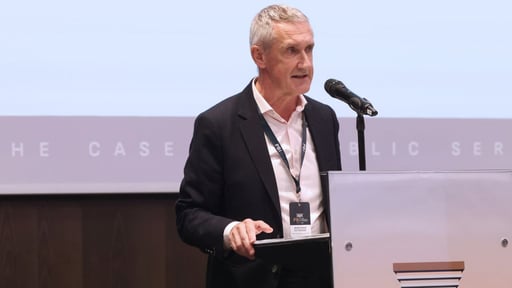
Jean Philip De Tender : la société aura toujours besoin des médias de service public si nous restons fidèles à nos valeurs
Jean Philip De Tender, directeur général adjoint et directeur des médias de l'UER, a prononcé ce discours lors du salon Public Broadcasters International,...
Blogs
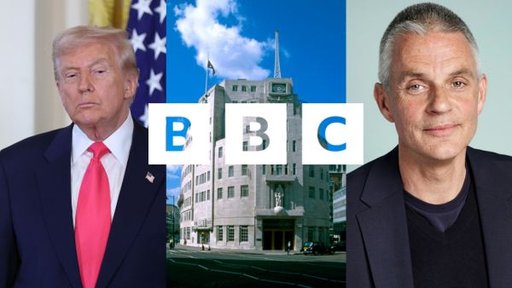
Ce que la crise de la BBC peut apprendre aux médias de service public
Dix jours de controverses et de démissions ont été traumatisants à la BBC, qui auront des répercussions dans toute l'Europe. La démission du directeur...

Histoires
Questions-réponses avec Pattie Maes : « Nous n’avons pas besoin de tout simplifier pour tout le monde »
Nous nous entretenons avec Pattie Maes, professeure d'arts et de sciences médiatiques au MIT Media Lab, dans le cadre d'une série d'entretiens avec les...

Blogs
Arnaques aux célébrités : protégez-vous et protégez les autres
Pour beaucoup, les preuves visuelles ont toujours été la forme de preuve la plus fiable. Cependant, grâce aux avancées technologiques, telles que l’intelligence...