Partnership Programme: Independence of PSM in Enlargement Countries
02 avril 2015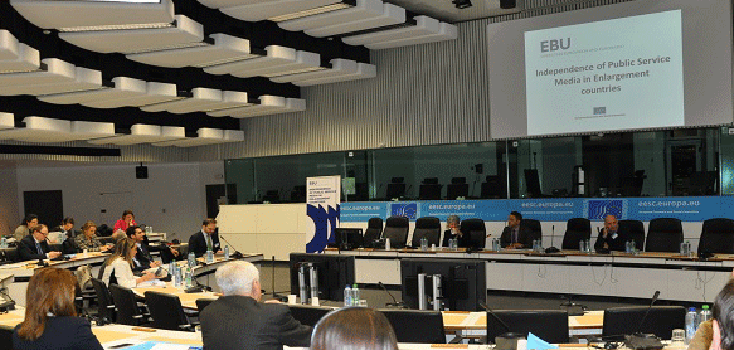
The EBU has brought together a broad cross-section of media and civil society in Brussels to debate the challenges and highlight the successes of PSM in the Western Balkans.
Around 50 journalists, politicians, officials, academics and broadcasters from Serbia, Bosnia-Herzegovina, Montenegro, Albania and Kosovo gathered to discuss the specific challenges faced by public service media in EU Enlargement countries in the Western Balkans. Guests participated in debates on public service media, democracy and civil society, editorial independence, self-censorship and investigative journalism.
Reporters from Montenegro and Kosovo showcased examples of their investigative work, produced under the auspices of the EBU's Partnership Programme. Mirko Bošković from Radio and Television Montenegro (RTCG) and Faton Salihu from Radio Television of Kosovo (RTK) shared their experiences before showing their reports, produced within the framework of the EBU project with the European Commission. EBU Partnership Programme Senior Project Manager Radka Betcheva says this shows the true will among PSM organisations to serve their citizens and act as watchdogs in society: "The development and broadcast of these stories is a real breakthrough and is evidence of positive changes in public service media organisations in the region. This has to be supported and encouraged as the benefits to the fledging public sphere are real and concrete."
The long list of challenges faced by PSM in the Western Balkans led participants to highlight stable funding and genuine civil society involvement as much-needed remedies. The independence of public broadcasters in the Western Balkans is plagued by governmental interference, intimidation of journalists and concentration of media ownership. Against this background participants agreed that change, though notable, is slow and difficult to implement.
In an initial panel discussion on PSM, democracy and civil society, participants all highlighted that while vital, laws alone cannot guarantee the independence of public broadcasters.
Sandra Basic Hrvatin, the Head of the Media Studies Department at Slovenia's University of Primorska said: “Legislation changes all the time. The most significant problem is the lack of political will to properly implement rules” while MEP Knut Fleckenstein added: “Civil society must ensure that governments and political parties do not have influence."
Goran Djurovic, a member of the Council of Radio and Television Montenegro (RTCG), believes the value of a thriving public service broadcaster is incremental: "Democracy won't come from changing PSM, but changing PSM can contribute to democracy." Frane Marovic, OSCE Senior Adviser and Representative on Freedom of the Media, said PSM organisations are at the heart of democracy: “They shape the capacity for citizens to take informed decisions."
The EBU’s Partnership Programme has building sustainable public service media as a primary aim. It offers support to media organisations in the EU enlargement target countries as they transition to reputable and independent public service broadcasters.
Liens et documents pertinents
Contact
Radka Betcheva
Responsable des relations avec les Membres - Europe centrale et orientale
Liens intéressants
Related news
Déclarations
L'UER, des organisations internationales et les radiodiffuseurs publics d'Europe centrale et orientale exhortent la Commission européenne à agir alors que les médias de service public de Bosnie-Herzégovine sont confrontés à l'effondrement
L'Union européenne de radio-télévision (UER), les principales organisations internationales de défense de la liberté des médias et les médias de service...
Histoires
ERNO Regional Workshop in Sarajevo Focuses on Audience Engagement
This week, the Office of Eurovision Regional News Exchange for Southeast Europe (ERNO) hosted media professionals from in Sarajevo for a regional workshop...

Communiqués
Rapport sur la liberté de la presse : environnement de plus en plus hostile au journalisme en Europe
Le 3 mars, les organisations partenaires de la Plateforme du Conseil de l'Europe pour promouvoir la protection du journalisme et la sécurité des journalistes...

Communiqués
Couverture diffusée par 212 chaînes du débat Eurovision 2024
Le 20 juin, l'UER a dévoilé les chiffres d'utilisation du débat Eurovision. 212 chaînes dans 51 pays ont diffusé le débat, qui s'est tenu le 23 mai et...

Positions
L'UER exhorte la Pologne à accompagner les réformes de la liberté des médias d'un financement adéquat des médias de service public.
Le 5 novembre, l'UER a adressé une lettre au gouvernement polonais l'exhortant à garantir un financement adéquat et durable aux médias de service public...

Déclarations
L'UER et ses partenaires internationaux font part de leurs préoccupations concernant les modifications proposées au cadre des médias de service public en Lituanie
L'Union européenne de radio-télévision (UER) et les organisations de médias internationales soussignées ont fait part de leurs préoccupations concernant...
Histoires
Un nouveau groupe d'experts en relations internationales élu lors de la plénière de Bucarest
Un nouveau groupe d'experts en relations internationales a été élu lors de la réunion plénière sur les relations internationales qui s'est tenue à Bucarest,...

Communiqués
L'UER lance le réseau de vérification des faits Spotlight pour lutter contre la désinformation et soutenir les informations fiables
Eurovision News Spotlight met en avant la collaboration, le partage de ressources et la formation Le réseau démarre avec 18 radiodiffuseurs publics, intégrant...