From Vienna to the world: How Eurovision’s signal reaches audiences across the globe
13 May 2026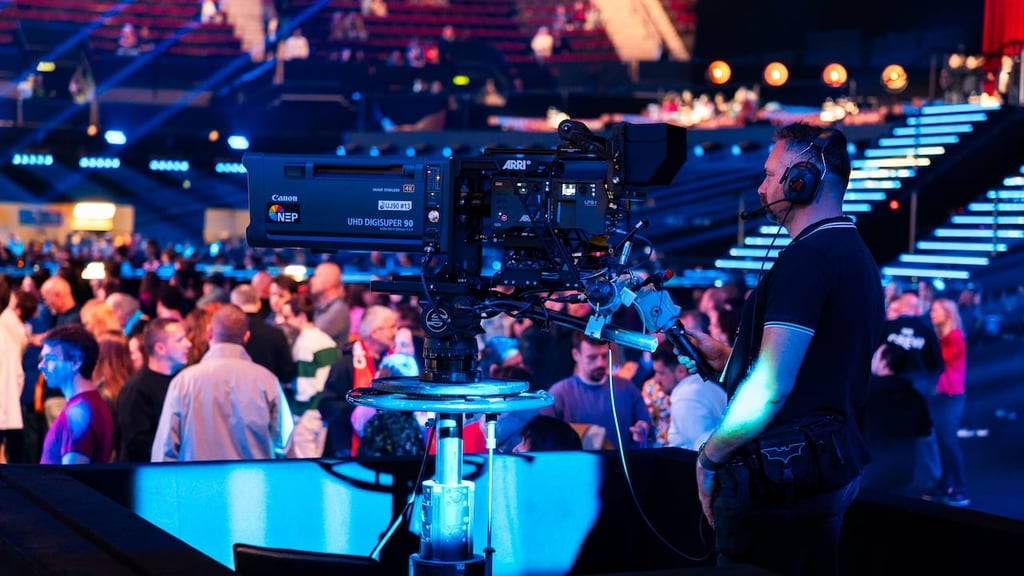
Every May, millions of viewers sit down to watch the Eurovision Song Contest Grand Final. What appears on screen feels immediate and effortless: a performer steps onto the stage in Vienna, fireworks explode overhead, presenters appear in the Green Room and, within seconds, audiences from Oslo to Australia are watching the exact same moment.
But behind the spectacle is one of the most sophisticated live television operations in the world – a vast technical network that stretches from the host broadcaster in Vienna through the EBU’s distribution systems in Geneva and onwards to broadcasters, streaming platforms and devices across the globe.
For the 70th edition of the Song Contest in 2026, hosted in Vienna by Austrian Member ORF, that infrastructure is more ambitious and more complex than ever.
The journey begins inside the arena itself. Dozens of broadcast cameras capture every angle of the live show – sweeping crane shots, handheld backstage moments, drone-style wire cameras and ultra-tight close-ups designed for huge LED screens and 4K broadcasts. Hundreds of microphones pick up vocals, audience cheers and orchestral-style sound design, all mixed live in real time.
Inside the production galleries, directors, vision mixers, graphics teams and replay operators work with split-second precision. The Song Contest is no longer simply a television programme; it is effectively a live global media event produced simultaneously for television, streaming, social platforms and second-screen viewing.
Once the programme feed leaves Vienna, it enters the EBU’s international broadcast network. Historically this operation became known as the 'Eurovision network' – long before the Song Contest itself adopted the name. The EBU’s headquarters in Geneva act as the coordination hub, routing signals between broadcasters across Europe and beyond.
In earlier decades, this was an extraordinary technical achievement. In the 1950s and 1960s, television signals travelled via microwave relay towers and terrestrial links that had to cross mountains, borders and incompatible national broadcast systems. Engineers had to overcome challenges such as transmitting live pictures across the Alps and beneath the English Channel.
The first Contest in 1956 involved just seven countries and was essentially an experiment in transnational live broadcasting. Today, the Eurovision Song Contest reaches hundreds of millions of viewers worldwide across television, online platforms and mobile devices.
Satellite technology transformed the Contest from the 1970s onwards, allowing broadcasters far beyond Europe to join the network. Digital fibre connections then revolutionized speed and reliability. In 2026, much of the signal distribution happens via ultra-fast IP and fibre infrastructure, allowing near-instant delivery in multiple formats and resolutions simultaneously.
The way audiences consume Eurovision has changed dramatically too. Where earlier generations gathered around an analogue family television with occasional signal interference, today's viewers watch on smart TVs, tablets, phones, laptops or social media clips within seconds of transmission.
The Contest has repeatedly pushed broadcasting technology forward. Large-scale televoting systems, real-time graphics, massive LED staging and integrated live streaming have all become part of Eurovision’s technical legacy.
That story is now being explored in a major new exhibition at the National Science and Media Museum, in Bradford, UK. From 15 May, 'Setting the Stage: 70 Years of the Eurovision Song Contest' will examine how the Contest evolved from a post-war broadcasting experiment into one of the world’s most advanced live entertainment productions.
The exhibition includes historical broadcast equipment, interactive displays and behind-the-scenes production technology, tracing innovations from early television cameras through to modern LED staging and audience interaction systems. Visitors can also explore how televoting changed audience participation and how Eurovision helped redefine what live television could achieve. Special events tied to the exhibition include Big Family Party (a Song Contest-inspired day of free family fun) and Setting the Stage Pop-up Parties.
For ORF, hosting the 70th edition of the Eurovision Song Contest is about far more than putting on three television shows. It is an opportunity to showcase Austrian creativity and technical expertise at the centre of a global broadcast operation that still reflects the Contest’s original ambition of connecting audiences across borders through live television.
Seventy years after the Eurovision Song Contest first linked together a handful of European broadcasters, the principle remains remarkably similar. The technology may have evolved from relay towers to fibre networks and smartphones, but the goal is unchanged: to bring millions of people together to share the same live moment, United by Music, wherever they are watching.
Relevant links and documents
Related news

Press release
Eurovision Song Contest celebrates 70 Years of being United by Music
70 years ago, on 24 May 1956, artists representing seven broadcasters gathered at the Teatro Kursaal in Lugano, Switzerland, for a bold new experiment...

Press release
Fans from more than 70 countries to travel to Vienna for 70th Eurovision Song Contest
As it celebrates its 70th anniversary the Eurovision Song Contest is proving once again that music knows no borders, as fans from across the globe prepare...
Press release
Eurovision Song Contest marks 70th anniversary with biggest-ever global celebration
With rehearsals beginning in Vienna this weekend, the European Broadcasting Union (EBU) and its Members are kicking off the Contest’s 70th anniversary...

Press release
EBU unveils the very first official Eurovision Song Contest Live Tour to celebrate 70 magical years
The European Broadcasting Union (EBU) is excited to announce the very first official Eurovision Song Contest Live Tour will travel across Europe this summer...

Press release
SRG SSR Honoured with EBU Excellence in Media Award for Eurovision Song Contest 2025
The European Broadcasting Union (EBU) has awarded Swiss public service media organization SRG SSR the Excellence in Media Award in recognition of its outstanding...

Press release
Bulgaria’s Dara wins spectacular 70th Eurovision Song Contest with ‘Bangaranga’
DARA has won the Eurovision Song Contest 2026 for BNT with the song 'Bangaranga', securing Bulgaria’s first-ever Eurovision victory. Hosted by ORF at the...

Press release
Bangkok to Host First-Ever Eurovision Song Contest Asia in 2026
The European Broadcasting Union (EBU) and Voxovation together with S2O Productions and Thailand’s Channel 3 are excited to announce that Eurovision Song...

Press release
Semi-Finals Lineup Confirmed for 70th Eurovision Song Contest
The line-up for the Semi-Finals of the 70th Eurovision Song Contest has been decided by a draw preceded by an official handover ceremony at the Rathaus...