Jean Philip De Tender: society will always need PSM if we hold on to our values
22 October 2025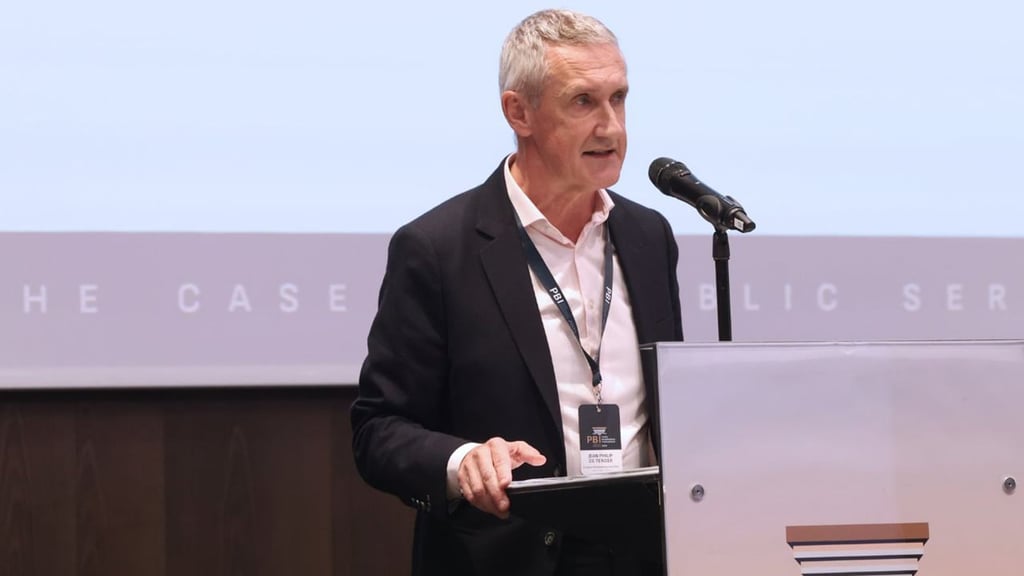
EBU Deputy Director General & Media Director Jean Philip De Tender gave this keynote at Public Broadcasters International, on Tuesday 22 October 2025, in Sofia, Bulgaria.
Good morning everyone. It’s a real privilege to join you here in Sofia among friends and colleagues.
Let me begin by thanking our host, Milen Mitev, Director General of Bulgarian National Radio, for welcoming us so warmly.
Milen and his team truly embody the values of public service media in this region, and it’s very fitting that PBI should gather in Sofia under BNR’s roof.
//
Now, the theme of this year’s PBI – the state of public service media – could not be more timely.
Because if we take a good look at the issue, we might see a glaring paradox.
On the one hand, public service media are adaptable, creative, and trusted.
But on the other, we’re also vulnerable, contested, and constantly under fire.
We face simultaneous pressures on multiple fronts: political, technological, financial, as well as radical changes in audience behaviours.
And all the while, we have to prove our worth more convincingly than ever: what are we for? Whom do we serve? How do we justify our funding?
So, before this morning’s discussion, I wanted to sketch out three points for you: where we’re succeeding, where we’re challenged, and where I believe there are opportunities for all of us.
//
Ok, so I’ll start with some positive news.
Firstly, research in Europe consistently shows that PSM are the most trusted media institutions. Without exception.
In this age of information overload, where conspiracy theories and deepfakes reach millions of people in seconds, that enduring trust is extremely precious.
Because not only is public trust like oxygen for public service media – but it’s an essential component of national democratic infrastructure.
Secondly, we also see our Members constantly reinventing themselves to meet audiences where they are.
Whether it’s NRK in Norway launching youth-first formats on TikTok, France Télévisions expanding their Okoo children’s brand, an ad-free digital offering that’s also present on multiple terrestrial channels, or the many broadcasters reshaping their strategy to the new political environment – our Members are adapting well.
Thirdly, PSM are stepping up in the public interest where others can’t – or won’t.
A powerful example of this is a seismic piece of BBC / EBU joint research into AI assistants, which we released a few days ago.
Across 22 countries, in multiple languages, we tested what happens when people ask AI tools for news.
The results showed systemic distortion, inconsistencies, and bias.
Every day, millions of times, AI is taking news from European PSM, repackaging it, and giving people a false version of it.
AI is misquoting, decontextualising, misattributing ideas and statements, and even hallucinating false information.
As far as we know, regulators are not looking at this problem with any urgency, if at all.
European Union and national laws that are supposed to hold information providers to account are not being effectively enforced.
Someone had to raise the alarm, so public service media did. We filled the gap because it’s in the public interest to do so.
//
So now I’m afraid it’s time for some gloomier news.
Public service media today are facing greater challenges to their existence than at any time in their history.
We have to be clear-eyed about this.
Audiences are fragmented, with young people often bypassing our traditional radio and TV services entirely.
We’ve seen the rise of hard-to-reach audiences and news avoidance by some. Not because they don’t care, but because they feel overwhelmed, disenchanted, or excluded from the way stories are told.
If our content is not discoverable in the spaces where these people spend their time, it’s invisible and we’re irrelevant to them.
Politically, the ground is shifting beneath our feet. More and more governments no longer see strong, independent media as an asset. Instead, they see us as an inconvenient limitation to their control.
As a result, our funding models are being squeezed, governance structures challenged, boards politicised. We see examples of this kind of indirect pressure across Europe and beyond.
Some of our Members are fortunate to operate in robust democracies, where PSM are properly funded and safeguarded by strong laws.
But others work in precarious contexts where their independence is under siege.
In other words, the global picture is not uniform: it’s a patchwork story of strength and struggle.
//
I would say that the question we need to ask ourselves every single day, is how do we protect what matters most?
One of the keys is by getting our governance right.
This means independent boards. Transparent funding. Robust legal safeguards against political interference.
But besides that, governance is a culture. It’s the daily, lived practice of independent decision making.
If audiences think that politicians dictate our editorial lines, their trust will evaporate. If journalists feel constrained, their curiosity and creativity die.
We must constantly defend this culture of independence, because without it, we can’t serve the public.
//
Ladies and gentlemen, having darkened the mood in the room, I’m going to try to lighten it again.
Because I’m an optimist, I’ll end on an optimistic note.
Despite the big challenges, we still have good reasons to remain hopeful and look forward.
Because PSM have a unique quality: we exist to serve the whole of society, not just profitable or powerful parts.
We have no shareholders – our dividend is trust.
We are in the privileged position of being able to invest in stories that commercial operators won’t touch because they don’t maximise clicks or ad revenues – but they matter to our communities.
We can lead the way on essential social initiatives, like media literacy.
In a world of deepfakes, deception and algorithmic bias, someone needs to help people navigate the chaos.
And who better than us? No one else has both the expertise and the public mandate.
And let’s not forget our role as innovators.
Public service broadcasters were pioneers of television, of radio, and today, we’re pioneers of podcasts, streaming, and yes, AI experimentation.
We don’t just adapt to change, it’s often PSM who anticipate and guide it.
PSM are not a luxury or a nice-to-have. They are essential engines of democracy, culture, and citizenship, and it’s in everyone’s interest to ensure they remain strong.
//
I’d like to finish with this observation.
The “state of public service media” is not a picture to be hung on a wall and contemplated.
It’s a living, evolving story that’s subject to the changing circumstances in which it exists.
It’s affected by politics, technology, and social change.
But it also depends on our daily choices: the courage to stand firm, the creativity to reinvent, the commitment to serve the public interest in all we do.
There are fierce headwinds coming at us. But there’s also resilience.
There are full frontal attacks. But there’s also public trust.
If we hold on to our values – independence, innovation, inclusion – then I believe PSM won’t just survive the next chapter.
We will always be what societies need most, which is trusted, independent, authoritative voices in a noisy, contested, confused world.
Thank you.
Relevant links and documents
Contact

Related news
Speech
When we produce meaningful content for young people, we help them navigate the world.
Keynote speech delivered by Jean Philip De Tender, Deputy Director General/Director of Media, EBU, at the annual ABU-Rai Days conference, in Naples, on...

Speech
Some of our red lines have become constrictive red tape. Time for a rethink.
This text is based on a speech delivered by EBU Director of News, Liz Corbin, at the AI Forum, on 25 March 2026, in Brussels. I’ve been thinking a lot...
Blog
In a world of noise, we need VOICES: The European Festival of Journalism and Media Literacy
In an era where misinformation spreads rapidly and the digital landscape grows increasingly polarized, the need for media literacy and quality journalism...
Blog
What the BBC crisis can teach public service media
It's been a traumatic ten days of controversy and resignations at the BBC, which will have repercussions right around Europe. The resignation of Director...

Policy Position
EMFA in focus: EBU urges strong safeguards for public service media in Poland
On 23 January, the EBU submitted its response to Poland’s public consultation on the implementation of the European Media Freedom Act (EMFA). In our submission,...
Stories
Q&A with Anne Lagercrantz: “Accountability is so valuable because it will become a rare commodity”
We talk to Anne Lagercrantz, Director General of SVT Swedish Television, as one of a series of interviews with contributors to the EBU News Report 2025:...

Statement
EBU Statement on Eurovision Song Contest General Assembly Discussion
At today’s EBU General Assembly, Members held an open and constructive discussion on the Eurovision Song Contest (ESC) and the increasingly complex global...

Stories
Top 10 Legal and Policy news of 2025
Keeping Members up to date with important news related to public service media is an important part of the EBU’s Legal & Policy work. In 2025, the Audiovisual...