As Lithuanian parliament threatens its public broadcaster, new report proves that public media boosts private news in Lithuania
14 April 2026
A new independent study finds that Lithuania’s public broadcaster LRT strengthens, rather than weakens, private news media. The findings come at a crucial time as lawmakers consider changes that could cut its funding and independence.
Strong public media = stronger private news
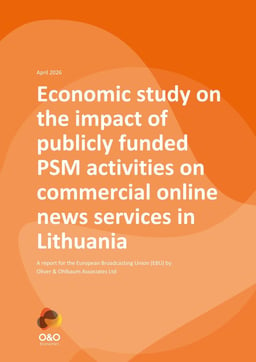
A new study commissioned by the EBU, and carried out by Oliver & Ohlbaum Associates (O&O), shows that when Lithuanians use their public broadcaster, LRT, more, they also use private news websites more.
Looking at four years of audience data (2022–2026), the study finds consistent positive links across all key metrics. For instance, a 1% increase in LRT page views is linked to a +0.70% increase in commercial page views. In other terms, when people use public service news more, they don’t switch away from private media. They consume more news overall, including from commercial publishers.
“From a competition perspective, the evidence shows no substitution effect between public service media and commercial news. On the contrary, the data points to a complementary relationship, where increased engagement with public service content is associated with higher usage of private news services,” said Alexandre Fall, Head of Competition and State Aid at the EBU.
Why this matters now in Lithuania
The study comes as Lithuania debates new legislation that could reduce LRT’s funding and limit its independence. Notably the government will debate on 16 April changes that could make it easier to dismiss the Director General, introducing intrusive oversight of editorial activities and a significantly expanded governance structure.
Some have argued that public media puts pressure on private companies. This new evidence shows the opposite: LRT helps grow the overall news audience, benefiting commercial publishers alongside public media.
“If you weaken public media to ‘protect’ the market, you risk damaging the very ecosystem you are trying to defend,” Fall added.
Confirmed across Europe
This Lithuanian study follows earlier independent research across Europe, which reached the same conclusion: public media and private media grow together.
Because media markets are national, country-specific evidence is key. The fact that Lithuania shows the same results as the wider European study makes the findings especially strong.
Refocusing the competition debate
From a competition and State aid perspective, the implications are clear. Where no crowding out is demonstrated, restrictions on public service media cannot be justified as a necessary measure to protect competition.
Instead, the study reinforces a broader point: the main challenges facing commercial publishers stem from structural factors (e.g. declining advertising revenues, the growing role of global platforms, and changing consumer behaviour) rather than from public service media activity.
In that light, ongoing complaints at EU level alleging that public funding of broadcasters such as LRT distorts competition appear increasingly difficult to sustain.
At a time when media systems are under pressure, the evidence points in one direction: strong, independent public service media supports a healthier, more competitive and more pluralistic news ecosystem for everyone.
Relevant links and documents
Contact

Relevant Links
Documents
Related news
Policy Position
New study finds Yle’s online news boosts commercial publishers in Finland
On 19 June, new data, from an independent study conducted by Oliver & Ohlbaum Associates (O&O), revealed that people who use Yle’s online news were 6.7...

Press release
New Study: Public service media online news - No impact on commercial sector
On 12 June, the EBU released independent research, an Economic study on the impact of publicly funded PSM activities on commercial online news publishers,...

Blog
Public service media online news and the crowding out myth
The EBU commissioned an independent study to consider the theory that PSM news and information online somehow “crowds out” or hinders the profitability...

Statement
Adequate funding vital to SRG SSR’s public service mission
On 8 March, Swiss citizens will vote on a popular initiative that includes a massive reduction in household licence fees and the elimination of business...

Blog
Why funding public service media helps all of us get better online news
We’ve heard for decades that public broadcasters ‘crowd out’ private media; why does this claim persist when the evidence says otherwise? The claim persists...

Press release
EBU calls for rethink of online news limits for German public media in draft reforms
[Siehe unten für die deutsche Version dieser Pressemitteilung zum Reformstaatsvertrag] The European Broadcasting Union (EBU) welcomes efforts to ensure...

Statement
EBU and international media organizations raise concerns over proposed changes to Lithuania’s public service media framework
The European Broadcasting Union (EBU) and the undersigned international media organizations have written to Lithuanian authorities to express their concern...

Blog
Why investing in public service media is an economic imperative
Across Central and Eastern Europe, public service media (PSM) are under growing political and economic pressure. Funding mechanisms are being questioned,...