EBU develops public service investigative journalism training in Balkans
10 March 2014
The EBU is working together with media professionals from the Balkans to develop the first investigative journalism training programme for public service media (PSM) in the region.
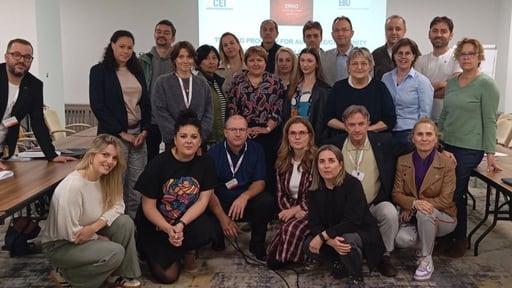
The EBU Partnership Programme (EPP) and the Eurovision ACADEMY invited investigative journalists from Swedish (SVT) and German (ARD/WDR) Member broadcasters, the Balkan Investigative Reporting Network, B92 and BIRN Kosovo to Belgrade, Serbia.
The group was charged with creating a curriculum that will equip public service journalists from the Balkans with the necessary skills to research, carry out and broadcast investigative stories at their own stations.
Nils Hanson, Editor in Chief of Uppdrag granskning (Mission Investigate), SVT's hugely popular investigative programme, commented on what the training is meant to achieve: "The aim is to put them into an investigative journalism state of mind. Talking about the public service values it brings to the company, investigative journalism plays an invaluable role in a democratic society. Swedish Televison has been doing it since the '70s and our program, Mission Investigate, reaches as many viewers as many popular entertainment programmes - some weeks, as much as ten percent of the population!"
EPP Project Manager Radka Betcheva added that increasing audience trust through investigative journalism will also give public broadcasters in the region a competitive edge.
“It is going to be challenging, since this is will be the first programme aimed at developing public service investigative journalism in the Balkans, but they have to change. PSM have to get closer to their audience, to show citizens that they are producing high quality reporting and are an indispensible source of information," she said.
The first investigative journalism training programme will include modules on research, investigative journalism techniques, data mining, libel and storytelling, after which students will work on stories under the supervision of tutors.
Participating public broadcasters will select 16 journalists to participate in the course, which is expected to start on 26 May.
Relevant links and documents
Related news

Press release
Playing with fire: EBU investigates Russia’s hybrid attacks on Europe
A new report by the EBU Investigative Journalism Network reveals the extent of Russian hybrid attacks in Europe – including the use of “disposable agents”...

Press release
Sveriges Radio wins Prix Italia for “Nyhetssök” built on EBU NEO
The Swedish broadcaster's service “Nyhetssök” (News Search), which based on the co-developed EBU NEO platform, won the prestigious international Prix Italia...

Stories
Suspilne at Four Years of War: Resilience and trust
Four years into Russia’s full-scale invasion of Ukraine, our Member Suspilne continues to ensure access to trusted journalism at home while strengthening...
Stories
ERNO Regional Workshop in Sarajevo Focuses on Audience Engagement
This week, the Office of Eurovision Regional News Exchange for Southeast Europe (ERNO) hosted media professionals from in Sarajevo for a regional workshop...

Stories
Ask away: EBU Neo powers Sveriges Radio AI news chatbot
AI-powered search on the Sveriges Radio (SR) Play mobile app is now helping audiences to explore news stories by asking questions and getting reliable...

Press release
EBU Investigative Journalism Network exposé reveals how sperm from a donor with a rare genetic mutation linked to heightened cancer risk conceived at least 197 children across Europe.
Fourteen EBU Members are today publishing a collaborative investigation into an alarming donor case where one man’s sperm was used to conceive at least...

Stories
EBU launches new Eurovision News site to centralise and focus its services
The EBU has launched a new website for Eurovision News, the collaborative news network powering real-time journalism across Europe and beyond. At eurovisionnews.ebu.ch,...

Stories
EBU Members elect new News Committee at News Assembly 2025
The European Broadcasting Union (EBU) News Assembly has elected the next News Committee at its annual meeting, taking place in Naples, Italy, Drawn from...