CASE STUDIES
The Advent of AI: The Sami kids whose story saved Christmas
Storytellers were weaving subthemes into the magic of Christmas long before the big man in red was marketing Coca Cola to starry-eyed kids.
When Charles Dickens wrote ‘A Christmas Carol’, he created a genre that has, erm, snowballed into a vast canon of stories about the kindness, hope and humanity that make Christmas the fuzziest of festivals.
So when producer Simon Staffans, from Swedish broadcaster SVT, elected to tread this well-trodden path, he saw the need to write an original story and tell it in a fresh way.
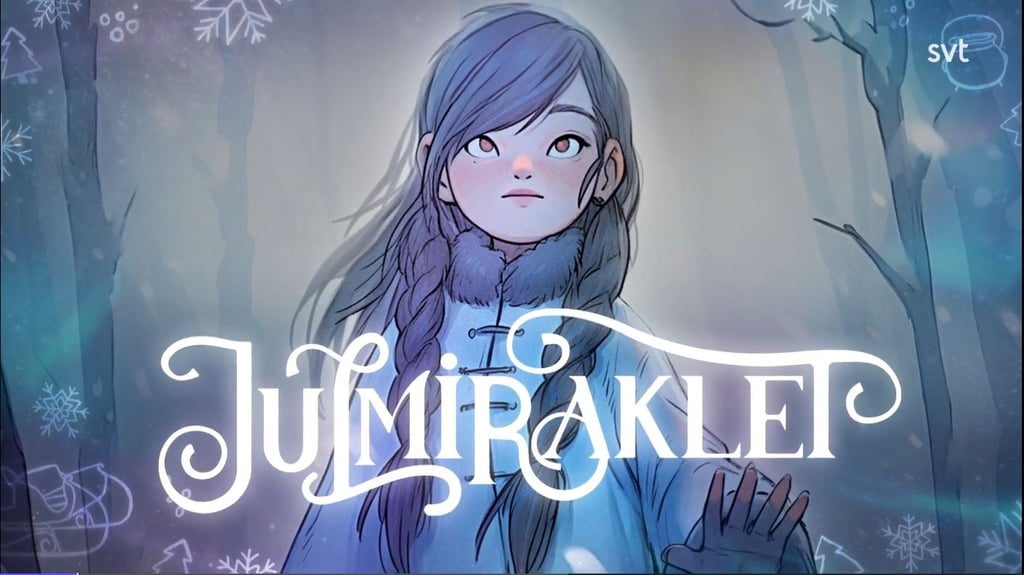
What resulted was ‘The Christmas Miracle’, a 24-part animated opus, which, when counted in all its language variations, totalled 96 episodes across Swedish and three Sami languages.
What inspired SVT series ‘The Christmas Miracle’?
Simon’s vision, after discussions with project manager Maria Viklands, was to empower Sami indigenous kids to flex their creativity using AI. The 24-day airing from December 1st to Christmas Eve, 2023, was a homage to the Nordic advent calendar tradition. And, as well as a daily televised episode, fans could open a new picture every day on the SVT app.
By infusing technology with tradition, SVT created a deeply engaging visual experience that resonated equally with Swedish children and adults.
Simon highlighted the significant public investment and anticipation linked to Christmas productions in Scandinavia, but said this project was the first to deeply integrate generative AI in its creation.
How did SVT get school kids to create a series using AI?
Simon said: ‘We based the AI work on what the kids had been drawing, so the story was not developed with AI. That was with us, the kids, and Annica Wennström, a writer with deep connections to the Sami story world we had working with us,’ he said.
‘The Sami kids are native to Lapland, to the north of Sweden, and we wanted them to tell us in their own way what it’s like to grow up in the icy, snowy forests. They told us the details of what life’s like for them, and how different characters would react and behave, and what their goals, fears, and needs would be.’
The children worked to create scenes with drawings, characters and storylines. These then served as the basis of work done in MidJourney to prompt images, as well as Adobe suite and Pika Labs to turn their ideas into animated chapters.
It was the unique blend of traditional Sami culture with cutting-edge technology that offered the children a novel way to express their experiences of life in the Arctic Circle. While initially sceptical about AI's capabilities, the students soon warmed to the project and learned firsthand about the tool’s strengths and limitations.
What’s the plot of the Christmas Miracle?
Simon described how the groups of 11- and 12-year-olds collaborated with the writer to build a storyline around Santa Claus adapting to a changing world. In their telling, Santa’s new rocket-powered turbo-sleigh crashes, prompting a rescue mission to save Christmas.
The plot was neatly layered with a parallel narrative that illustrated both the in-universe events and the behind-the-scenes journey of the children working with AI.
The children sketched the characters by hand and set them in stories echoing their lives and heritage. Their scanned drawings were the foundation for AI to generate more refined visuals, a process that engaged the students in discussions about the direction and details of the final output.
The challenges of working with children
Managing the creative input of 17 ‘tweenagers’ (not a typo) from two schools was no mean feat, entailing the balancing of differing opinions while ensuring all contributions were valued.
Budget and deadlines added to the complexity, as a slimmed-down team consisting of Simon, producer Victor Lindgren and cameraman Fredrik Westerberg visited the schools following a fairly demanding schedule. The most demanding was the editing, the majority of which was handled by Anders Wik, which required dexterity to honour the children’s vision in an authentic yet coherent way.
Simon explained: ‘The more accurate you try to be with AI, the more difficult it becomes for it not to hallucinate. So if a kid wanted a magical pink fox with a lilac tail and a horn in its forehead, that was a bit difficult, whereas a regular fox it could create from scratch in a second. We needed to work with the kids to find compromises the AI could handle.’
Despite these speedbumps, the project stayed on track, proving that AI can hasten workflows so much that once-prohibitively labour-intensive animation projects can now be, literally, child’s play.
And while AI did not supplant human input, it enhanced human creativity to make the impossible possible by powering quick-fire iterations that brought ideas to life in vivid detail.
Media literacy and ethics
Simon took the project as an opportunity to give the children some media literacy training around AI’s capabilities and limitations, including ethical issues around creating avatars with their likeness, and data protection.
He said: ‘The first thing the kids wanted was to have avatars made of themselves, so we made an episode with avatars of them, and took the opportunity to be public-service-minded and explain that it’s not good to take pictures of yourselves and upload them to servers, especially not those outside the EU’s GDPR jurisdiction. Instead, they drew pictures of themselves, and we used those as the basis of their avatars.’
Impact and future miracles
The series aired last Christmas to public acclaim, which was undoubtedly helped by the parallel publication of a book featuring extra background content that didn’t make the cut.
Although the project hasn’t yet been sold to other territories, it has caught the attention of broadcasters interested in similar AI-driven projects. Rapid evolution of AI means some of the techniques used may already feel dated, but the basic experience remains valid.
Simon hinted at future AI-assisted projects, including a series titled ‘Sami Lore’, which will bring new life to ancient beings from Sami mythology and will premiere in the spring of 2025. He’s also interested in reprising the ‘Christmas Miracle’ cast for a follow-up series.
Reflections on AI’s role
Simon stressed that while AI facilitated the project’s completion within tight budgetary and time constraints, it is no substitute for traditional artistry or storytelling. The children also learned something about navigating AI and working towards a goal with humour, patience and flexibility.
The ‘Christmas Miracle’ is an expression of how traditional narrative expression, community engagement, and modern technology can intersect to create something of value.
Even with the most advanced tools at our disposal, the storytelling spirit remains rooted in human experience, emotion, and connection—not unlike Christmas itself.