Constant successes mean constant changes
30 October 2012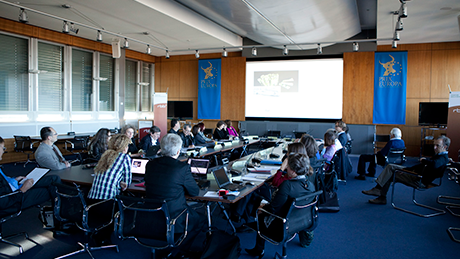
2012 Berlin Summit
"Radio has a golden opportunity, but change is also needed!" This was the theme that Cilla Benkö, Director General of Swedish Radio and member of the EBU Executive Board, focused on in her presentation to the managers of culture Radio stations gathered in Berlin on 26 October 2012 for their annual plenary meeting on the fringes of Prix Europa.
Stressing a very broad definition of "culture", Annika Nyberg Frankenhaeuser, EBU Media Director, opened the meeting describing the new EBU Media Department’s development of synergies between Radio and TV.
Regarding the changes, Cilla Benkö stressed that Radio is facing stronger competition with the print press, even if the latter’s content value is becoming poorer, and with more TV channels in sport, entertainment and fiction. At the same time, stations devoted to culture, Classical music and jazz are rarely launched. Music and culture are thus more than ever an essential part of public service media. The changes which Cilla Benkö spoke about are "aimed at bringing our unique cultural content to the audience, using any possible platforms, including newspaper Web sites".
For the Chair of the EBU Culture Group, Karl Karst, Head of WDR 3 Radio, who presented the new organization of his channel, the changes are aimed at making his station the main cultural platform of the region.
The new integration of Radio, TV, News and New Media is now completed in Hungary, said Lidia Márton, MTVA Director of International Relations. Here again, the unique content is looking for all possible platforms to reach a demanding and interacting audience.
A culture Radio station?
There was a lively discussion at the Berlin Summit on the definition of a culture Radio station. For some, the obvious definition, that of a music and arts broadcaster, is not enough since culture is wider than music and the arts. A culture Radio station should highlight for listeners what is important in life, including social aspects, politics, science, etc. For others, such a programme should include everything not dealt with by other channels, such as “news and entertainment” or “music for youth”. Yet quality is not enough since commercial competitors also provide quality programming.
Culture radio stations should therefore offer quality programmes, with more culture and more background information.
More on Prix-Europa: « Dans les coulisses des jurys radio du Prix Europa » (telerama.fr, 29 Oct 12)
Relevant links and documents
Relevant Links
Related news
Stories
Journalism under attack like never before, warns Cilla Benkö on World Press Freedom Day
Journalism has never been more dangerous, EBU Vice President and Director General of Swedish Radio Cilla Benkö warned today during a special event in Ukraine...

Press release
EBU calls for rethink of online news limits for German public media in draft reforms
[Siehe unten für die deutsche Version dieser Pressemitteilung zum Reformstaatsvertrag] The European Broadcasting Union (EBU) welcomes efforts to ensure...

Blog
Cilla Benkö: Radio must remain at the heart of the connected car
Audiences love radio in their cars. But the complexity of newer cars threatens radio's convenience. Car makers should be ready to give audiences free,...
Press release
ARTE joins the European Broadcasting Union, strengthening cultural connections across Europe
ARTE, the Franco-German public service broadcaster dedicated to culture, has become the newest Member of the European Broadcasting Union (EBU), having...

Press release
EBU anniversary project premieres 10 new classical music works to millions
As part of its 75th anniversary celebrations, the European Broadcasting Union (EBU) has launched the EBU Music Commissioning Scheme, a new initiative uniting...
Press release
European Parliament defends EU media rules against US pressure
The EBU welcomes the adoption of the European Parliament resolution on Audiovisual Media Services Directive (AVMSD) obligations in the transatlantic dialogue....
Policy Position
Public procurement consultation: EBU calls for a future-proof approach for the broadcasting sector
On 26 January, the EBU submitted its position and consultation response to the European Commission’s review of the EU Public Procurement Directives. For...
Speech
Jean Philip De Tender: society will always need PSM if we hold on to our values
EBU Deputy Director General & Media Director Jean Philip De Tender gave this keynote at Public Broadcasters International, on Tuesday 22 October 2025,...