Eurovision ACADEMY to help field journalists get IT-savvy
14 November 2012
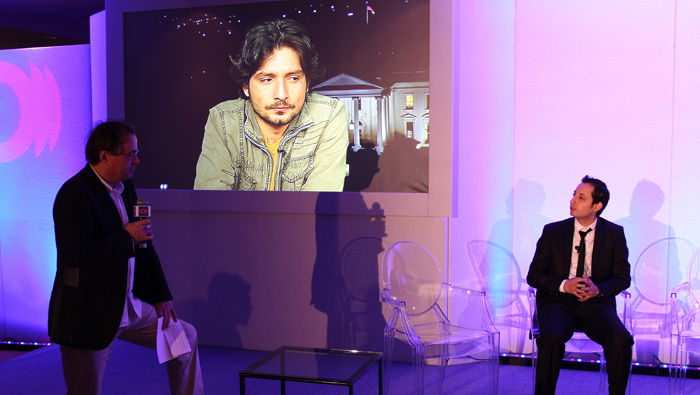
Eurovision ACADEMY will look at building a training programme for EBU Member journalists heading to countries where failure to protect digital data can endanger their own lives and those of their sources.
Head of Eurovision ACADEMY, Nathalie Labourdette, raised the prospect at the seventh News Assembly, in Barcelona, after talks on the paramount importance of protecting sensitive data in the field.
The session was joined by speakers with first-hand experience of the spreading phenomenon, which has become a routine strategy for governments of Arab Spring countries.
Dlshad Othman, a Syrian human rights activist and computer expert, joined via a live satellite link from Eurovision’s studio in Washington, DC, where he fled when a Western journalist contact was arrested in possession of unencrypted data and video with interviewees' faces left visible.
He said: “(Syrian President) Assad has a highly capable ‘cyber army’ that is waging warfare via the internet. They are launching trojans and viruses and gathering information. People who do not use encryption tools put a lot of other people in serious danger.”
His fears were echoed by a former IT chief in Colonel Gaddafi’s Foreign Ministry, Marwan Arebi, who began passing information to the opposition once the Libyan revolution ignited.
Arebi, who used an array of cyber tools to cover his trail, learned that Gaddafi’s hackers had accessed the computer of a CNN journalist with numerous undercover sources in Tripoli.
“I went into the journalist’s computer and sent him his own username and password as proof that his system was vulnerable,” he said. “One of the first things I came across in his emails was a message to his managers listing all of his sources in Tripoli. That was when they took action.”
The session drew a round of questions from attending Members wanting information about how to prepare reporters to protect their data from cyber attacks.
During the Q&A, Nathalie Labourdette said: “Security is ultimately the responsibility of each broadcaster, but we need to address this issue in a holistic way. Today, part of that is ensuring that journalists are more IT-savvy then ever before.”
Ms Labourdette added that while cyber knowhow was an important aspect of modern security in journalism, it was no less important to tend to the basics too.
“Reporters still have to be trained in the security fundamentals,” she said. “Preparation for hostile environments, care over what you say and write and ensuring that newsrooms are crisis ready will always be decisive factors in the safety of media professionals.”
Relevant links and documents
Relevant Links
Related news

Press release
Playing with fire: EBU investigates Russia’s hybrid attacks on Europe
A new report by the EBU Investigative Journalism Network reveals the extent of Russian hybrid attacks in Europe – including the use of “disposable agents”...

Statement
EBU News Committee demands that foreign journalists be allowed unrestricted access to Gaza following ceasefire
The EBU News Committee, comprised of senior newsroom leaders from public service broadcasters, has demanded that the Israeli authorities allow foreign...

Stories
NVIDIA Media Chief: 'We’re ready to work with you to unlock AI’s benefits.'
The media and entertainment chief of the world’s most valuable company, NVIDIA, has told the EBU Summer General Assembly his company is ready to work with...

Statement
EBU urges unrestricted access to Gaza for foreign journalists
On the occasion of the EBU’s News Contacts Meeting, the world’s leading alliance of public service media again calls on the Israeli government to unblock...

Press release
Eurovision News unites broadcasters to deliver in-depth reporting on Gaza famine – despite strict media blockade
Multiple EBU Members have delivered a complex journalistic collaboration to report on the hunger and hardship in the Gaza Strip. Coordinated by Eurovision...

Stories
"You can’t look at GenAI too fearfully. You have to find as many opportunities as you can."
In which ways is generative AI a game-changer for journalism? As with previous disruptive technologies – the internet, social media, and smartphones –...

Policy Position
“Deepfake scams hurt everyone, but Big Tech platforms don’t care” says EBU in call for evidence
On 13 February, the EBU submitted our feedback to the European Commission’s call for evidence on the future action plan to combat online fraud. We highlight...

Stories
Q&A with Pattie Maes: “We don't have to simplify everything for everybody”
We talk to Pattie Maes, Professor of Media Arts and Sciences at the MIT Media Lab, as one of a series of interviews with contributors to the EBU News Report...