French TV format the table talk of Public service media
02 October 2013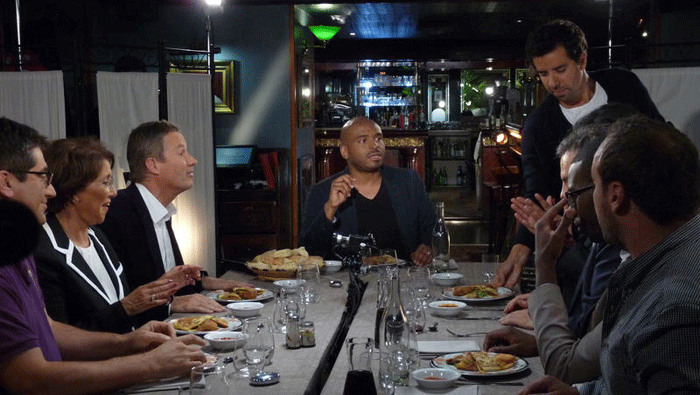

If there is a recipe for social cohesion, it should be no surprise that for the French, food is a key ingredient.
"Whatever the conflict, the outcome will always be the better for a shared bowl of couscous," says Sandrine Roustan, Head of Programming, France 4.
There is wry humour in her observation.
The French public service broadcaster was recognized in Berlin earlier this month (10/9) by the Eurovision Creative Forum for its seven part series, 'Viens dîner dans ma cite,' which roughly translates to 'Share my table, down on the estate.'
The entertainment format invites opinion makers across the political spectrum to sit and eat with residents from suburbs of France frequently headlined for social unrest.
"These bona fide French citizens," says Roustan, "are still viewed by many as immigrants for no other reason than their parents have originated from parts of Africa and Asia. They are a generation in search of an identity, who have been unfairly marginalized by the French establishment."
The series was conceived and produced by esteemed French filmmaker Djamel Bensalah, who was born in Saint Denis, one of the Paris suburbs featured in the series. Bensalah's parents were from Algeria, which won independence from France in 1962 after 132 years of oppressive colonial rule. Today, many French-Algerians remain disaffected, living in impoverished circumstances cross France, with few opportunities for social advancement.
"Without Bensalah," says Roustan, "the series could not have been made. Themes such as racism and life in the suburbs frequent his work. It helped enormously that he is a respected film-maker. This month, Series 2 airs in France. The popularity of the first series has politicians queuing for invitations."
It wasn't always the case. Issues of security almost led to the cancellation of a dinner planned in France's second largest city Marseilles.
"We had invited Manuel Valls, the minister of the interior," said Roustan. "At the last moment, his political advisors expressed concern for his safety and pulled out. We had already been given assurances from community leaders that the dinner would go ahead without disruption. As a compromise, we invited the minister to choose a local venue where he'd feel safe. In the end, his entourage outnumbered the dinner guests."
Senior public service media executives awarded the series third place among the 7 Best Formats presented during the annual Eurovision TV Meetings.
EBU Head of TV Bettina Brinkmann says the programme fulfils important expectations audiences have of PSM.
"Public service media is about universality, about taking an inclusive approach," says Brinkman. "This programme excels in providing a minority group with a voice, an opportunity to present themselves and their neighbourhoods in a different light. It's a winning format which can be easily adapted by other EBU Members whose communities face similar challenges."
ABOUT Eurovision
Eurovision, operated by the European Broadcasting Union (EBU), is the industry's premier distributor and producer of top quality live sport and news, as well as entertainment, culture and music content.
The Eurovision satellite and fibre network is the largest and most reliable in the world directly plugged in to public service media everywhere.
Eurovision's staff of experienced media professionals acquire and manage media rights on behalf of EBU Members, and provide network, transmission and events services to the broadcasting industry.
web: www.eurovision.com - twitter: @EBU_Eurovision @Eurovision_TV
Relevant links and documents
Related news

Press release
EBU strengthens kids’ content offering with new animation co-production, supported by nine public broadcasters
The European Broadcasting Union (EBU), France Télévisions and CARTOON are delighted to announce a new collaborative animation production project, developed...

Press release
Basel chosen as Host City for 69th Eurovision Song Contest in 2025
The third largest city in Switzerland, Basel, has been selected by Host Broadcaster SRG SSR and the EBU to host the 69th Eurovision Song Contest in May...

Press release
EBU reveals new animation co-production for 2025, supported by 11 Member broadcasters
In a major move for children's entertainment, the EBU has announced a dynamic new animation co-production that will aim to inspire and entertain young...

How France TV is accelerating technology innovation at the Paris Olympic Games
For France Télévisions, the Paris Olympic Games provide the impetus for several advances in production and distribution technology. Skander Ben Attia (Head...

From local TV intern to Olympic broadcast technology architect – and award winner!
Yannick Olivier is a broadcast engineer and tech lead for ST 2110 at France Télévisions. Below, we ask him about being named EBU Young Technology Talent...

Press release
Rose d’Or Awards go to Baby Reindeer and a dozen international shows – with special honours for Rosario Fiorello, Gary Oldman and Ambika Mod
Productions from Belgium, Norway, Italy, Japan, Australia and the UK picked up trophies at the 63rd Rose d’Or Awards on Monday, including the series Baby...

Press release
EBU launches Spotlight fact-checking network to combat misinformation and support trusted news
Eurovision News Spotlight features collaboration, resource-sharing and training Network starts with 18 public broadcasters, incorporating French public...
Press release
ARTE joins the European Broadcasting Union, strengthening cultural connections across Europe
ARTE, the Franco-German public service broadcaster dedicated to culture, has become the newest Member of the European Broadcasting Union (EBU), having...