Promoting understanding between cultures by exchanging audiovisual works
14 May 2014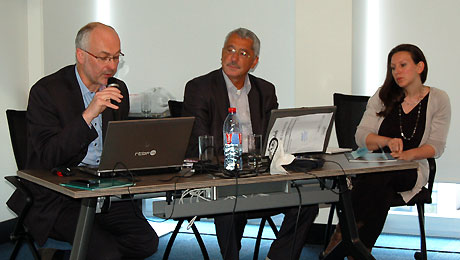
Daniel Brouyère (URTI), Saidi Fethi (Algerian TV) and Micol Pancaldi (COPEAM)
The intercultural role of international audiovisual exchange programmes amongst broadcasters was highlighted during the Media Lunchtime Talk held today in the EBU Brussels office.
Presenting the leading role in TV and radio programme exchange played by International Radio and Television Union (URTI) since its establishment in 1949, Deputy Director General Daniel Brouyère underlined how documentaries “convey human values” and “facilitate mutual understanding amongst peoples.”
Exchange of documentaries between broadcasters at international level is a focal point of URTI’s mission. This Paris-based organisation has in this regard set up an online catalogue of over 6000 programmes, all available in English, French and Arabic.
Exchanging audiovisual works is nevertheless confronted by another challenge: different languages. In this light, Algerian television’s Saidi Fethi presented the Terramad Plus project, an impressive translation and sub-titling enterprise. Over the course of 18 months, a dedicated team created and synchronised sub-titles in English, French and Arabic for over 100 hours of audiovisual works.
The Terramad Plus project also has an online platform of its own which allows the viewer to “go beyond the constraints of the TV programme schedule.” As a close supporter of the Terramed Plus project, Micol Pancaldi of the Permanent Conference of the Mediterranean Audiovisual Operators (COPEAM) was on hand to present the Terramed Plus website that makes available documentaries, series and short and feature films from Algeria, Morocco, France, Spain and Italy with sub-titles in three different languages.
For the European Commission, which offered financial support for the Terramad Plus project via the Med Media funding programme, it is essential to perpetuate such audiovisual exchange projects through a long term partnership rationale.
In this light, Hristo Hristov of the Directorate General for Development and Cooperation underlined the importance of a conducive regulatory framework for media independence in the EU’s Mediterranean neighbourhood, in particular for public service media organisations. The European Commission wishes to deepen this dimension with the pursuit of the Med Media programme.
Relevant links and documents
Related news

Measuring the presence of the UN Sustainable Development Goals in RTVE programming
Carmen Pérez Cernuda, Deputy Director of Innovation and Technological Strategy, describes the Spanish broadcaster’s innovative analysis to quantify the...
Press release
ARTE joins the European Broadcasting Union, strengthening cultural connections across Europe
ARTE, the Franco-German public service broadcaster dedicated to culture, has become the newest Member of the European Broadcasting Union (EBU), having...

Policy Position
Invest in free media: Europe’s democratic foundation
As the European Union negotiates the Multiannual Financial Framework (MFF), its long-term budget for 2028-2034, the EBU and over 100 media organisations...

Press release
EBU anniversary project premieres 10 new classical music works to millions
As part of its 75th anniversary celebrations, the European Broadcasting Union (EBU) has launched the EBU Music Commissioning Scheme, a new initiative uniting...
Stories
EBU expands animation collaboration for 2024
The EBU, in partnership with France Télévisions and CARTOON, is renewing its commitment to fostering innovative animation projects for young audiences...
Press release
A new framework of actions promises more diversity and inclusion for a resilient audiovisual sector
Today, European Social Partners published their Framework of Actions (FoA) on diversity and inclusion. One of the formal outcomes of European social dialogue,...

Press release
EBU reveals new animation co-production for 2025, supported by 11 Member broadcasters
In a major move for children's entertainment, the EBU has announced a dynamic new animation co-production that will aim to inspire and entertain young...

Stories
The VOICES festival arrives in Zagreb: Free talks, films and workshops
The second edition of VOICES, the European Festival of Journalism and Media Literacy, officially kicked off yesterday at the Museum of Contemporary Art...