'One-to-many' broadcasting platforms vital for success of ultra-high definition viewing
20 November 2014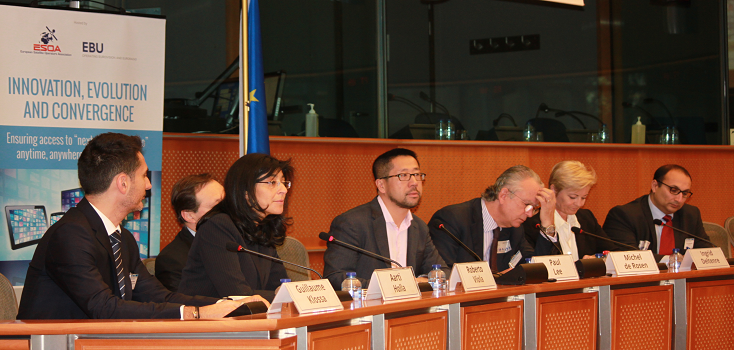
A conference in the European Parliament has put in perspective the key policy needs to foster the success of the ultra-high definition viewing technologies.
The conference, organised as part of the 6th European Innovation Summit, was co-hosted by the EBU with the European Satellite Operators Association (ESOA).
The ensuing debate will fuel upcoming policy initiatives on audiovisual media convergence, radio spectrum and net neutrality, which are all on the EU’s “to-do” list over the next year.
Panel speakers underlined that audiovisual content is a driver of demand for new services and technologies, and the need to foster a holistic approach to the use of various content delivery networks. Enthusiasm for 4k technology – which offers more than 4 times the definition available with HDTV - was very clear, but all participants were quick to point out the potential strain higher viewing resolutions would have on delivery networks. Digital Terrestrial Television (DTT) and satellite networks have sufficient capacity to broadcast 4K programmes on an efficient one-to-many basis.
EBU Director General Ingrid Deltenre said: “We have to embrace technology and use a mix of the different networks to their best strengths to meet the expectations of customers.”
She added: “When it comes to 'one-to-many' and showing live events, there is no alternative to broadcast. Spectrum for digital platforms remains a crucial issue. For us broadcasters, it is very important to have a competitive market with different platforms.”
DG Connect Deputy Director General Roberto Viola highlighted Europe’s strengths in the audiovisual sector and heralded the EBU’s capacity to develop standards for a converging audiovisual environment. He announced the potential launch of a Commission action plan for UHDTV involving all relevant industry players and confirmed an upcoming “regulatory fitness exercise” next year on the Audiovisual Media Services Directive, stating that: “The whole debate on media is burning in Europe, and all the debate is about convergence. This will be the regulatory challenge.”
ESOA Chairman Michel de Rosen and TeliaSonera Vice-President Freenasp Mobedjina also took part in the panel discussion. Both were quick to point at the role of video as a driver for demand for satellite services and Internet connectivity, and Michel de Rosen specifically noted that 4K services can be a 'game-changer' for which Europe should develop 'hybrid solutions' to remain at the forefront of developments.
One day before World Television Day, Sabine Verheyen MEP rounded-up the discussions the discussion by reminding all of the importance of TV: “The majority of viewers continue receiving video through traditional TV”, she said. “But there are new behaviours around media consumption; what will matter is ensuring for viewers to cultural and audiovisual content.”
Event co-organisers ESOA issued a press release following the debate underling the importance of digital broadcasting and satellite communications amidst media convergence and better ever-improving viewing experience.
Relevant links and documents
Relevant Links
Documents
Related news

Press release
DNA: European Commission rightly safeguards media in its push to modernise telecom markets, but radio needs more
The EBU welcomes the Digital Networks Act (DNA) proposal, published today by the European Commission. The DNA aims to modernise telecommunications markets and...

Policy Position
EBU calls on EU lawmakers preserve radio in cars and net neutrality in the Digital Networks Act
On 18 May, the EBU published its policy position on the Digital Networks Act (DNA). The DNA will shape how people across Europe access digital services...
Press release
Upcoming evaluation of the AVMSD: Council addresses key issues for public service media
On 13 May, EU Culture Ministers have agreed their position on the forthcoming evaluation of the Audiovisual Media Services Directive (AVMSD). The AVMSD...

Stories
Top 10 Legal and Policy news of 2025
Keeping Members up to date with important news related to public service media is an important part of the EBU’s Legal & Policy work. In 2025, the Audiovisual...

EBU Technical Assembly calls for trusted Cloud and AI infrastructure in Europe
The European Broadcasting Union's (EBU) Technical Assembly has agreed on a position calling for the development of sovereign, interoperable, resilient,...

EBU TC Statement calling for Trusted Cloud and AI Infrastructure in Europe published
The European Broadcasting Union (EBU) Technical Committee has now officially published its position statement calling for sovereign, interoperable, resilient...

Building a collaborative cloud future for European public service media
"Diversify rather than divide" – the newly formed EBU Cloud Strategy Group held its inaugural kickoff meeting in mid-August in Geneva. The group aims to...

Preparing for the next generation of free television services in Ireland
DVB-I, the open standard for internet-centric television service discovery, could be key to the future development of the digital terrestrial television...