Services
SERVICES

The EBU offers its Members a wide range of services covering our three strategic pillars: Strategy and Transformation, Regulation and Advocacy, and Content and Distribution. Browse our services pages to learn more.

DEPARTMENTAL SERVICES
Eurovision News Legal & Policy Media MUS  Music Exchange Podcast Exchange TV Programme Collaboration SportTechnology & Innovation
STRATEGIC SERVICES EBU Academy  Media Intelligence PSM Compass Transformation Services
Topics
Topics

Topic pages bring together on a single page all EBU events, groups, resources and contacts linked to a specific topic. If you like them, make sure to bookmark them.

All Topics
Artificial Intelligence Leadership, Strategy and Values Radio and Audio Audience and Market Trends Media freedom and pluralism Spectrum Copyright and Intellectual Property Music Sport Diversity, Equity and Inclusion News, Journalism and Trust Sustainability Eurovision Song Contest Online Platforms Transformation EU Affairs Production Technology TV Content Funding and Advertising PSM Crisis Preparedness Young Audiences
Events
Groups
Resources
Resources

The knowledge produced by the EBU helps media professionals make crucial decisions and keep up-to-date with industry trends. Explore our various formats: video talks, guides, research, case studies and technical publications.

Go to platform Research Guides Case Studies Video Talks Tech Publications
About
About

Find everything you ever wanted to know about the EBU. Not only do our About pages help you understand our history and our purpose, but also offer easy access to our job openings, contact points, and much more.

About the EBU
Careers Management Contact Member Relations DEI Policy News Funds Our Members Governance Press Centre
Languages

English and French are available to all users. EBU Members can log in to access our website in 20 additional languages as well. This innovation is powered by the EBU’s internal AI engine, EuroVox.

(Note: Translations are generated with the help of AI without human review. These translations are made available to you for convenience and may contain inaccuracies or errors. Please check important information in the original English version or contact us. The EBU cannot be held liable for any inaccuracies or errors contained in these translations.)

Languages EnglishFrançais
Member login required Powered by Eurovox
عربيбългарскиČeštinaDeutschEspañolעבריתHrvatskiItalianoελληνικάMagyarNederlandsPolskiPortuguęsRomânăPусскийShqipSuomiSvenskaTürkçeYкраїнська

Translation in progress

Not signed in

Login

Dear user,

Last month, the EBU switched to a new authentication method, Microsoft Entra, and decommissioned the former one (sso.ebu.ch).

What this means for most EBU Members ?

Employees of most EBU Members should now use a federated login to authenticate. This means your organization acts as the identity provider. You no longer need 2 separate accounts or 2 separate passwords. 

Your work credentials give you access to EBU content.

What to do on the next screen ?

If you already have an EBU account, enter your professional email address and select Next. You will see the EBU logo change to your organization’s logo. Enter your usual work password and, if prompted, accept the sharing of information with the EBU.

What if we are using shared mailboxes ?

The new authentication mechanism does not work with shared mailboxes. If you usually access EBU websites using a shared account, you must create a new individual user account. Scroll down to view the instructions.

If federated login does not work ?

For some EBU Members, as well as the general public, federated login will not work. Login remains possible with your existing account. 3 different cases may occur:

  • Case 1: If your email address is linked to a Microsoft account, you will be redirected to https://login.live.com. Log in using your usual Microsoft credentials.
  • Case 2: If your email address is linked to a Google account, you will be redirected to https://accounts.google.com. Log in using your usual Google credentials.
  • Case 3: If your email address is not linked to either service, you will receive a temporary password by email each time you log in.

What to do if none of the above seems to work ?

Please read the instructions below carefully, as the choice you make during your first login cannot be changed later.

To create a new account, select No account? Create one.

You will have 3 options:

  1. Microsoft: Recommended for users working for EBU Member organizations.
  2. Google: Create an account using your existing Google account.
  3. Other valid email address: A temporary password will be sent to your inbox each time you log in.

If you still cannot log in after following these instructions, contact [email protected].


Continue to Login

Legal & Policy

The EBU’s Legal and Policy team works to secure the right regulatory framework for public service media at a national, EU and international level. We also provide expert legal advice to Members on day-to-day matters such as governance and media law, intellectual property, commercial contracts, and more.

For the latest policy news and views, follow us on LinkedIn or Bluesky.

Who gets prominence!?

Join us on 9 June in Brussels for the policy event Who gets prominence!? Ensuring audiences can’t miss the media that matters in the AVMSD.

Find out more
Latest Policy priorities Member groups Featured publications Keep up to date

Latest

Policy Position18 May 2026
EBU calls on EU lawmakers preserve radio in cars and net neutrality in the Digital Networks Act
Policy Position15 May 2026
EU Member States take next step in unlocking major funding package for media, culture and democracy
Statement07 May 2026
EBU writes to Czech Prime Minister over public media reform plans
Policy Position06 May 2026
European media associations call on the EU to reconsider introducing data-usage consent restrictions in the Digital Omnibus
Press release30 Apr 2026
EBU says “Policymakers must be decisive in promoting Europe’s media sector in the revision of the AVMSD”
Policy Position24 Apr 2026
EBU calls for better protection of whistleblowers who disclose information directly to the media
Press release14 Apr 2026
As Lithuanian parliament threatens its public broadcaster, new report proves that public media boosts private news in Lithuania
Policy Position23 Mar 2026
European broadcasters urge the European Commission to apply gatekeeper rules to connected TVs and virtual assistants
Blog17 Mar 2026
Sustainability Rulebook: What is the impact of the EU's Sustainability Omnibus?
Blog12 Mar 2026
The 4 burning policy questions for AI and the media sector
Policy Position11 Mar 2026
EBU says to UK government: “Changes in the BBC Charter could shape the future of public service media in the digital age”
Blog10 Mar 2026
Lost and found: Helping media outlets navigate Big Tech’s self-declaration maze
More news

Policy priorities

Media Freedom and Pluralism

Freedom of expression, protection of journalists, political advertising, SLAPP

Find out more

Media Freedom and Pluralism

Protecting the independence and diversity of media in Europe

A thriving public service media (PSM) upholds the freedom of expression and the right to information, while empowering journalists to work to the highest standards. It enables people to seek and receive information, and promotes the values of democracy, diversity, and social cohesion.

Securing Media Independence

One of the main challenges of public service media is to secure the right level of independence from those holding economic and political power, while ensuring appropriate funding. The organization of PSM and the definition of the public service remit is a question for individual Member States. EU initiatives on media independence and enhancing transparency of media ownership should not impinge on Member States’ competence to act but should complement relevant national rules.

An Independent And Sustainable Governance Framework

PSM’s independence from political and commercial interests hinges on sustainable and predictable funding combined with an appropriate governance framework. Although there is no “one size fits all” approach to how PSM is set up at the national level, the governance framework should follow the principles of independence, accountability, and sustainability.

Protection Of Journalism

Journalists and media professionals are increasingly exposed to hostility, harassment, and violence offline and online. The editorial independence of media organizations must be protected. EU legal initiatives on journalist protection must be consistent with the standards of the Council of Europe. See our work on journalist safety.


Other sources
Members only

Members exclusive content

Login to read more

Our Positions

Want to know where we stand? Check out our latest updates on Media Freedom and Pluralism!

View our positions

Contacts

Jenny Weinand

Head of Media Law

+41 22 717 2420

[email protected]

Media Content Regulation

Audiovisual Media Services Directive (AVMSD), prominence, content integrity, and greater fairness

Find out more

Media Content Regulation

Key principles for a safe, pluralistic and open media landscape

The Audiovisual Media Services Directive (AVMSD) is the legal framework that establishes principles for a thriving media landscape in Europe.  

Ensure Prominence Of General Interest Content Everywhere

The AVMSD allows national regulators to take measures ensuring the prominence of general interest content and services. TV manufacturers, aggregators of audiovisual media services as well as online platforms have a clear incentive to draw audiences to content that furthers their commercial interests. This risks marginalizing content and services of general interest. National policymakers must establish modern rules to make public service media (PSM) content and services prominent and ensuring their accessibility for everyone.   

Protection Of Content Integrity

The AVMSD states that programmes and audiovisual media services should not be altered, interrupted, or overlaid by third-parties for commercial purposes, without the media service provider’s explicit consent. We encourage national legislators to adopt comprehensive and effective rules to protect content integrity.

Increase Responsibility Of Online Providers And Strengthen Fairness

The AVMSD introduces new responsibilities for video-sharing platform service providers, for instance in terms of basic advertising rules. We believe that these new rules are an important first step to increase the responsibility of these providers and to strengthen fairness in the European audiovisual media sector if effectively and consistently implemented. We advocate, however, for further regulation of online platforms as they impact the way audiovisual content and services can be found online.


Other sources
Members only

Members exclusive content

Login to read more

Our Positions

Want to know where we stand? Check out our latest updates on Media Content Regulation!

View our positions

Contacts

Jenny Weinand

Head of Media Law

+41 22 717 2420

[email protected]

Thomas Bergmann

Senior EU Policy Adviser

+32 2 286 91 03

[email protected]

Online Platforms

Brand attribution, access to data, self-preferencing, algorithmic transparency, competition, platform-to-business Regulation

Find out more

Online Platforms

Uphold trusted and high-quality services online and enable citizens to access and find public service media online.

To reach all segments of society, public service media (PSM) increasingly rely on online platforms. This comes with specific challenges.

Content Moderation

Based on their own content policies, online platforms have taken down or restricted the visibility of PSM content. Thus, they deprive users of content that is already regulated and trusted. The EU should establish robust procedural guarantees for PSM that ensure effective remedies against unjustified or flawed content moderation decisions.

Brand Attribution

Online platforms must ensure that the identity of media organizations is clearly visible alongside their content, so that users can make informed decisions about the content they consume.

Algorithmic Transparency

PSM need transparency about the algorithmic decision-making processes and content recommendations of online platforms to understand how their content and services are ranked.

Prominence

To allow citizens easy access to PSM content and services online, EU policymakers should ensure that platforms present content and services of general interest prominently. Learn more about our work on prominence. 

Access To Data

Data is a crucial resource in the digital age. PSM needs guaranteed access to meaningful data about their own content and services that appear on platforms.

Self-Preferencing

The EU should fight against all forms of self-preferencing – where platforms treat their own services more favourably than those of their competitors.
With the Digital Services Act, the Digital Markets Act and the Platform to Business Regulation, EU policymakers have taken measures to react to the increasing influence of online platforms. This effort must be continued so that PSM can operate freely and remain relevant to their audiences online.

Other sources
Members only

Members exclusive content

Login to read more

Our Positions

Want to know where we stand? Check out our latest updates on Online Platforms!

View our positions

Contacts

Alexandre Fall

Head of Competition Law and State Aid Law

+41 22 717 2509

[email protected]

Thomas Bergmann

Senior EU Policy Adviser

+32 2 286 91 03

[email protected]

François Lavoir

Senior EU Policy Adviser

[email protected]

Jenny Weinand

Head of Media Law

+41 22 717 2420

[email protected]

Data and Privacy

The General Data Protection Regulation (GDPR), ePrivacy Regulation (ePR), Artificial Intelligence (AI), Data Governance Act, Data Act

Find out more
Data and Privacy

Ensuring the right balance between offering innovative digital services and protecting privacy rights.

The collection and use of data have become essential to better understand audiences’ expectations and needs, and thus to improve the overall quality and diversity of media offerings. Embracing new data opportunities while protecting individuals’ personal data is one of the most important challenges media companies are facing today. 
As part of their public service remit, public service media (PSM) has a particular duty to ensure that data is collected, stored and handled in the most responsible way and in compliance with applicable EU and national laws. 

GDPR

PSM supports consistent and effective enforcement of the GDPR to ensure individuals’ privacy and legal certainty for organisations, especially when processing personal data outside the EEA to third countries which do not benefit from an EU adequacy decision. In addition to other key GDPR compliance issues such as data security, controllers and processors’ obligations, data subjects‘ rights, the EBU is also involved in protecting the delicate balance between the right to the protection of personal data and the right to freedom of expression and information, to avoid creating a chilling effect on journalistic activities.

ePrivacy

The ePrivacy Regulation proposal is meant to harmonise notably consent requirements and rules for the tracking of online activity through the use of cookies. The EBU supports the proposed cookies’ consent exceptions as well as a sound and workable audience measurement system.

Artificial Intelligence (AI)

Public Service Media develop and use AI tools to support journalism, foster diversity, and optimise workflows. By their nature and mission, PSM are committed to applying the highest ethical and technological standards to protect and inform citizens. 
 

Other sources
Members only

Members exclusive content

Login to read more

Our Positions

Want to know where we stand? Check out our latest updates on Data and Privacy!

View our positions

Contacts

François Lavoir

Senior EU Policy Adviser

[email protected]

Ausra Semeniene

Head of Technology Law

+41 22 717 25 23

[email protected]

Sophia Wistehube

Senior Legal Counsel

[email protected]

5G and Open Internet

5G networks, wireless production, 5G distribution, vertical, 5G broadcasting, net neutrality, specialized services

Find out more

5G and Open Internet

Giving audiences transparent and non-discriminatory access to content, public service media are proponents of 5G broadcasting and the Open internet.


5G

The EBU and public service media (PSM) are pioneering the use of 5G for content production and distribution via technical trials. They have worked on its standardization and initiated the coordination of media and ICT stakeholders with 5G MAG, to foster a media vertical. 

The EBU calls for appropriate regulatory guidelines and the right technology choices. The broadcasting industry should be able to own and operate its own 5G networks for specific purposes, e.g. for wireless production infrastructure for live event coverage.

It is also key that large-scale content distribution over 5G is technically and economically sustainable, to keep PSM affordable and accessible. 5G Broadcasting has thus been put forward to ensure PSM content is present on all mobile devices also via broadcasting, to enable free access. Learn more about 5G. 

Open Internet

Audiences should have unfettered, non-discriminatory, and transparent access to online content of public interest. Measures strengthening transparency need to be combined with a clear policy regarding internet traffic management that ensures that equivalent types of traffic are treated equally.

Regulators must prevent new forms of traffic discrimination where only content providers with sufficient resources can negotiate ‘preferential’ deals, distorting competition, hampering innovation, and reducing user choice.

Net neutrality must be the norm with specialized services as the exception to avoid that finite network capacity would be dominated by specialized services, impairing access to the Open Internet.

Other sources
Members only

Members exclusive content

Login to read more

Our Positions

Want to know where we stand? Check out our latest updates on 5G and Open Internet!

View our positions

Contacts

Vincent Sneed

Senior EU Policy Adviser

+32 2 286 91 43

[email protected]

Ausra Semeniene

Head of Technology Law

+41 22 717 25 23

[email protected]

Darko Ratkaj

Senior Project Manager

+41 22 717 2713

[email protected]

Competition and Funding

PSM Funding, Sustainable funding, competition policy, innovation, Amsterdam protocol

Find out more

Competition and Funding

Freedom to innovate in a rapidly changing digital landscape


The media landscape is changing rapidly, shifting away from traditional broadcasting and embracing the ‘age of platforms’. Competition and State-aid rules need to take into account the full impact of global media players on the European media landscape and allow public service media (PSM) to innovate and develop new services and content to fulfil their universality obligations and stay relevant.

PSM Funding Schemes

These funding schemes should allow PSM organizations to fulfill their public interest mission. Governments should provide adequate financial support to PSM so that they benefit all citizens and fulfill their role to promote democracy, social cohesion and cultural values.

Sufficient, Stable And Sustainable Funding

A lack of stable and sustainable funding impacts the quality of programming and news in particular, leaving our Members vulnerable to commercial and political influence, and reducing their capacity to invest in new offerings, technologies and talented people.

Give Public Service Media Freedom To Innovate And Stay Relevant

Competition law and State aid rules must allow PSM to innovate and work together to compete fairly with non-European competitors in the provision of new media and digital services.

Support The European Dual Broadcasting System

This model which has been recognized in many international texts and court judgments ensures that public and private media compete effectively to provide high-quality media content.

Other sources
Members only

Members exclusive content

Login to read more

Our Positions

Want to know where we stand? Check out our latest updates on Competition and Funding!

View our positions

Contacts

Alexandre Fall

Head of Competition Law and State Aid Law

+41 22 717 2509

[email protected]

François Lavoir

Senior EU Policy Adviser

[email protected]

Copyright and Neighbouring Rights

Intellectual property (IP), Contractual freedom and territoriality, International and EU regulatory framework

Find out more

Copyright and Neighbouring Rights

Fostering a copyright environment suitable for the audiovisual sector


Public service media (PSM) invests €18 billion a year in original European content. These programmes exist thanks to a variety of contributors entitled to remuneration for the use and licensing of their work.

High-Quality Content

Since PSM are both rightsholders and rights users, it is crucial that the EU copyright framework enables them to fulfil their national obligation: bring high-quality content and service to their citizens. The EBU provides legal advice and support to PSM in the implementation of EU law and acts as the contact point with the EU.

Contractual Flexibility

The EBU advocates for fostering an environment facilitating broad distribution and access to content, while protecting artistic creators. Maintaining contractual flexibility allows rightsholders and rights users to negotiate how, when, and where licensed content is offered, to best match consumer preferences. This flexibility depends on the possibility to exploit audiovisual works on a territorial and exclusive basis. Territoriality emphasises the funding of European works. Removing it would limit audience choice and favour the largest players.

WIPO

The current level of protection is insufficient to effectively combat today’s piracy of audiovisual content. PSM actively supports WIPO’s work on a Broadcasting Organizations Treaty and strongly encourages WIPO Member States to adopt a robust international instrument in the near future.

Other sources
Members only

Members exclusive content

Login to read more

Our Positions

Want to know where we stand? Check out our latest updates on Copyright and Neighbouring Rights!

View our positions

Contacts

Michele Evangelista

Senior Legal Counsel

+41 22 717 25 09

[email protected]

Vincent Sneed

Senior EU Policy Adviser

+32 2 286 91 43

[email protected]

Spectrum

Frequencies, Digital Terrestrial Television (DTT), Lower UHF band, 470-694 MHz, sub-700MHz band, UHF, WRC, RSPG, Digital Dividend, PMSE

Find out more

Spectrum

Choice and quality free-to-air content for all citizens

Spectrum is the range of frequencies used to transmit data wirelessly. It is divided into different bands. The Lower UHF band (470 to 694 MHz) is the band used by public service media (PSM) to deliver free-to-air Digital Terrestrial Television (DTT) to audiences. It has been shared with wireless production systems (PMSE) for decades.

A Scarce Resource

Spectrum has become a scarcer resource due to the increasing development of wireless technologies. In the recent past, broadcasters have invested to free up a significant portion of the spectrum they used, while also increasing choice and quality for TV viewers. This portion of spectrum has now been allocated to mobile-broadband services (Digital Dividends). Further diversion of spectrum resources away from broadcasting will undermine universal access to PSM, as, in practice, it would mean DTT has to stop. On the production side, PMSE would have to find another band for the wireless microphones, talk-back and in-ear systems used in political, religious, sport, cultural and local events every day. 

Protect Broadcasting 

The EBU relentlessly aims to ensure there is sufficient spectrum for DTT and to sustain a vibrant European audiovisual landscape. Following the ITU World Radiocommunication Conference (WRC-23), and especially regarding its Agenda Item 1.5, the EBU urges the EU to protect the current use of spectrum by DTT and PMSE in the Lower UHF band. This is key in the context of the Radio Spectrum Policy Group and European Commission work on the review of the UHF decision.

Other sources
Members only

Members exclusive content

Login to read more

Our Positions

Want to know where we stand? Check out our latest updates on Spectrum!

View our positions

Contacts

Vincent Sneed

Senior EU Policy Adviser

+32 2 286 91 43

[email protected]

Ausra Semeniene

Head of Technology Law

+41 22 717 25 23

[email protected]

Elena Puigrefagut Coarasa

Senior Project Manager

+41 22 717 2712

[email protected]

Member groups

Our Legal and Policy team defines our policy positions together with our Members, and in consultation with the  Legal and Policy Assembly, Legal and Policy Committee and our expert groups. Also find our archive of Legal and Policy Assembly documents, dating back to 1999.

  • Internal Audit Group
  • Data Protection Officers’ Group
  • Content Regulation Group
  • Audit Committee
  • Legal and Policy Committee
  • Sports/Legal Group
  • Public Service Media Funding and Governance Group
  • Media Freedom Act Ad hoc Group
  • Competition and Platform (Business) Regulation Group
  • Personnel Committee
  • Legal and Policy Distribution Group
  • Committee Chairs Group
  • Intellectual Property Group
View our upcoming meetings

Featured publications

...

Economic study on the impact of publicly funded PSM activities on commercial online news publishers

Online news from public service media (PSM) has been accused by the commercial press sector that it is...

Online news from public service media (PSM) has been accused by the commercial press sector that it is “crowding out” or negatively impacting the sustainability of their own news services.

This independent economic study, published by the EBU, addresses these claims at EU and national level, revealing that there is no evidence that PSM online news harms the revenues or reach of commercial news providers.

The study was carried out by Oliver & Ohlbaum Associates (O&O) and peer-reviewed by two leading independent experts, Robert G. Picard (Reuters Institute) and Vardges Levonyan (Zurich University).

If you missed our PSM Compass webinar on this research, you can watch it here.

 
Download publication
...

Finding your way: European digital laws and public service media

The European Union has an extensive framework for media and digital regulation, focusing on safeguarding...

The European Union has an extensive framework for media and digital regulation, focusing on safeguarding fundamental rights, encouraging media pluralism, and ensuring the functioning of the internal market. This framework continually adapts to address emerging technologies and challenges.

This guide is aimed at in-house lawyers of public service media organizations and individuals interested in understanding the main EU media and digital regulations and explains their relevance to public service media.

It provides:

  • An overview of the key instruments of EU media and digital regulation; and
  • Explanations of how each instrument is relevant to PSM.

UPDATE: The executive summary Signposts to Finding Your Way: EU Digital Regulation for Media has just been published.
Download publication Members Only
...

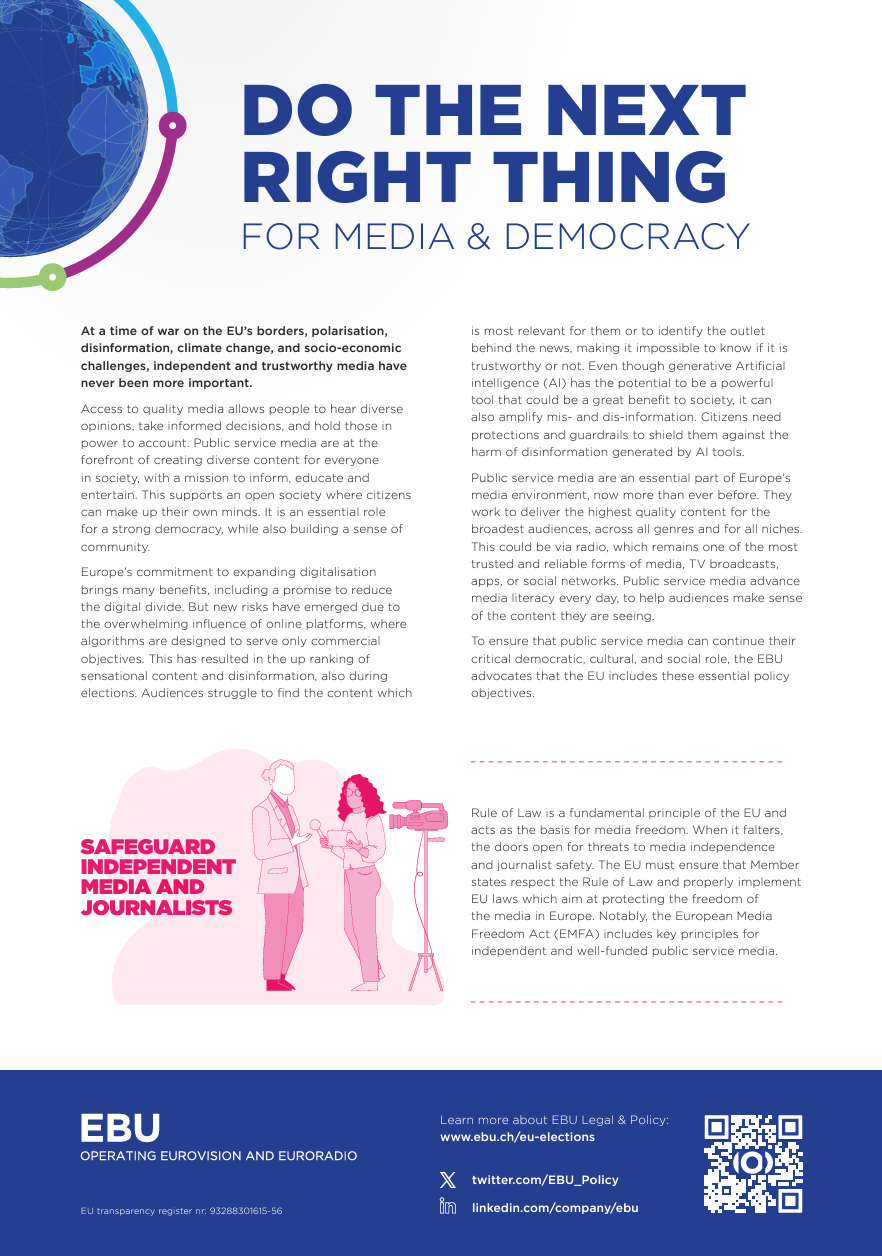
Do the next right thing for media and democracy

Media freedom and the very existence of public service media is threatened in Europe. This is why the...

Media freedom and the very existence of public service media is threatened in Europe. This is why the EBU takes this opportunity to highlight how EU politicians can help to turn the tide. In this publication, you can find the EBU’s priorities for the EU elections and new EU mandate. They are:

  • Safeguard independent media and journalists
  • Ensure that people cannot miss media that matters
  • Walk the talk with holding big tech accountable
  • Build a toolbox for AI and the media

Now is the time for policymakers to take a stand in support of the diverse and pluralistic media sector in Europe. The EU needs policies that support people’s ability to stay informed with reliable news and enjoy quality media. Independent public service media are ready and willing to be a key partner for the solution.

Download publication
...

Public service media bringing their best for Europe

In this publication, you can find the contribution that public service media are making to Europe. From...

In this publication, you can find the contribution that public service media are making to Europe. From balanced journalism to economic investment to technological innovation, public service media support our society. We have assembled facts and figures that prove the contribution that public service media are living up to their mandate to inform, educate and entertain every citizen.

Download publication
...

Digital Services Act Handbook (Public version)

UPDATED: This public version of our Digital Services Act (DSA) Handbook will help explain the new rules...

UPDATED: This public version of our Digital Services Act (DSA) Handbook will help explain the new rules that the DSA has put in place and how public service media can work with third-party online platforms in the broadest sense, whether on the business, technical or legal side, and should provide answers to the most pressing questions they may have concerning the DSA.

Specifically, this publication offers a breakdown of all the DSA provisions that may affect public service media activities, and considers what could be done to further rebalance the relationship with third-party online platforms.
Members' version available here

Download publication
...

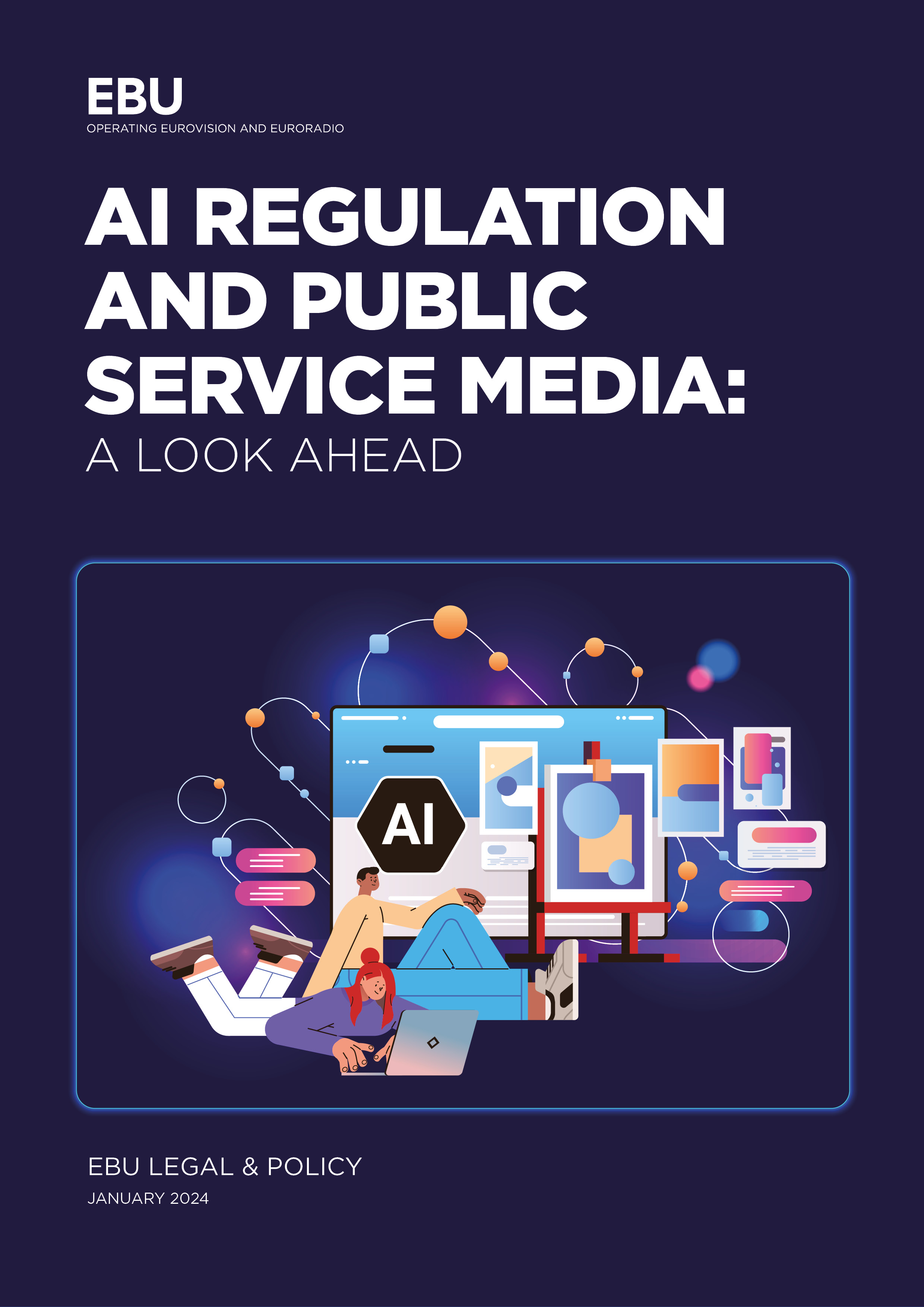
AI regulation and public service media: a look ahead

In Europe, we are currently witnessing a scramble for artificial intelligence (AI) regulation, both nationally...

In Europe, we are currently witnessing a scramble for artificial intelligence (AI) regulation, both nationally and internationally. The European Union (EU) is finalising a proposal to establish common rules and obligations for providers and deployers of AI-based systems in the EU internal market. In parallel, the Council of Europe (CoE), a different inter-governmental organisation made up of 46 member states, including the 27 EU member states, is negotiating an international treaty – the so-called “Framework Convention” – on the development, design and application of AI systems based on the Council of Europe’s standards on human rights, democracy and the rule of law. The Framework Convention is expected to become the leading global normative instrument for AI, as states such as the United States, Canada, Israel and Japan have committed to ratifying it.

At present, the main challenge of AI regulation is to foster innovation and encourage the use of AI while protecting fundamental rights. This is why the EU and the Council of Europe are proposing a "risk-based" approach,...
Continue reading
...

Missing identities: who is responsible for the media content we’re looking at?

Online access to editorial content has evolved, with audiences now relying on third-party platforms and...

Online access to editorial content has evolved, with audiences now relying on third-party platforms and devices. However, the presentation of media content is largely in the hands of intermediaries, who often neglect to attribute content to its source, sometimes intentionally obscuring media identities.

This lack of attribution makes it challenging for audiences to identify content origins, impacting their ability to discern between credible and sensationalized sources. This distortion of perception can influence opinions and hinder active societal participation, ultimately affecting media freedom and pluralism.

Download our publication to find out more.
Download publication Members Only
...

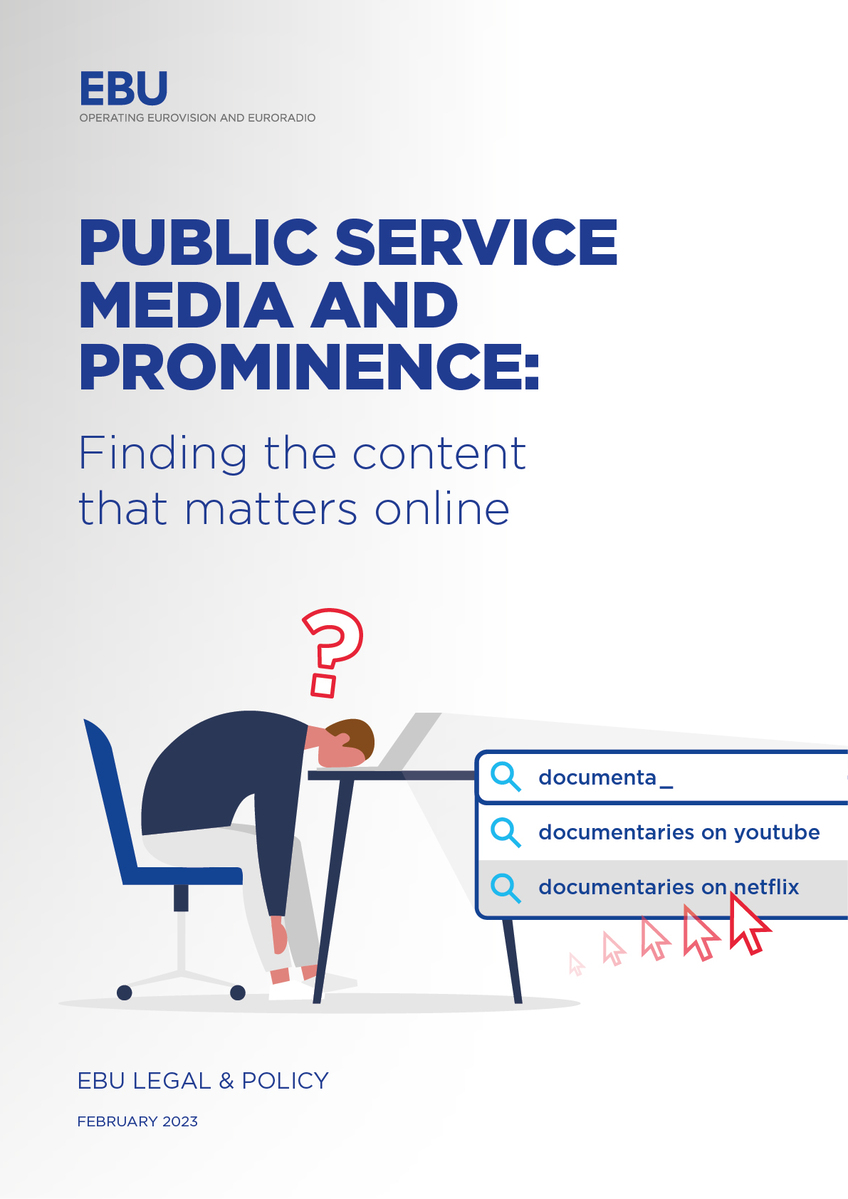
Public service media and Prominence: Finding the content that matters online

In today's online world, big tech platforms unilaterally determine who sees what and when –...

In today's online world, big tech platforms unilaterally determine who sees what and when – based on their own recommender algorithims and community standards. Device manufacturers also act as powerful gatekeepers between media providers and their audiences. Whether on Smart TVs or remote controls, commercial objectives determine which media services and content is displayed or easily found.

Public service media are an important source of varied quality content, reliable information, and diverse opinions. But they, like many other European broadcasters, lack the bargaining power to ensure that their services and content are easy to find and prominently placed when offered on online platforms or connected devices.

Find out more about all aspects of prominence by downloading our publication.
Download publication
...

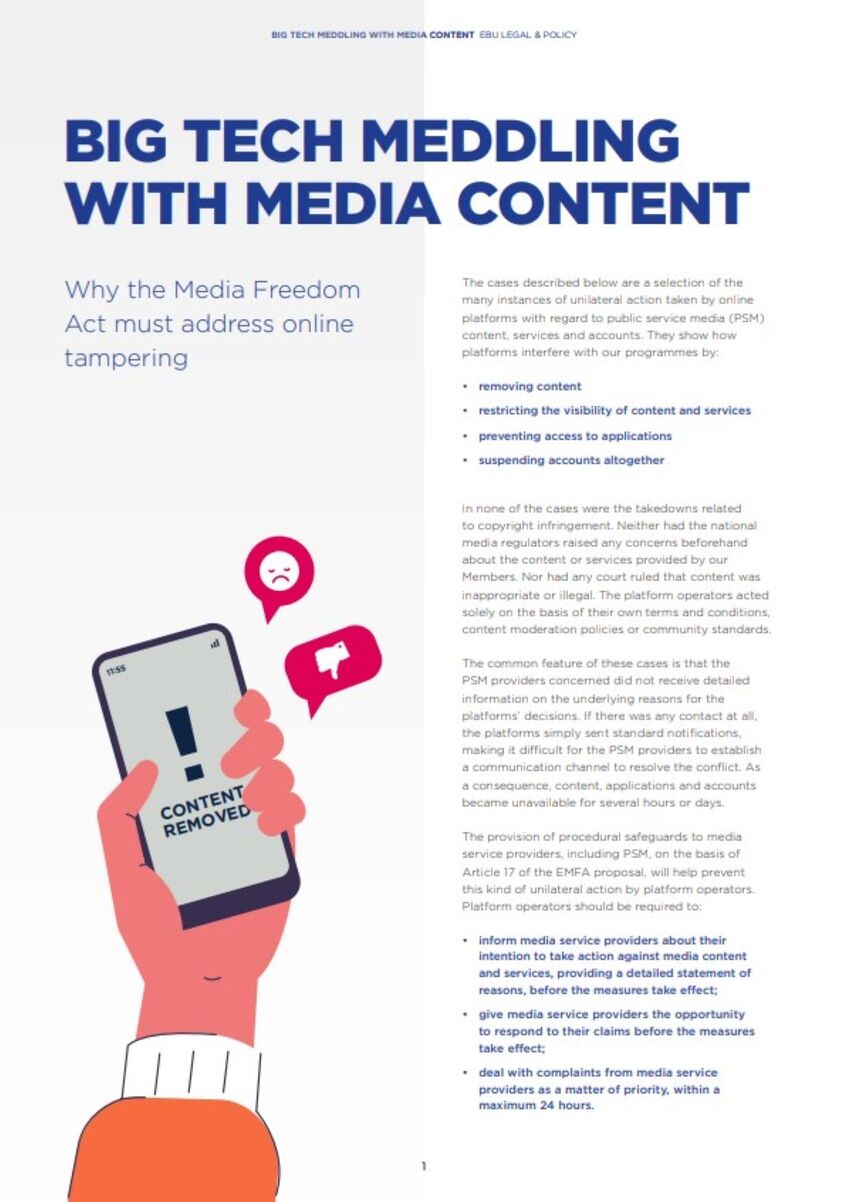
Big tech meddling with media content

Nowadays, access to audiovisual and audio media content is increasingly mediated by digital devices and...

Nowadays, access to audiovisual and audio media content is increasingly mediated by digital devices and user interfaces.

In the current competitive media landscape, apps, and services risk becoming irrelevant to audiences if not easily accessible. This poses a struggle for prominence, posing a threat to media service providers and citizens' access to diverse media, trustworthy information, and local content.

Download our publication to find out more about specific examples influencing PSM prominence and their findability by audiences. 


Read more about Big Tech infringements and what the EBU is doing about it here.
Download publication Members Only
...

Who gets prominence?

Nowadays, access to audiovisual and audio media content is increasingly mediated by digital devices and...

Nowadays, access to audiovisual and audio media content is increasingly mediated by digital devices and user interfaces.

In the current competitive media landscape, apps, and services risk becoming irrelevant to audiences if not easily accessible. This poses a struggle for prominence, posing a threat to media service providers and citizens' access to diverse media, trustworthy information, and local content.

Download our publication to find out more about specific examples influencing PSM prominence and their findability by audiences.
Download publication Members Only
...

European Media Freedom Act protect media to preserve democracy

Media freedom and pluralism are core European values, and they need strong protection. Threats like government...

Media freedom and pluralism are core European values, and they need strong protection. Threats like government interference, attacks on journalist integrity, financial pressures, and online gatekeepers obstructing content access endanger these values.


We welcome the European Media Freedom Act (EMFA) for acknowledging the importance of media in democracy and supporting independent public service media. To ensure EMFA addresses media independence and online access, we call on European decision-makers to clarify public service media principles and enhance provisions for services of general interest and tech companies' influence.


Download our publication to learn more about how to strengthen EMFA's proposal.
Download publication Members Only
...

Digital Markets Act Handbook (Members only)

The Digital Markets Act Handbook is intended for EBU Members to clarify to public service media the “dos...

The Digital Markets Act Handbook is intended for EBU Members to clarify to public service media the “dos and don’ts” for digital gatekeepers included in this legislation.

The Handbook focuses on the most relevant provisions and implementation hurdles for PSM that were identified by the EBU during the legislative process.

Non-Members are invited to contact the EBU Legal Secretariat for information on how to obtain a copy.

Download publication Members Only
...

PSM Remit Principles for the Digital Age

This Legal Focus publication deals with the critical question of public service media's role and...

This Legal Focus publication deals with the critical question of public service media's role and the scope of its activities in the global digital media markets, identifying the following non-binding guidance Principles:

  • Broad
  • Impartial and ambitious
  • Future-Proof
  • Platform neutral

Find more publications from the Legal & Policy department here.

Download publication
...

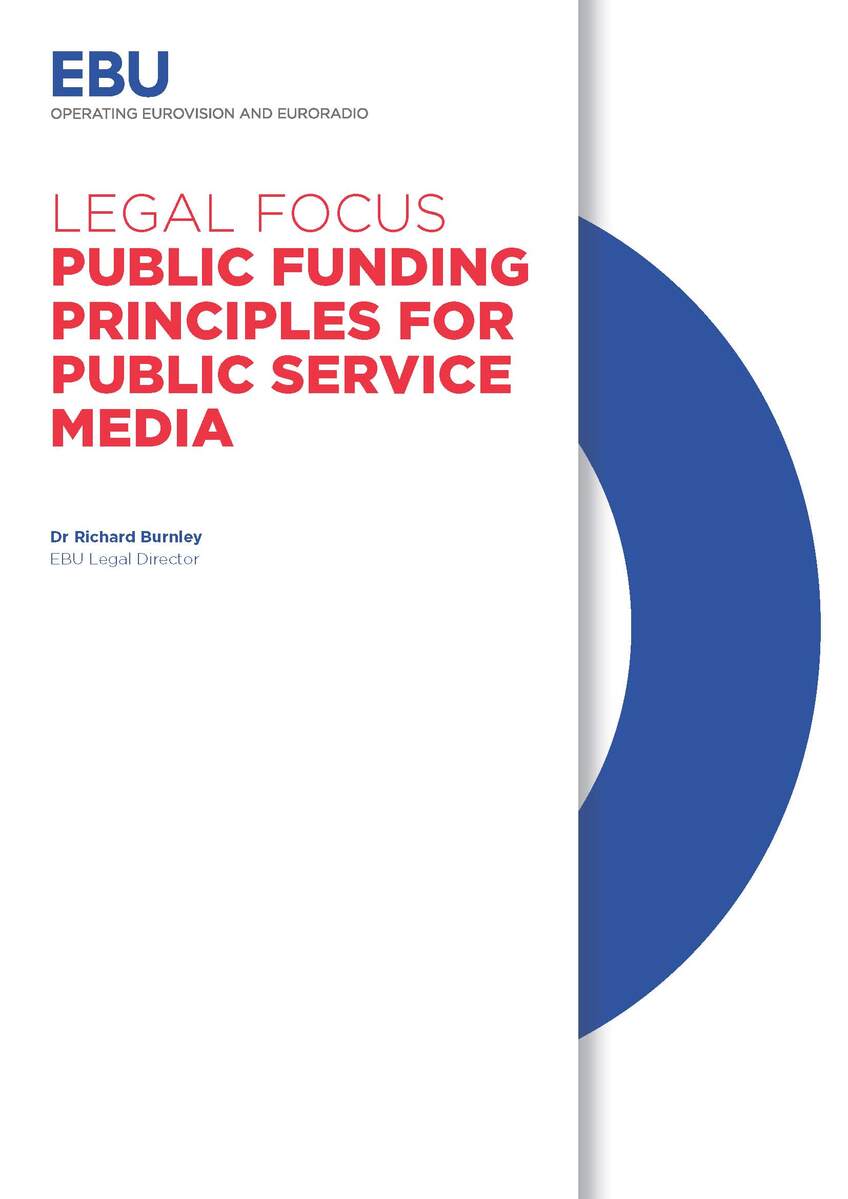
Public Funding Principles for PSM

The EBU has published Public Funding Principles for Public Service Media (PSM). Coming at a critical...

The EBU has published Public Funding Principles for Public Service Media (PSM). Coming at a critical time when PSM funding is under pressure in many different countries, these principles serve as a non-binding source of guidance and reference for PSM in the assessment and implementation of new and existing funding models. There are many different approaches to PSM funding used in Europe, taking into account the different legal, constitutional, economic and cultural structures of each country. However, it is possible to identify certain broader principles that should be relevant in any funding debate.

The EBU's Legal Focus on Public Funding Principles for PSM builds on the EBU Core Values of Public Service Media, declared by the General Assembly in 2012, in Strasbourg.

Download publication
...

Copyright Handbook

With its new Copyright Handbook, the EBU provides its Members with a reference tool addressing the...

With its new Copyright Handbook, the EBU provides its Members with a reference tool addressing the main copyright issues faced by broadcasters. This Handbook is complementary to the EBU Copyright Guide, providing an overview of all relevant topics and illustrative case law as well as legal references to enhance the understanding of copyright matters in broadcasting.

Non-Members are invited to contact the EBU Legal Secretariat for information on how to obtain a copy.
Download publication Members Only
...

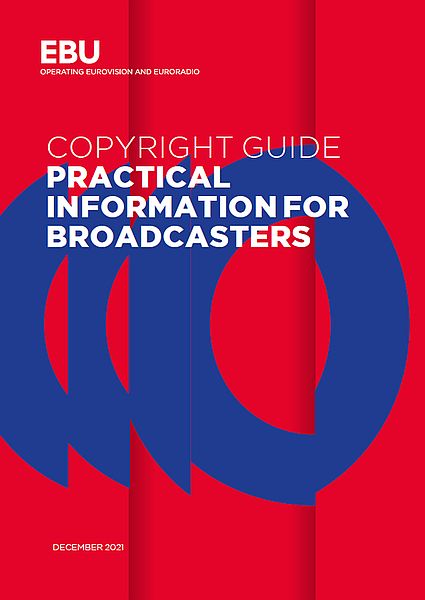
EBU Copyright Guide

The EBU Legal Department has published a practical toolkit for editors and programme makers working...

The EBU Legal Department has published a practical toolkit for editors and programme makers working for public service broadcasters, with the aim of increasing awareness of all the rights and obligations under copyright law to be taken into account when creating, selecting and using protected material.


Download publication
More Legal & Policy publications

Keep up to date

Sign up for our Members only newsletters. The Legal and Policy Spotlight features periodic updates of the work that the department is doing. News2Know is a daily snapshot of the most relevant news for public service media. Also see our searchable News2Know database (Members only).

Members exclusive

Login to subscribe

Contact

Get in touch with the Legal & Policy team. We’re here to help.

Show all contacts (4)
Contact
Richard Burnley

Legal & Policy Director

+41 22 717 25 13

[email protected]

Valérie Brackers

Head of Business Legal

+41 22 717 27 72

[email protected]

Wouter Gekiere

Head of Brussels Office

+32 2 286 91 12

[email protected]

Mélanie Alexandre

Senior Executive Assistant & Membership Legal Secretary

+41 22 717 25 05

[email protected]

The European Broadcasting Union is the world’s foremost alliance of public service media, representing over a hundred organizations worldwide. We strive to secure a sustainable future for public service media, provide our Members with world-class content through the Eurovision and Euroradio brands, and build on our founding ethos of solidarity and co-operation to create a centre for learning and sharing. Find out more about us.

Our Services

  • EBU Academy
  • Eurovision News
  • Legal & Policy
  • Media
  • Media Intelligence
  • Music Exchange
  • Sport
  • Technology & Innovation

Follow the EBU

  • Newsletters
  • LinkedIn
  • Facebook
  • Instagram
  • Bluesky
  • YouTube
  • Podcasts

Our Websites

  • ebu.ch
  • Eurovision Song Contest
  • Eurovision Sport
  • See a list of all websites
  • Terms of Use
  • Privacy Notice
  • Contact
  • Careers
  • Support
  • Cookies
Copyright EBU 2026. All rights reserved.