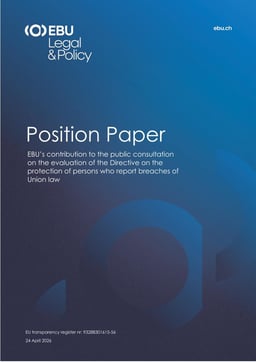
EBU calls for better protection of whistleblowers who disclose information directly to the media
24 April 2026
The EBU urges stronger EU whistleblower protections, especially for those disclosing directly to media, arguing the current Directive creates legal uncertainty and weak safeguards that hinder investigative journalism, and calls for better alignment with the EMFA and clearer recognition of media’s role and protections, including exemptions for public service media from access to information laws.
On 24 April, the EBU published its response to the European Commission’s public consultation on the evaluation of the Directive on the protection of persons who report breaches of Union law. In our contribution, we emphasize the need for stronger protections for whistleblowers who directly disclose information to the media.
Public service media play an essential democratic role by informing citizens and holding power to account. Their investigative journalism work often depends on the courage of whistleblowers to provide information that uncovers wrongdoing, exposes corruption and abuses of power, often at great personal risk, facing retaliation or sanctions. The comprehensive protection of whistleblowers when they disclose information directly to the media is a key element for the work of independent media and is complementary to the protection of journalistic sources foreseen in the European Media Freedom Act (EMFA).
However, the current Whistleblower Protection Directive falls short in offering comprehensive protections for individuals who bypass formal channels and disclose matters of public interest directly to the media. The restrictive conditions in the Directive, such as requirements to exhaust internal reporting channels or to prove imminent public danger, create legal uncertainty and discourage whistleblowers from coming forward, creating a broader chilling effect that undermines the media’s ability to conduct investigative journalism and exposing urgent matters of public interest to citizens. Moreover, since these protections are tied to varying national laws, individuals who reveal wrongdoing in countries with weaker freedom of expression legislation or insufficient whistleblower protection frameworks risk being left unprotected and vulnerable.
Independent media, bound by rigorous editorial standards and legal accountability, should serve as safe havens for whistleblowers. Protecting disclosures to the media reinforces journalism’s watchdog role, freedom of expression, strengthens democratic accountability and ensures vital information reaches society in a reliable and impactful way.
We also highlight in our contribution that the Directive would benefit from alignment with the EMFA on the definition of media, providing greater legal certainty and coherence within the EU framework, while also emphasizing the defining characteristic of media organizations central to whistleblower protections: their editorial responsibility. Also, that any effort to enhance whistleblower protection, must ensure that, in alignment with the EMFA, public service media are exempted from access to information laws.
Relevant links and documents
Contact

Relevant Links
Documents
Related news
Op-ed
No facts? No freedom. Democracy depends on access to reliable information
Citizens cannot make informed decisions or participate in democratic life without access to reliable, independent, and locally relevant sources of information....

Stories
Top 10 Legal and Policy news of 2025
Keeping Members up to date with important news related to public service media is an important part of the EBU’s Legal & Policy work. In 2025, the Audiovisual...

Stories
How to get Big Tech to play fair: Rights and remedies for public service media in EU law
On 24 June, the EBU published a new guide 'Big Tech, fair play: PSM rights and remedies under the EU digital legal framework'. This publication breaks...

Stories
Top 10 Legal and Policy downloads of 2025
The EBU’s Legal & Policy team advocates for public service media's interests within the EU Institutions and keeps Members consistently informed through...

Statement
EBU writes to Czech Prime Minister over public media reform plans
The EBU has written to the Czech Prime Minister to express concern about draft legislation that could undermine the independence, stability and European...

Policy Position
“The AVMSD is indispensible!” Says EBU in consultation response
On 19 December, the EBU submitted its contribution to the European Commission’s call for evidence on the evaluation of the Audiovisual Media Services Directive...
Speech
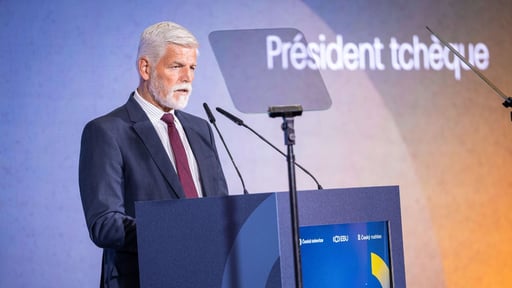
The importance of public service media and their indispensable role within democratic societies
In the Czech Republic, we benefit from a well-functioning media environment that combines strong public service media with robust private media organizations. ...

Policy Position
EBU responds to the call for evidence on the evaluation of the public procurement Directives
Public service media (PSM) play a crucial role in European democracy, providing trusted news, diverse cultural content, and innovative programming. However,...