European media call on the Commission to refrain from unhelpful labelling obligations in the AI Act’s transparency guidelines
16 June 2026
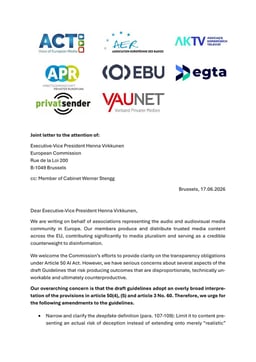
The EBU and media sector stakeholders have written to the European Commission about the draft guidelines on the transparency obligations in Article 50 of the AI Act. The letter warns that the current "deepfake" definition is too broad and would lead to systematic over-labelling of trusted media content, and they call for targeted changes before the guidelines are finalised.
On 17th on June 2026, EBU and a coalition of private broadcasters and sales houses (VAUNET, ACT, egta, AER, AKTV, APR and Privatsender) sent a joint letter to Executive Vice-President Henna Virkkunen, responsible for the European Commission's digital portfolio. The letter responds to the draft guidelines the Commission published in May on the implementation of the transparency obligations in Article 50 of the AI Act, in particular the disclosure of deepfake content to audiences. While we welcome the Commission's effort to provide clarity, draft guidelines raise serious concerns that they may be disproportionate, technically difficult to apply and ultimately counterproductive.
"The draft defines deepfakes so broadly that broadcasters could end up labelling large amounts of non-deceptive content. If warning messages become ubiquitous, people will stop noticing them, and labels will lose their meaning exactly where it matters most. That is not what the AI Act set out to do.” said Sophia Wistehube, Senior Legal Counsel, EBU.
“We share the Commission’s goal of protecting audiences from genuinely misleading content, and we are asking for some targeted changes so the guidelines would actually deliver that." said François Lavoir, Senior Policy Adviser, EBU.
In the letter, we set out three main requests:
- Narrowing and clarifying the deepfake definition so that it captures only content presenting a real risk of deception and explicitly excludes fictitious, non-deceptive content.
- Clarifying the timing of disclosure to avoid continuous or persistent labelling obligations.
- Ensuring that labelling standards are proportionate and technically workable, taking into account of the limits of human perception as well as the fact that media service providers already operate under strict editorial standards and human editorial responsibility.
Read the full letter to the right.
Relevant links and documents
Contact
Get in touch. We're here to help.
Relevant Links
Documents
Related news

Policy Position
European broadcasters urge the European Commission to apply gatekeeper rules to connected TVs and virtual assistants
On 23 March, a coalition of audiovisual media and radio sector representatives called on the European Commission to designate connected TV operating systems...

Policy Position
“Deepfake scams hurt everyone, but Big Tech platforms don’t care” says EBU in call for evidence
On 13 February, the EBU submitted our feedback to the European Commission’s call for evidence on the future action plan to combat online fraud. We highlight...

Policy Position
European media associations call on the EU to reconsider introducing data-usage consent restrictions in the Digital Omnibus
On 6 May, the EBU and a coalition of associations representing the media sector expressed strong concerns about the data usage consent-related provisions...

Press release
Media industry unites to advocate for robust implementation of audience measurement obligations under the European Media Freedom Act
In anticipation of its entry into application in August this year, the EBU has joined forces with ACT and egta to inform the implementation of the European...

Policy Position
EBU stresses that new EMFA obligations are non-negotiable
On 17 July, the EBU submitted its contribution to the European Commission’s consultation on the European Media Freedom Act’s (EMFA) Article 18. Under Article...

Policy Position
EBU calls for enhancing Commission guidelines promoting the protection of minors online
The Digital Services Act (DSA), which entered into application in February 2024, requires online platforms to ensure a high level of privacy, safety, and...

Press release
Commission guides Big Tech through EMFA: A helping hand for the struggling giants
On 6 February, the European Commission published its implementation guidelines for Article 18 of the European Media Freedom Act (EMFA). This provision...
.jpg)
Stories
EBU welcomes AI Act publication by European Parliament
On 12 July, the European Parliament published the AI Act. The EBU welcomes this step that establishes a binding and comprehensive AI rulebook for Europe. ...

