It's time to get prominence right.
23 June 2026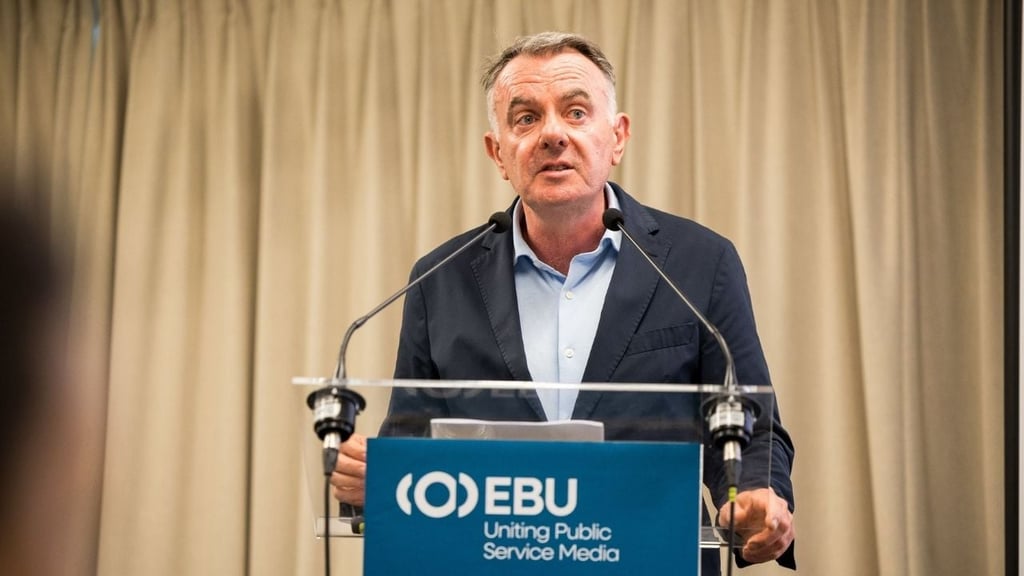
This is an extract from a speech given by Noel Curran, Director General, EBU at the event Who gets prominence!?. This event, held on 9 June in Brussels, addressed the issue of prominence of general interest media as part of the revision of the Audiovisual Media Services Directive.
The revision of Audiovisual Media Services Directive (AVMSD) is coming, and with it, a genuine opportunity, perhaps the best in years, to get prominence right.
In a digital landscape dominated by global tech giants, helping Europeans find and access trustworthy, general interest content is not a technical detail or a nice-to-have. It is a strategic necessity for democracy and social cohesion.
Public service media, and many of our local commercial counterparts, do something no algorithm is designed for. They hold power to account. They produce documentaries that open windows onto worlds we might never otherwise see. They tell stories in local languages, create quality fiction and drama, and invest in children's programming that no commercial logic would sustain alone. They cover hyperlocal events alongside major international ones, so that no community is left without a voice. They serve every part of society, including communities that no advertiser would prioritise. And they give people the tools to form their own opinions, to participate meaningfully in democratic life, and to share in the collective moments that bind societies together.
This is not a small thing. And we have the evidence that it matters.
Public service media are the biggest investors in original content in Europe, EUR 22 billion a year. In more than 90% of European countries, PSM remain the most trusted news source. And we see what that trust means in practice. When the power blackouts hit Spain and Portugal last year, people relied on broadcast media for accurate, reliable information. That direct connection between public service media and audiences is not incidental, it is the whole point. Maintaining it requires that public service media can actually reach people. And that means being prominently, reliably, consistently findable and discoverable, on the interfaces people use every day.
And that is under serious threat. Not because public service media have stopped investing or stopped serving their audiences, they have not. But in today's connected media environment, finding that content is getting harder and harder. Commercial deals, not editorial value, determine what people see first. The devices people use, the platforms they navigate, the algorithms that shape what appears on their screens, all of these are controlled by companies whose primary obligation is to their shareholders, not to European citizens. We are, in effect, at the mercy of global tech, manufacturing and automotive companies whose business interests have nothing to do with the democratic value of the content they are gatekeeping.
The scale of that dependency is worth pausing on.
People today access media through connected TVs, in-car infotainment systems, social media and video sharing platforms. The companies behind those interfaces have become an integral part of the European media environment. But they are not media companies. Their interests do not align with the goals behind general interest content.
The imbalance is striking. In 2024, the 10 biggest tech and device companies, Meta, Apple, Amazon among them, had combined revenues 48 times larger than the total funding of public service media across Europe. Online platforms and search engines are also the dominant advertising intermediaries. A tiny group of big tech players controls more than half of global ad spend. Many public service media organisations engage in partnerships with these platforms, partnerships that are necessary for visibility but that leave all the cards in the platforms' hands. Paying for advertising on a platform does not change the algorithm. The algorithm is designed to keep people on the platform, not to surface content with public value.
The result is a structural risk to plurality. User interfaces and algorithms prioritise commercial partners or personalised content. The prominent spots go to big tech's own services, or to the highest bidder. YouTube now sits at the centre of many TV screens and competes directly with broadcast media for audience attention. Even when public service media invest heavily in their presence on these platforms, their posts and content are routinely side-lined. There were always more visible spots at the newsstand, but every publication still had a chance to be seen. Online, that is not the case.
And this connects directly to the misinformation crisis. We know that groups, both inside and outside Europe, are deliberately spreading disinformation to undermine our democracies. These campaigns use AI tools to create artificial divisions at scale and they are increasingly difficult to detect and dismantle. Ensuring that reliable, independent journalism is prominent and easy to find is one of the most effective defences we have. Prominence is not just about market access. It is about protecting people.
The EBU and our Members want to work with platforms, and I am pleased that some are genuinely willing to engage. But even where partnerships do exist, public service content is still buried beneath content optimised for engagement over public value. Commercial agreements have their place. But when access to accurate information depends solely on the goodwill of private actors, we are on unstable ground. That is precisely why we need clear, enforceable law.
We cannot discuss prominence without talking about AI.
AI is already reshaping how people find and access media, and the pace of change is accelerating.
According to Reuters Institute research from last year, 7% of online news consumers now use AI assistants for news, rising to 15% among under-25s. Publishers expect search traffic to almost halve over the next three years, as AI overviews and zero-click searches replace traditional link-clicking. The way people navigate to trusted media is changing fast. If we do not build prominence obligations that cover these new interfaces now, we will find ourselves, in a very short time, with legislation that is already out of date.
The good news is that AI used responsibly looks entirely different. Our Members are already using AI for translation, content recommendation and audience tools, always with human oversight. At the EBU, we have developed tools to allow the public to engage with news from trusted media. But it requires genuine accountability from those building the interfaces people rely on for news. That is why we launched FACTS IN: FACTS OUT, a global campaign with thousands of public and private news media worldwide, calling on big tech to cooperate with media on accuracy, proper attribution and authorisation when content is used in generative AI models. Any serious prominence framework must cover AI interfaces. That is not optional, it is essential.
So what are we asking for?
We would like the Commission to strengthen the prominence provisions in the AVMSD, so that prominence is meaningful and effective. That comes down to three things.
First: make it binding. Not guidelines. Not voluntary commitments. A clear, enforceable obligation, with real teeth, and meaningful consequences for those who do not comply. The Commission has recognized prominence as a priority. We welcome that. Now the proposal has to match the ambition.
Second: scope and substance. Let me be concrete. On smart TVs and car dashboards, it means our apps among the most visible on the first screen, reachable in a single click, and there by right, not only available to those who pay the platform for prime position, as the big commercial services do today. In recommendations and search, it means our content is effectively surfaced, actively, not just permitted to compete, and used only with our consent. In AI assistants, it means our content cited, attributed and linked back, not absorbed and served up anonymously. And it must apply without exception, no carve-outs, no loopholes for those who benefit from European audiences while avoiding European responsibilities.
Third: a framework built to last. The legislation must be flexible and dynamic enough to keep pace with technological change, including the profound shifts already being driven by generative AI, without ever losing sight of its core purpose. That means provisions that can evolve as the landscape changes, not a text that is out of date on the day it enters into force.
The detail will be shaped by Member States, applying the directive in their own markets and cultures. But that is the next step. The foundation is set now, in this proposal.
The prominence challenge is not going away, it is intensifying. Every year that passes without strong legislation is another year in which the default is set not by democratic choice, but by commercial interest.
We call on the Commission to be ambitious, to think beyond the platforms and business models of today, and to put the public interest at the heart of Europe's media environment, now and in the years to come.
We are encouraged that several national Ministers raised prominence at their most recent Council meeting. We are pleased that the Commission has identified it as a priority in the Democracy Shield. Strong political statements are a start. Now we need them turned into strong, meaningful law.
The EBU stands ready to support that process with expertise, evidence and advice. Let's get this right.
Relevant links and documents
Contact

Andrea Campbell
Communications Manager, Legal & Policy, EU and Institutional Affairs
Relevant Links
Related news
Op-ed
No facts? No freedom. Democracy depends on access to reliable information
Citizens cannot make informed decisions or participate in democratic life without access to reliable, independent, and locally relevant sources of information....

Blog
The 4 burning policy questions for AI and the media sector
AI is moving fast, and it’s no secret that it’s impacting Europe’s media landscape. Public service media embrace the opportunities AI brings to drive responsible...

Policy Position
EBU responds to the call for evidence on the evaluation of the public procurement Directives
Public service media (PSM) play a crucial role in European democracy, providing trusted news, diverse cultural content, and innovative programming. However,...

Stories
"Transparency is important, but the public does not want AI labels everywhere, only when it is materially important"
Is generative AI a game-changer for journalism? I’m a bit more sceptical than six months ago. It’s a huge transformation in terms of the potential for...

Press release
DNA: European Commission rightly safeguards media in its push to modernise telecom markets, but radio needs more
The EBU welcomes the Digital Networks Act (DNA) proposal, published today by the European Commission. The DNA aims to modernise telecommunications markets and...

Speech
Some of our red lines have become constrictive red tape. Time for a rethink.
This text is based on a speech delivered by EBU Director of News, Liz Corbin, at the AI Forum, on 25 March 2026, in Brussels. I’ve been thinking a lot...

Stories
How to get Big Tech to play fair: Rights and remedies for public service media in EU law
On 24 June, the EBU published a new guide 'Big Tech, fair play: PSM rights and remedies under the EU digital legal framework'. This publication breaks...

Blog
Truth in the Balance: Defending Democracy in the Intelligent Age
As global leaders gather in Davos for the World Economic Forum’s Annual Meeting, under the theme ‘Collaboration for the Intelligent Age’, the stakes for...