Laudatory Speech on awarding of Charlemagne Medal to Eurovision Song Contest - Björn Ulvaeus
27 April 2016And the winner is Sweden … Those may not have been the exact words, but it certainly was the meaning. The venue is the Dome in Brighton and the year is 1974. The song writers have been asked to go on stage and Stig Anderson and my friend and co-writer Benny are already there while I’m struggling with a security guard at the bottom of the stairs leading to the stage.
I can see what was going on in his head: Song writers don’t look like that. Platform boots and star guitar. He has misunderstood, he must be an artist. So he says: No, no, no you have to wait. This is for song writers only. I’m really pissed off by now. I don’t know how Benny has managed to sneak past him. Maybe there was violence. He and Stig are basking in thunderous applause. But I finally get to go on stage together with the ladies when it’s time to perform the winning song again. Waterloo.
And that, ladies and gentlemen, is the reason I am here today and I’m very proud to be asked to present this award to the Eurovision Song Contest and its founders the European Broadcasting Union.
60 years ago – when television was in its infancy – a new television show was created by the European Broadcasting Union to expand the boundaries of technology and unite audiences in different European countries through the love of music.
It was launched in 1956 – the year Elvis changed the world with Heartbreak Hotel and a year before the Treaty of Rome created the European Community.
In the early 1990s the Contest welcomed former communist countries of central and Eastern Europe a full 10 years before they joined the EU.
The Eurovision Song Contest has never been limited by geographical boundaries – Israel and Turkey were invited to compete in the 1970s and with Australia participating again this year the Contest is now truly a global phenomenon.
In this competition I’m afraid it’s true to say, if you’ll excuse me, that the winner takes it all. We rarely remember those who came second or third, do we? Who were they for instance in 1974? When I wrote this speech I just had to look it up. Italy and Gigliola Cinquetti came second with “Si”. Remember that one? And third; I remember we thought they would be really tough competition. A duo from Holland. A woman and a man. Mouth & MacNeal with “I see a star”. Good tune.
Mouth, that was the guy, I could see that he and I shared a problem. Our pants were too tight. I’d been walking up and down corridors the whole evening. Had I sat down, my pants would have ripped. One morning after I had come home to Stockholm again one I took a good look at myself in the mirror and said to myself: Good God, man! You wanna be a pop star! What you see in the mirror right now is NOT one of those! You need to lose 15 kilos! And I did. Steak, medium rare and mixed salad. For a very long time. Without the help of the drugs my contemporaries no doubt were using back then to stay slim.
In 2013 Sweden hosted the ESC final. The motto for the event was ”We are one” to celebrate European unity. Me and Benny together with Avicii were asked to write a song for the artist procession into the arena at the beginning of the show and I called it: We write the story. I took inspiration from European history once more, but not Napoleon and the Duke of Wellington this time.
Now, as we all know, there are far too many dark chapters in that history. The wars. Religious, Nationalistic, ideological or just plain power struggles. The inquisition etc. But I took inspiration from the forces that stood against that cruel and superstitious world order.
I’m a European. I’ve always felt like one. Sometimes even more than Swedish. In this postmodern age I will stick out my neck and say that I don’t think it’s hubris or arrogance to be quietly proud of the Greek and Roman philosophers, of the renaissance and the enlightenment or our modern democratic, liberal and secular societies with its freedom of speech and striving for equality between men and women. These are values I will stand up for always.
We are living in distressing times. The migration crisis and religious fanaticism threaten to break up Europe again. Extreme nationalism seems to be on the move. We thought we were rid of them once and for all, but no. The Europe we love must always be defended and fought for.
For me the ESC is a powerful symbol and I would say, even a weapon in that fight against the dark forces that want to drag us back to the middle ages again. It is more relevant than ever. I feel that during those hours, those bright, uplifting hours when the ESC final is on the air, that’s one of the few times nowadays when Europe gets a sense of what it’s like to be unified. To live in harmony.
Because music has the power to unify – it knows no borders. For 60 years the marriage of television and music through the Eurovision Song Contest has brought nations closer together and this is apparent through the numbers of people the event reaches – 199 million in 2015 – and also through the number of nations that now takes part. From 7 countries in 1956 to the 42 in Stockholm in 2 weeks’ time.
The Eurovision Song Contest is more than just a musical event - it has social, political and cultural impact right across Europe and beyond. It celebrates diversity and provides a common space to be European.
After ABBA had won that fateful night in Brighton in 1974 it was chaos and I don’t remember much of that. But I do remember waking up early the next morning, having slept only a few hours. I was lying there, my beautiful blond wife Agnetha beside me, still sleeping and I felt so good despite, I suspect, a slight hangover. I thought: Yesterday we were this rather obscure little group from Sweden. Today the whole world knows about us. The power of the ESC.
No one can be more grateful than me. It changed my life. Back there in that bed in that hotel I realised the world was open if we could take good care of the opportunity we’d been given. It is now 42 years ago. And my perspective back then was, like, one year ahead. No more. That’s as far as my dreams would let me go.
What was later to happen in reality was at that moment so farfetched that it couldn’t even be imagined by the young man in Brighton. And I still to this day don’t know exactly how it happened, but I know one thing for certain. It all started with the Eurovision Song Contest.
And now you all understand how honoured and pleased I am to present the Award of the Médaille Charlemagne 2016 to the EBU, represented by director general Ingrid Deltenre and to Eurovision Song Contest, represented by Executive Supervisor Jon Ola Sand.
Relevant links and documents
Related news

Blog
EBU x Eurosonic: a long story of collaboration
How it all started: At the EBU, we spend a lot of time talking about music crossing borders and Eurosonic Noorderslag is one of the places we can actually...
Blog
What the BBC crisis can teach public service media
It's been a traumatic ten days of controversy and resignations at the BBC, which will have repercussions right around Europe. The resignation of Director...
Stories
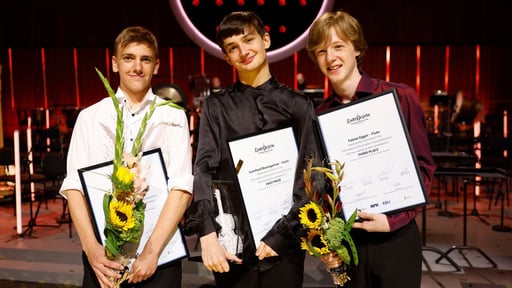
Austria's Leonhard Baumgartner wins Eurovision Young Musicians 2024
A 17-year-old violinist has won the 21st edition of Eurovision Young Musicians, the prestigious international music competition, held this year at the...

Press release
EBU launches global hunt to find missing editions of the Eurovision Song Contest
As the Eurovision Song Contest celebrates its 70th anniversary, the European Broadcasting Union (EBU) is turning to its greatest resource - its fans -...

Stories
Q&A with Pattie Maes: “We don't have to simplify everything for everybody”
We talk to Pattie Maes, Professor of Media Arts and Sciences at the MIT Media Lab, as one of a series of interviews with contributors to the EBU News Report...

Speech
Some of our red lines have become constrictive red tape. Time for a rethink.
This text is based on a speech delivered by EBU Director of News, Liz Corbin, at the AI Forum, on 25 March 2026, in Brussels. I’ve been thinking a lot...
Stories
From Vienna to the world: How Eurovision’s signal reaches audiences across the globe
Every May, millions of viewers sit down to watch the Eurovision Song Contest Grand Final. What appears on screen feels immediate and effortless: a performer...

From local TV intern to Olympic broadcast technology architect – and award winner!
Yannick Olivier is a broadcast engineer and tech lead for ST 2110 at France Télévisions. Below, we ask him about being named EBU Young Technology Talent...