Milano Cortina 2026: Winter Olympic Games at a glance
26 January 2026
Event: Olympic Winter Games
Dates: 6–22 February 2026
Host Country: Italy
Coverage in Europe: Free-to-air via EBU Member broadcasters
Where: Linear and digital platforms operated by Europe's public service media
Millions of fans across Europe will be able to enjoy Milano Cortina 2026 free-to-air thanks to our network of public service media Members. Here’s everything you need to know ahead of the Games!
What is Milano Cortina 2026?
Milano Cortina 2026 is the Olympic and Paralympic Winter Games. This edition of the Games will bring together the world’s top winter sports athletes to compete across snow and ice disciplines, with the Olympic Winter Games taking place first, followed by the Paralympic Winter Games (6-15 March 2026).
Where is Milano Cortina taking place?
- Milano; metropolitan hub and one of the two official host cities
- Cortina d'Ampezzo; second official host city in the Dolomites
- Predazzo; Nordic skiing / ski jumping area in Val di Fiemme
- Tesero; Val di Fiemme cross-country / Nordic cluster
- Bormio; Valtellina alpine skiing cluster
- Livigno; snowboarding & freestyle cluster
- Antholz-Anterselva; biathlon area in South Tyrol
- Verona; closing ceremony site
When is Milano Cortina 2026?
The Olympic Winter Games take place from 6–22 February 2026 and last for 17 days of competition.
With the Games taking place in a central European time zone, events will be scheduled by public broadcasters throughout the day and evening, making them easily accessible to audiences across Europe.
How to enjoy Milano Cortina 2026 for free in Europe
Audiences across Europe will be able to follow the Olympic Winter Games free-to-air thanks to coverage provided by the following EBU Members:
Broadcasters
- Albania – Radiotelevisioni Shqiptar
- Andorra – Ràdio i Televisió d'Andorra
- Armenia – Public Television of Armenia
- Austria – ORF
- Azerbaijan – Ictimai
- Belgium – VRT
- Belgium – RTBF
- Bosnia and Herzegovina – BHRT
- Bulgaria – BNT
- Croatia – HRT
- Cyprus – CyBC
- Czech Republic – Česká televize/Cesky Rozhlas
- Denmark – DR
- Denmark – TV 2
- Estonia – ERR
- Finland – Yle
- France – France Télévisions/Radio France/France Médias Monde (rfi)
- Georgia – GPB
- Germany – ARD
- Germany – ZDF
- Greece – ERT
- Hungary – MTVA
- Iceland – RÚV
- Ireland – RTÉ
- Italy – RAI
- Kosovo – RTK
- Latvia – Latvian Public Service Media
- Liechtenstein – Coverage provided by Switzerland
- Lithuania – LRT
- Luxembourg – RTL
- Malta – PBS Malta
- Moldova – TRM
- Monaco – Coverage provided as in France
- Montenegro – RTCG
- Netherlands – NOS
- North Macedonia – MRT
- Norway – NRK
- Norway – TV 2 Norway
- Poland – TVP
- Portugal – RTP
- Romania – TVR
- San Marino – Coverage provided by Italy
- Serbia – RTS
- Slovakia – STVR
- Slovenia – RTVSLO
- Spain – RTVE
- Sweden – SVT / TV4 / Sveriges Radio Ab
- Switzerland – SRG SSR
- Turkey – TRT
- United Kingdom – BBC
- Ukraine – Suspilne
- Vatican City – Coverage provided as in Italy
As the exclusive media rights partner in Europe, the EBU works on behalf of its public service media Members to ensure that:
- Major sporting events remain universally accessible
- Coverage is available without subscription or paywall barriers
- Audiences can follow the Games on trusted national linear and digital platforms
Where will coverage be available?
Coverage will be provided by EBU Member broadcasters across Europe, delivering:
- Live coverage of Olympic events
- Opening and Closing Ceremonies
- Daily highlights
- Digital and online coverage across broadcaster websites and apps
Availability of channels and platforms may vary by country, but access will remain free for all European audiences.
Read why public service media coverage matters at moments like this.
Relevant links and documents
Related news
Stories
Milano Cortina 2026: Paralympic Winter Games at a glance
Millions of fans across Europe will be able to enjoy the Milano Cortina 2026 Paralympic Winter Games free-to-air thanks to our network of public service...

Blog
Milano Cortina 2026: Why public service media matters at moments like this
In just two weeks, the Olympic Winter Games begin in Europe. From the first Opening Ceremony on 6 February, Milano Cortina 2026 will bring together the...

Press release
EBU Members draw multi-million audiences in opening week of Milano Cortina 2026
European Broadcasting Union (EBU) Member broadcasters are delivering the Milano Cortina 2026 Winter Olympic Games to mass audiences across Europe, with...

Press release
Fondazione Milano Cortina awards exclusive Milano Cortina 2026 Paralympic Winter Games media rights to European Broadcasting Union
EBU Members to deliver broad free-to-air coverage across all of continental Europe (with the exception of Italy and the United Kingdom) Warner Bros. Discovery...

Press release
EBU Members deliver most-watched Winter Olympic Games ever with Milano Cortina 2026
European Broadcasting Union (EBU) Member broadcasters have delivered their most successful Winter Olympic Games ever, with Milano Cortina 2026 achieving...
Blog
Milano Cortina 2026: A defining moment for public service media
When the Olympic Games come to an end, beyond the results and the medal table, what remains is something less tangible, but no less important. For several...

Press release
29 EBU Members and licensees set to offer record-breaking coverage of Milano Cortina 2026 Paralympic Winter Games across Europe
The European Broadcasting Union (EBU) today confirmed that 29 EBU Member broadcasters and licensees will deliver unprecedented free-to-air coverage of...
Press release
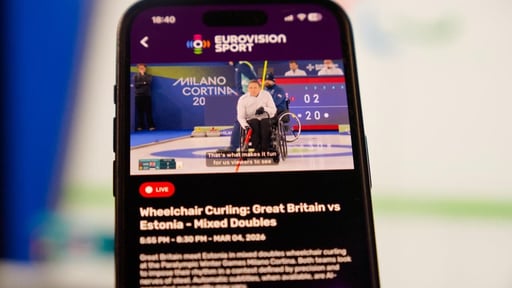
Eurovision Sport and CAMB.AI to provide live and on-demand subtitling for Milano Cortina 2026 Paralympic Winter Games
Eurovision Sport, the European Broadcasting Union’s (EBU) free-to-air streaming platform, with its partner CAMB.AI, will deliver live and on-demand subtitling...