Media Summit - embracing the future
30 May 2013
The second part of the media summit embraced the future. With apps that weren’t in existence four years ago but now are used by hundreds of millions, what’s next for broadcasting?

Paul Lee, Global Director, Technology, Media & Communications at Deloitte sees a very positive future for the role of television and radio in the increasingly connected world. With broadband accessibility rising in British households from 17% in 2003 to 75% in 2011 and still on the rise, it is encouraging to note that television viewing has also increased by ten percent. “Most of us need to be together; enjoyment of television is greater when people are watching together.” He points out too that sales of large TV screens are rising, predicting that in five years’ time, most households with have two enormous screens on their wall, allowing families to watch different programs, but together.
With an exhausting array of choice on what to watch, record or view online, it actually becomes a chore. “People like the notion of change, but don’t like the reality of it,” he says. “We defer to brands that we trust and it is the broadcasters’ own over-the-top offerings such as 4OD or BBC iPlayer that are used four times more than Netflix or Love film.”
Technology also has its limits on how it is used compared to the reliability of television: video comprises only 0.5% of all online viewing but takes up 30% of online functions. “Try watching Netflix in the US on a Friday night.”
There is no doubt that the market for social media and different ways of viewing entertainment online will become bigger, but that television is likely to plateau. This is not a negative, however. Professionally-created television with high production values is not able to replicate on other forms of media due to prohibitive costs, time restrictions and lack of skills. “The reality is, when given a choice, 58% of UK television viewers refer to the live TV timetables first.”
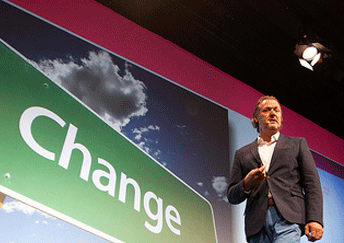 Entrepreneur and Mobile Strategist Rudy de Waele believes that ‘it’s all about Apps,” and that broadcasters – along with other business organisations seeking to grow – needs to embrace the mobile phone user and viewer.
Twitter may receive the lions’ share of attention, but the Angry Birds app has more purchasers than there are users of Twitter, and music identifying App ‘Shazam’ is now moving into television. Now running on 160 channels in the US, Shazam can identify clothing and other products for the viewer to purchase for themselves. “It is merely a click away.”
He predicts that mobile usage and downloading of apps will bypass desktop internet usage within twelve months and a study already shows that 40% of viewers are using social media whilst they’re watching live television. Described as ‘mobile snacking,’ sixty three percent of women and seventy three percent of men check their mobile phones at least once per hour; all of which can provide invaluable data on what people are watching, liking, playing and reading.
And don’t forget to look beyond the west, either, as China and Africa are the first and second largest mobile phone purchasers in the world respectively. The ‘World Reader’ program established in four developing nations in Africa is already showing that children will read more if they’re given a choice in what they can read, and apps via kindle and other readers with long battery life is allowing them to do just that.
Even television news is affected by the mobile phone, with a significant source of footage and live content being provided by viewers and people on the scene. “TV won’t die; it will just be enhanced by mobile.”
Futurescape co-founder Colin Donald sees television viewers as an engaged audience, actively participating in digital interaction and embracing social media. “It’s no longer just about TV programmes sticking a twitter hash tag on the bottom of the screen,” he says, “but inviting viewers to participate in discussions immediately after the show has aired, joining conversations and recommending and sharing these shows with others.”
Viewers that are overwhelmed with choice – as discussed by Paul Lee earlier – can use Twitter and other social media to see what shows are generating ‘buzz’ and therefore select that one to watch. Apps are available – with more sophisticated ones to be launched in future – that will connect viewers with other people who share the same interests. Television programmers can then see how people are viewing, talking, tweeting and sharing their programmes – live, on a TV screen, tablet, mobile, online?
He also concurs with Rudy de Waele in that Twitter isn’t the Be-all and End-all of social media. Facebook is five times larger than Twitter and should not be ignored by TV makers. “Not everyone is live tweeting during a broadcast. Around 75% of the chat happens before and after the show has aired,” he says.
In fact, too much Twitter can saturate the media field and smart TV broadcasters are learning how to filter this content. Separating the feed into streams, such as official tweets, cast tweets and viewer tweets allows viewers to find the most relevant information.
 What’s next for the social media-savvy viewer? Twitter video (with subtle banner advertising) and Facebook watching (allowing an automatic status update of the show the person is watching) are already released, providing broadcasters with even more information on what their viewers want.
The later afternoon sessions discussed ‘Using the Power of Visual Storytelling.’ Award-winning photographic artist, Chris Jordan joined us live to talk about the power of visual storytelling and what that means to us and to the world today. He shared insights on how to tell stories that give audiences and viewers new visions for our world.
Relevant links and documents
Relevant Links
Related news

Blog
YouTube - Friend or Enemy? The dilemma for broadcasters
For much of the past decade, YouTube occupied a relatively straightforward place in the digital strategies of public service media (PSM): a marketing channel....

Blog
Incoming EBU Digital Committee Chair Philippe Keutgen brings a bold new vision
The EBU Digital Committee has entered a new chapter under the leadership of its recently elected Chair, Philippe Keutgen, Media Platforms Strategy and...
Stories
From Vienna to the world: How Eurovision’s signal reaches audiences across the globe
Every May, millions of viewers sit down to watch the Eurovision Song Contest Grand Final. What appears on screen feels immediate and effortless: a performer...

All content, for everyone, everywhere: a core challenge for PSM, past, present and future
With Italy’s Rai hosting the EBU Technology & Innovation Summit and Technical Assembly 2024 in Naples, Chief Technology Officer, Stefano Ciccotti provides...

Speech
Some of our red lines have become constrictive red tape. Time for a rethink.
This text is based on a speech delivered by EBU Director of News, Liz Corbin, at the AI Forum, on 25 March 2026, in Brussels. I’ve been thinking a lot...

Preparing for the next generation of free television services in Ireland
DVB-I, the open standard for internet-centric television service discovery, could be key to the future development of the digital terrestrial television...

Stories
Q&A with Pattie Maes: “We don't have to simplify everything for everybody”
We talk to Pattie Maes, Professor of Media Arts and Sciences at the MIT Media Lab, as one of a series of interviews with contributors to the EBU News Report...
Speech
When we produce meaningful content for young people, we help them navigate the world.
Keynote speech delivered by Jean Philip De Tender, Deputy Director General/Director of Media, EBU, at the annual ABU-Rai Days conference, in Naples, on...