Journey along WWI front line the road to winning TV formula
17 September 2013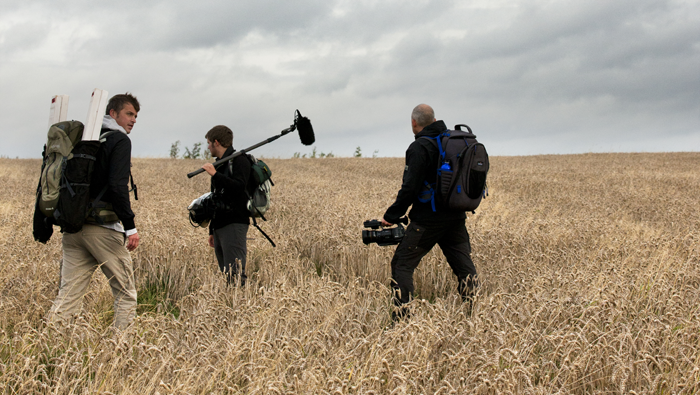
One hundred years on, the battlefields of the First World War still evoke trepidation. Belgian director Arnout Hauben, winner of this year’s Eurovision Creative Forum "7 Best Formats" for the historical roadshow At War, said he feared aspects of the 1,700 kilometre trek, which traces the European front line from the Belgian coast to the legendary battlefields of Gallipoli, in Turkey.
Hauben, who accepted the peer-awarded prize during the Eurovision TV Meetings in Berlin (9-11 September) on behalf of Belgian public service broadcaster VRT, said one of his initial concerns was that the subject matter may be too heavy to translate into a format suitable for a broad television audience.
“On another level, there was also an element of personal fear to walk the biggest cemetery on earth,” says Hauben. “Soldiers died on that soil. We wanted the project to be worthy of the men and women who lost their lives on the front line.”
The 80-day journey undertaken by Hauben and his two-man crew – Mikhael Cops, co-director and cameraman, and actor Jonas Van Thielen, who doubled as sound assistant – began in March, 2012. Every day, they would mark their progress by hammering a white stake into the ground – a modest, personal salute to those who lost their lives, irrespective of the uniform they died in.
The three men set out from the westernmost point of the front line, the Belgian coastal town of Nieuwpoort. Along the way, they passed the famous battlefields of Flanders and the Somme, and Verdun, in France. In Italy, the route took them to the lofty peaks of the Alps, where soldiers fought in unrelenting snow. Further on, they set foot on the uncharted Balkan front and marched down through Greece before finally reaching Gallipoli.
Along the way, they encountered locals who related personal tales from then and now.
The idea for the eight-episode, 45-minute format sprang from the documentarymaker’s childhood memories of his grandparents' home in Passchendaele, where between June and November 1917 the British and their allies battled the German Empire for control of the ridges south and east of the Belgian city of Ypres, in West Flanders.
“Part of my family grew up on the front line and are living in de Westhoek beyond the river Ijzer. Thousands of British, Australians and New Zealanders visit the area every year. They are pilgrims, wanting to relive the past, to connect with the experiences of relatives, friends, and names from the past. The personal stories of these strangers touched me deeply. I wanted to take it further.”
This universal endeavour – to make sense of life – became the driving force of the project, which began in earnest in 2011.
“The research period was relatively fast, nine months of gestation,” says Hauben. “The local 'In Flanders Fields' Museum provided a huge amount of material, and we went to the British Imperial War Museum for maps. But it was day-to-day encounters with people still living on the front that triggered emotion. We were a small battalion, following our own inevitable course.”
EBU Head of TV Bettina Brinkman says the themes resonated with Members attending the annual Eurovision Creative Forum.
"There was something fresh about the directorial approach that gave the subject matter new life," she said. "Here were young men, separated from their counterparts by 100 years, exploring the front line through new eyes. World War One was a conflict which continues to define today's geopolitical era. Next year, Eurovision is offering its Members a portfolio of thematically-linked projects across a variety of platforms to commemorate the centenary of the War. There is no more timely example of public service media meeting audience needs."
Relevant links and documents
Related news

Blog
The EBU Ukraine Archive: a repository of some of the best reporting in the world on the Russia-Ukraine War.
By Anne Koch, Project Lead, EBU Ukraine Archive The EBU, the world’s largest alliance of public service media, is preparing to open its Ukraine Archive...

Press release
Austria’s JJ wins 69th Eurovision Song Contest with ‘Wasted Love’
Austrian artist JJ has won the 69th Eurovision Song Contest with the song ‘Wasted Love’. This is Austrian broadcaster ORF’s first win since 2014 and...

Press release
Ukraine's Suspilne wins 2025 Gunnar Høidahl Award for Excellence in the Eurovision News Exchange
Ukrainian public broadcaster Suspilne has won the 2025 Gunnar Høidahl Award for Excellence in the Eurovision News Exchange for resilience and professionalism...

Press release
Bangkok to Host First-Ever Eurovision Song Contest Asia in 2026
The European Broadcasting Union (EBU) and Voxovation together with S2O Productions and Thailand’s Channel 3 are excited to announce that Eurovision Song...

Press release
Dutch broadcaster NOS wins 2024 Gunnar Høidahl Award for contributions to Eurovision News Exchange
Dutch public broadcaster Nederlandse Omroep Stichting (NOS) has won the 2024 Gunnar Høidahl Award for Excellence in the Eurovision News Exchange in recognition...

Press release
Basel chosen as Host City for 69th Eurovision Song Contest in 2025
The third largest city in Switzerland, Basel, has been selected by Host Broadcaster SRG SSR and the EBU to host the 69th Eurovision Song Contest in May...

Press release
Martin Österdahl to step down as Executive Supervisor of the Eurovision Song Contest this summer
The European Broadcasting Union (EBU) has announced that Martin Österdahl will be stepping down from his role as Executive Supervisor of the Eurovision...

Press release
Georgia wins 22nd Junior Eurovision Song Contest and sets new competition record
Georgia has won the 2024 Junior Eurovision Song Contest (JESC) held in Madrid on Saturday 16 November. The winning song “To My Mom” was performed by 11-year-old...