Eurovision TV Assembly asks ‘is digital the new normal?’
03 June 2015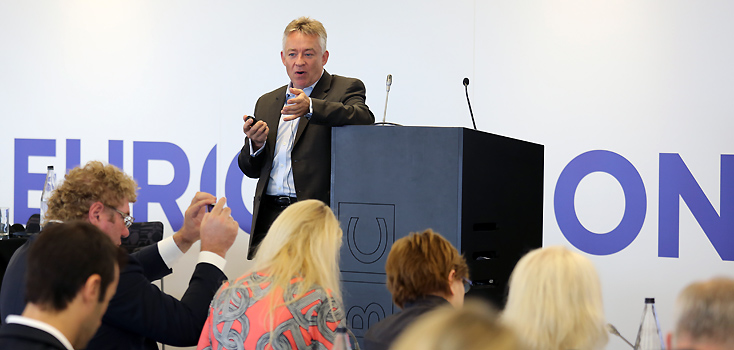
Television executives from public service media across Europe are exploring the impact of digital media on the future of broadcasting at BBC Manchester – hosts of the 21st EBU Television Assembly.
More than 50 decision makers were welcomed by TV Committee ad interim chairman Frank-Dieter Freiling (ZDF, Germany), Peter Salmon, Director of BBC England, and Jean Philip De Tender, outgoing TV Committee chairman and new Director of Media at the EBU.
Mr De Tender said Members face three key challenges in their new role as 'publishers' as opposed to broadcasters of content.
"The first is to reinvent the art of storytelling because new media offers new potential," he said. "The second challenge is to get that content directly to the audience. Public service media (PSM) is competing against new gatekeepers who are taking control of that access. They know our audiences; they have the big data; we need to reclaim that ground. Thirdly, we need to ensure that the origin of our content is clearly identifiable as ours – as having come from a trusted and reliable source."
In a presentation titled ‘The network always wins,’ European technology thought leader Peter Hinssen outlined strategies to help PSM maintain relevance by staying abreast of emerging trends.
“Connect with your audience, your customers, and encourage them to interact,” he said. "User creativity is transforming the way we use technology. For example, Twitter was never conceived for the purpose of sending selfies; this is a transitional phase. Techonology is addictive; technology is the new normal."
Mr Hinssen said two of every five minutes spent online by the generation of digital users known as Millennials (aged 18-34) was taken up with FaceBook.
"Whereas previously we used the term 'digital native,' this next generation are network natives," he said. "Information is not static, it is rich and visual. One way to be relevent is to speak the language of the network. Identify key influencers who are delivering content, through for example YouTube. There is a fundamental shift towards making content relevant to youth audiences."
Peter Salmon, Director BBC England, said that in seeking to attract and retain young audiences, the BBC had developed a policy to harness new voices and fresh content that stretched across the country, which in part reflected the organization's relocation to Manchester three years ago.
"Children are the new teachers," he said. "Flooded with digital choice, there is no one better to learn from. We test brands at schools and create 'kids' labs to develop ideas. We are also giving the 'olympic digital treatment' to new projects, to offer an increasingly personal experience to audiences. We're also forging a closer relationship with external audiences and pioneering mass live audience participation events with arts bodies and cultural groups.
New TV Committee elected
Participants also elected Members of the TV Committee, the principle policy-making body of the EBU television sector, who will serve for the next two years. The new appointments can be seen on the Eurovision TV Committee page.
The Assembly acknowledged the contribution of outgoing Committee Chair Jean Philip De Tender, Vice Chair Frank-Dieter Freiling, and Members Arne Helsingen, Ekaterina Orlova, and Neli Vozelj.
Photo gallery
Relevant links and documents
Relevant Links
Related news

Blog
Incoming EBU Digital Committee Chair Philippe Keutgen brings a bold new vision
The EBU Digital Committee has entered a new chapter under the leadership of its recently elected Chair, Philippe Keutgen, Media Platforms Strategy and...

Press release
EBU calls for rethink of online news limits for German public media in draft reforms
[Siehe unten für die deutsche Version dieser Pressemitteilung zum Reformstaatsvertrag] The European Broadcasting Union (EBU) welcomes efforts to ensure...
Stories
EBU Members elect new Digital & TV Committees at Media Summit 2025
EBU Members today elected new representatives to the Digital and TV Committees at the Media Summit 2025 in Yerevan. Each committee is composed of 13 senior...
Blog
In a world of noise, we need VOICES: The European Festival of Journalism and Media Literacy
In an era where misinformation spreads rapidly and the digital landscape grows increasingly polarized, the need for media literacy and quality journalism...
Speech
When we produce meaningful content for young people, we help them navigate the world.
Keynote speech delivered by Jean Philip De Tender, Deputy Director General/Director of Media, EBU, at the annual ABU-Rai Days conference, in Naples, on...

Press release
EBU says “Policymakers must be decisive in promoting Europe’s media sector in the revision of the AVMSD”
On 30 April, the EBU published its position on the revision of the EU’s Audiovisual Media Services Directive (AVMSD), urging policymakers to seize the...

Press release
EBU launches Spotlight fact-checking network to combat misinformation and support trusted news
Eurovision News Spotlight features collaboration, resource-sharing and training Network starts with 18 public broadcasters, incorporating French public...
Blog
Future-Proofing Public Service Media: Digital strategies for 2025
Social media in 2025 is shaping up to be a battleground for attention, credibility and the ability to adapt. As we move into an era of AI-driven workflows...