Big Data and Algorithms: Friend or Foe?
17 June 2016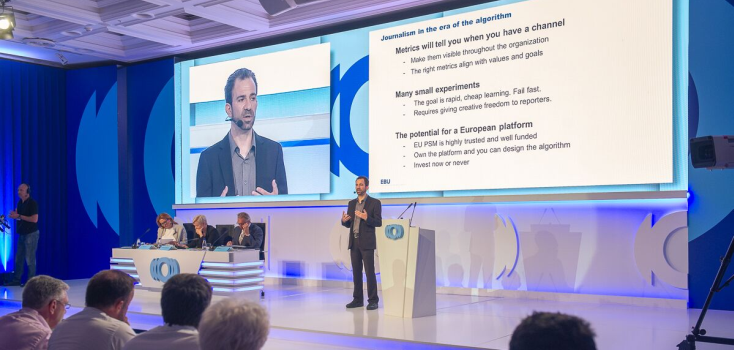
Jonathan Stray, a computer scientist specialising in data driven investigations, addressed delegates at the EBU’s General Assembly in Montenegro (17 June) on the importance of big data and algorithms to the future impact of public service media.
Stray was introduced by the EBU’s Director of Public Affairs and Communications, Guillaume Klossa who outlined the EBU’s commitment to leveraging the potential of Big Data.
“We are identifying concrete ways of working together on this around 4 axes: audience measurement, media content, recommendation systems and trusted data principles,” he told delegates.
Klossa called upon Members to nominate a ‘big data coordinator’ in their organizations to actively participate in this joint EBU initiative and participate in the many activities/meetings the EBU is organizing on the subject.
Jonathan Stray said algorithms were important to EBU Members to reach audiences because “we’ve gone from a world where broadcasters decide what people watch, and when, to those people deciding themselves.”
He highlighted the importance of social media in distributing content and that traditional methods of just providing a linear TV channel are rapidly diminishing in importance.
“Different channels need different content – they have different interaction modes – viewed on different devices. There are a huge number of experiments in storytelling that are cheap and fast and should be encouraged – without taking risks it will be difficult to move forward.”
Stray discussed the value of metrics too in understanding whether audiences are being reached at all.
“You have to listen to your metrics – if you are telling a story and its important and no-one is choosing to watch that’s a problem – try a new storytelling approach. Live blogging, live streaming, infographics - the number of ways to tell a story has exploded.”
He also told delegates that EBU Members have a window of opportunity right now to create a European platform to share and distribute content with a unique European algorithm.
There are already high level of resources and high level of trust for PSM in Europe, he said.
“European media is a unique position to do this globally – by global standards PSM is well funded. You have resources and funding to do this. This will require working together – both a technical and editorial collaboration – it’s a challenge but you are in a good place to do this. If you have the platform in place you can choose the algorithm – if it doesn’t work change it.”

Related news

Blog
YouTube - Friend or Enemy? The dilemma for broadcasters
For much of the past decade, YouTube occupied a relatively straightforward place in the digital strategies of public service media (PSM): a marketing channel....

Press release
EBU announces its strategic asks on generative AI and media
On 11 June, the EBU released a strategic paper for generative artificial intelligence (AI) and media. In 2024, the EBU designated AI a strategic priority...

Building a collaborative cloud future for European public service media
"Diversify rather than divide" – the newly formed EBU Cloud Strategy Group held its inaugural kickoff meeting in mid-August in Geneva. The group aims to...

Stories
"You can’t look at GenAI too fearfully. You have to find as many opportunities as you can."
In which ways is generative AI a game-changer for journalism? As with previous disruptive technologies – the internet, social media, and smartphones –...

Stories
Q&A with Kasper Lindskow: “Generative AI can give journalists superpowers”
We talk to Kasper Lindskow, Head of AI at the JP/Politikens Media Group in Denmark, as one of a series of interviews with contributors to the EBU News...

Press release
EBU calls for rethink of online news limits for German public media in draft reforms
[Siehe unten für die deutsche Version dieser Pressemitteilung zum Reformstaatsvertrag] The European Broadcasting Union (EBU) welcomes efforts to ensure...

Stories
How to get Big Tech to play fair: Rights and remedies for public service media in EU law
On 24 June, the EBU published a new guide 'Big Tech, fair play: PSM rights and remedies under the EU digital legal framework'. This publication breaks...

Speech
Some of our red lines have become constrictive red tape. Time for a rethink.
This text is based on a speech delivered by EBU Director of News, Liz Corbin, at the AI Forum, on 25 March 2026, in Brussels. I’ve been thinking a lot...