Press freedom report: increasingly hostile environment for journalism in Europe
02 March 2026
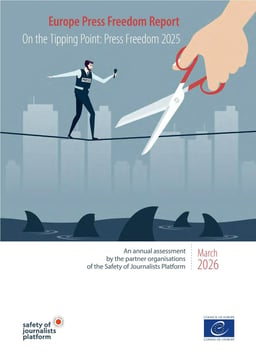
On 3 March, the partner organisations of the Council of Europe’s Platform to promote the protection of journalism and safety of journalists released their annual report, On the Tipping Point: Press Freedom 2025. It finds press freedom in Europe under sustained pressure in 2025, with the most serious threats to journalists surrounding Russia’s war against Ukraine.
On 3 March, the partner organisations of the Council of Europe’s Platform to promote the protection of journalism and safety of journalists released their annual press freedom report. The report outlines how press freedom continued to be under sustained pressure in Europe in 2025, driven by legal threats, physical attacks and intimidation, attempts of media capture and transnational repression. The report, entitled “On the Tipping Point: Press Freedom 2025”, notes that Russia´s war against Ukraine remained the most serious threat to journalists: four media workers were killed, others were injured, and many remain detained in occupied territories or have disappeared.
“When media freedom is attacked, democracy is weakened,” said Andrea Campbell, Communications Manager EU & Institutions, EBU. ‘The Safety of Journalists’ Platform Annual Press Freedom Report highlights how public service media are increasingly facing pressures from national governments, in the form of threats to editorial independence and uncertainty around funding. Yet they remain indispensable to media pluralism, social cohesion, and trusted information. Council of Europe member state governments must act decisively to safeguard the editorial independence and sustainable funding of public service media across the continent.”
In 2025, the platform partners published 344 alerts of serious threats to media freedom, a significant increase (+29%) from 2024, when 266 were registered. The countries with the highest number of alerts were Russia (50), Türkiye (49), Georgia (35), Serbia (35) and Ukraine (27) - mostly related to Russian-occupied territories or attributed to Russian forces.
Across Europe, journalists were frequently subjected to physical attacks during protests by police, political actors and demonstrators, with such incidents reported in one quarter of the states covered by the report and the highest levels recorded in Georgia, Serbia and Türkiye. In several countries, public service media faced political interference, restrictive legislation and inadequate funding, further undermining their independence and sustainability. Abusive lawsuits, known as Strategic Lawsuits Against Public Participation (SLAPPs), continued to be widely deployed to silence media scrutiny and discourage investigative reporting; in this context, the platform partners welcome initiatives in a number of countries to implement both the EU directive and the Council of Europe recommendation aimed at countering SLAPPs. The report also raises serious concerns about digital surveillance of journalists through spyware, instances of transnational repression, the adoption or planned introduction of “foreign agent” legislation, and the precarious working conditions affecting media workers across many countries.
The report warns against the systematic use of deprivation of liberty as a tool of media control. As of 31 December 2025, 148 journalists were held in detention across Europe, including 36 in Azerbaijan, 32 in Russia, 27 in Belarus, 26 held by Russia in the occupied territories of Ukraine, 24 in Türkiye, two in Armenia and one in Georgia.
The platform partners urge the Council of Europe, the European Commission, and the 46 Council of Europe member states to enforce press freedom standards. They recommend, as a matter of priority, strengthening journalists' safety, fully implementing anti-SLAPP standards, safeguarding the independence of public service media, and increasing the protection of women journalists, among other measures.
While regretting that in 2025, fewer than one-third of the alerts received a government reply, the partners call on states to increase their cooperation with the Platform.
The Platform’s annual report covers the 46 Council of Europe member states, as well as Russia, following its expulsion from the Council of Europe in 2022, and Belarus.
Relevant links and documents
Contact

Andrea Campbell
Communications Manager, Legal & Policy, EU and Institutional Affairs
Relevant Links
Documents
Related news

Press release
Europe Press Freedom Report 2024 warns about risks of war in Ukraine and persistent threats to media freedom across Europe
The risks that journalists faced covering the Russia's war of aggression against Ukraine remained the most pressing concern related to the safety of journalists...
Press release
The EBU contribution to the rule of law report: strengthening media freedom and democratic resilience
On 23 January, the EBU submitted its contribution to the annual Rule of Law report. A strong rule of law is essential for public service media to thrive,...
Stories
Journalism under attack like never before, warns Cilla Benkö on World Press Freedom Day
Journalism has never been more dangerous, EBU Vice President and Director General of Swedish Radio Cilla Benkö warned today during a special event in Ukraine...
Blog
EBU calls on Council of Europe Member States to safeguard public service media
I would like to start with the positive. The Council of Europe understands the role of public service media in upholding the fundamental right of freedom...

Op-ed
This World Press Freedom Day, public service media stand together
This Saturday, we will mark World Press Freedom Day, at a time when news integrity and press freedom face intense pressure from misinformation and polarised...

Stories
Top 10 Legal and Policy news of 2025
Keeping Members up to date with important news related to public service media is an important part of the EBU’s Legal & Policy work. In 2025, the Audiovisual...

Statement
Media organizations write to Lithuanian authorities to address remaining concerns over LRT law
The undersigned organizations - representing public service media, journalists, and press freedom organizations across Europe and globally, call on the...
Statement
EBU urges unrestricted access to Gaza for foreign journalists
On the occasion of the EBU’s News Contacts Meeting, the world’s leading alliance of public service media again calls on the Israeli government to unblock...